
Introduction
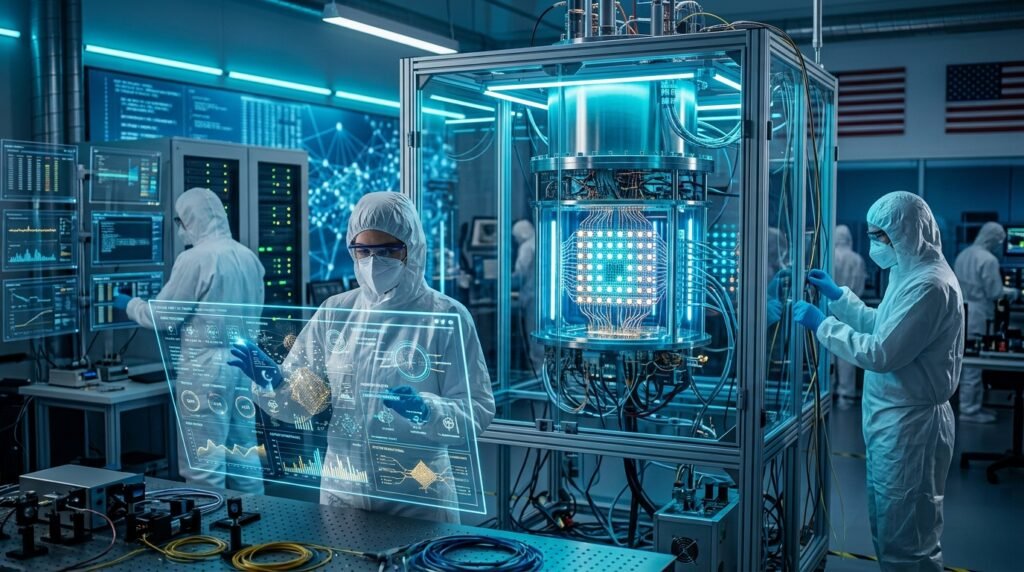
Quantum computing is no longer just a futuristic dream however; rapidly becoming a transformative power in technology, science, and business. 2025 is turning point for the US, where quantum computers move from labs to practical applications. With major funds from tech giants, government initiatives, and startups, the race to achieve “quantum advantage” is escalating.
For the better understanding about quantum computing and the difference from classical computing, and how will it change industries across the United States by 2025, let’s explore the article further.
Quantum Computing
Quantum computing is an emerging paradigm of computing that leverages the principles of quantum mechanics to perform calculations exponentially faster than traditional computers. Unlike classical bits (0s and 1s), quantum bits or qubits can exist in various states simultaneously thanks to superposition and entanglement.
This enables quantum computers to process massive datasets, solve optimization problems, and simulate molecular interactions at speeds that are impossible for classical supercomputers.
Quantum Computing Matters in 2025 (USA Focus)
The United States views quantum computing as a strategic technology that could restructure national security, healthcare, logistics, and financial systems. By 2025, breakthroughs are expected to accelerate adoption across sectors.
-The U.S. National Quantum Initiative Act continues to fund R&D.
-Companies like IBM, Google, and Microsoft are scaling quantum processors.
-Startups like Rigetti, IonQ, and D-Wave are developing cloud-based quantum access.
-Federal agencies (DARPA, NASA, NSA) are exploring defense and aerospace use cases.
In short, the USA is positioning itself as a global leader in quantum computing, competing closely with China and Europe.
Key Trends of Quantum Computing in 2025
Quantum Advantage Becomes a Reality
“Quantum advantage” denotes to the point where a quantum computer outperforms the best classical supercomputers. Google established this in 2019 with Sycamore, however by 2025, commercially viable quantum advantage is expected.
Industries like pharmaceuticals, logistics, and finance could see first-wave adoption of quantum solutions.
Hybrid Quantum-Classical Systems
Since quantum computers are not yet individual replacements, but hybrid systems that combine classical and quantum computing will also lead. Cloud providers like Amazon Braket and Microsoft Azure Quantum already deliver hybrid access, which will scale significantly by 2025.
Quantum Cloud Services Expansion
By 2025, more businesses will reach out for quantum computing via cloud platforms instead of owning physical machines. The initiative will democratize access for startups, universities, and enterprises that cannot have enough money for expensive quantum hardware.
AI + Quantum Computing Synergy
Artificial Intelligence (AI) and quantum computing will combine to enable faster machine learning training, better pattern recognition, and prognostic analytics. This will especially influence healthcare, finance, and national security.
Post-Quantum Cryptography & Cybersecurity
Quantum computers pose a threat to existing encryption methods like RSA and ECC. By 2025, the USA will invest greatly in post-quantum cryptography (PQC) to secure critical infrastructure, financial dealings, and government communication.
Quantum Hardware Breakthroughs
Different approaches to building qubits, upper conducting, trapped ions, photonics, and topological qubits will continue competing. U.S. companies are expected to reach thousands of stable qubits by 2025, a leap from the hundreds available today.
Industry-Specific Quantum Use Cases in USA
Healthcare & Pharma
Quantum computing will quickly work in the drug discovery, protein folding simulations, and personalized medication, reducing the time for R&D.
Finance & Banking
Banks like JPMorgan Chase are already analyzing quantum algorithms for scam detection, portfolio optimization, and risk modeling.
Logistics & Supply Chain
FedEx, UPS, and other logistics companies may embrace quantum computing for route optimization, fuel savings, and demand forecasting.
Energy & Climate
Quantum models can simulate complex climate systems and renewable energy storage, helping the USA meet sustainability goals.
Challenges Facing Quantum Computing in 2025
Error & Stability
Qubits are breakable and liable to to errors (decoherence).
High Costs
Developing hardware needs billions in funding.
Talent Deficiency
The USA faces a deficiency of quantum engineers and researchers.
Cybersecurity Bullying
Quantum decryption could threaten national security if not addressed with PQC.
Ethical Apprehensions
Access inequality could extend the digital divide.
The Future Outlook
Quantum Computing in USA Beyond 2025
By 2025, quantum computing will be at modulation point, no longer restricted to research labs but not yet mainstream in all businesses. The next 5 to 10 years will determine the magnitude and acceptance by the industries.
Experts Opinion
USA will maintain global leadership with the combination of state and private funding. However, more quantum startups will arise, supported by Silicon Valley VCs. Also cross-industry association will drive real-world applications. Moreover, Post-2025, quantum computing will form the AI revolution, national defense, and scientific breakthroughs.
FAQs
1.What is quantum computing in simple terms?
Quantum computing uses quantum physics principles to perform calculations much faster than normal computers.
2.Why is quantum computing important for the USA in 2025?
It is critical for national security, healthcare, financial modeling, and maintaining U.S. tech leadership.
3.Which companies are leading quantum computing in the USA?
IBM, Google, Microsoft, Amazon, Rigetti, and IonQ are leading U.S. quantum innovation.
Q4: Will quantum computers replace classical computers?
Not fully. Instead, they will work in hybrid systems, complementing classical computers.
Q5: How will quantum computing affect cybersecurity?
Quantum computers can break current encryption, so the USA is adopting post-quantum cryptography to stay secure.
Conclusion
Quantum computing is set to redesign the future of technology in the USA by 2025. While challenges like scalability and cybersecurity, the opportunities are massive. From healthcare breakthroughs to AI progressions and financial optimization, quantum computing will be an essential force of the years.
Keyword Focus: Quantum computing USA, quantum advantage, qubits, superposition, entanglement.

 By
By


 pkmony777 says: