
Saudi Arabia is continuing a significant transformation of its education system, with recent textbook revisions removing or changing lessons that previously referred to the concept of “Greater Israel.” The changes are being viewed as part of the Kingdom’s broader effort to modernize educational content, encourage critical thinking, reduce inflammatory material, and promote greater tolerance and coexistence.
The issue has attracted international attention because Saudi Arabia has historically included strong references to the Israeli-Palestinian conflict in its school curriculum. Earlier editions of some textbooks reportedly contained descriptions of Zionism and claims that the Zionist movement sought to establish a state extending “from the Nile to the Euphrates.” Such references have increasingly disappeared or been rewritten in newer editions.
Changes to Saudi Textbooks
Reviews of Saudi educational materials over recent years have identified substantial changes in the way students are taught about Jews, Christians, Israel, Zionism and the Middle East conflict. Several passages that were considered inflammatory, conspiratorial or hostile toward other communities have been removed, revised or placed in a different historical context.
One of the most notable changes concerns references to the idea of “Greater Israel.” Previous educational material reportedly presented the concept as part of alleged Zionist territorial ambitions. In newer editions, these references have been removed or significantly modified.
The change is important because school textbooks play a major role in shaping how young people understand history, religion, politics and relations between different communities. By changing the language used in textbooks, Saudi authorities are also changing the framework through which students encounter sensitive regional issues.
A Broader Educational Transformation
The removal of “Greater Israel” material is not an isolated development. It forms part of a broader educational reform program in Saudi Arabia.
The Kingdom has been attempting to modernize its education system as part of its wider Vision 2030 agenda. The reforms aim to prepare Saudi students for a rapidly changing economy and society while encouraging skills such as creativity, independent thinking and problem-solving.
Newer educational materials reportedly place greater emphasis on values including tolerance, compassion, coexistence and respect for people from different backgrounds. Lessons encouraging students to think independently and analyze information rather than simply accept statements as unquestionable facts have also become more prominent.
These changes represent a substantial shift from older approaches in which some political and religious subjects were presented in more rigid terms.
Changes in Language About Israel
Another important aspect of the textbook revisions concerns the terminology used to describe Israel.
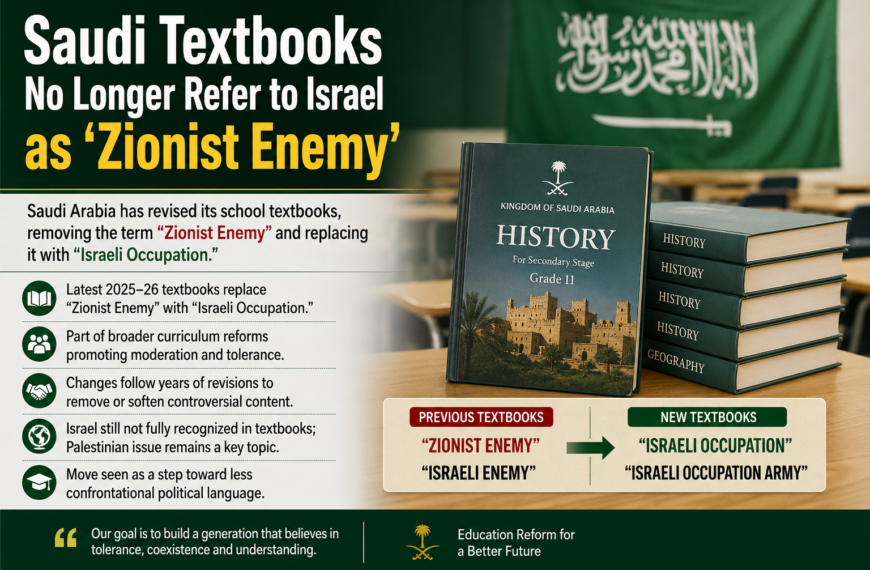
Earlier Saudi textbooks sometimes used expressions such as “Zionist entity” or “Israeli enemy.” Newer materials have reportedly reduced or removed some of this language. In certain contexts, references to Israel are now presented using more neutral or historically specific terminology.
However, this does not mean that Saudi textbooks have removed the Israeli-Palestinian conflict from the curriculum. The Palestinian issue remains an important subject, and references to the Israeli occupation and Palestinian rights continue to appear.
The distinction is therefore important. Saudi Arabia appears to be changing the way controversial issues are presented rather than completely eliminating political history from its classrooms.
The Palestinian Question Remains Important
Despite the curriculum changes, Saudi Arabia has not abandoned its longstanding position regarding the Palestinian issue.
The Kingdom continues to emphasize Palestinian rights and has repeatedly called for a political solution to the conflict. Saudi officials have also maintained that the establishment of a Palestinian state is central to achieving lasting regional peace.
Therefore, the removal of “Greater Israel” material should not automatically be interpreted as a complete change in Saudi foreign policy.
Instead, it can be understood as part of an effort to separate political disagreements from educational language. A government can maintain its political position on a conflict while also deciding that certain historical claims, stereotypes or emotionally charged descriptions are inappropriate for schoolchildren.
Encouraging Tolerance and Coexistence
One of the most significant themes emerging from Saudi curriculum reforms is the increased emphasis on coexistence.
Newer lessons reportedly include examples from Islamic history that can be used to teach students about agreements and peaceful relations between Muslim and non-Muslim communities. These examples are presented as opportunities to discuss tolerance, mutual respect and peaceful coexistence.
Such changes are particularly significant in a country with a central role in the Muslim world. Saudi Arabia hosts Islam’s two holiest cities, Makkah and Madinah, and its educational policies receive considerable attention across the region.
The introduction of more moderate and inclusive educational material could therefore influence discussions about education and religious tolerance throughout the wider Middle East.
Why the “Greater Israel” Change Matters
The phrase “Greater Israel” is politically sensitive because it is associated with claims about the territorial ambitions of Zionism. Supporters of the idea that such ambitions exist have historically pointed to religious, political or historical arguments, while critics have described the concept as an exaggerated or conspiratorial interpretation of Zionist objectives.
When such a concept is presented to students as established fact, it can influence their understanding of Israel and Jewish history from an early age.
Removing the material can therefore be seen as an attempt to prevent students from being taught controversial claims without sufficient historical context.
The change may also help Saudi Arabia present a more modern educational image internationally. As the Kingdom seeks to attract foreign investment, tourism, international businesses and educational partnerships, its leadership has increasingly emphasized modernization and global engagement.
International Reaction
Saudi educational reforms have received attention from organizations that monitor textbooks and educational content. Some observers have welcomed the removal of antisemitic stereotypes, conspiracy theories and inflammatory descriptions, arguing that such changes can help promote tolerance and reduce prejudice.
Others have urged caution when interpreting textbook reforms. Changes to educational materials do not necessarily mean that public attitudes or government policy have changed at the same pace.
Textbooks are only one part of a country’s broader educational and social environment. Teachers, families, religious institutions, media and political developments also influence how young people understand international conflicts.
Nevertheless, changes to textbooks remain important because they demonstrate what the education system officially considers appropriate for students to learn.
Part of Saudi Vision 2030
Saudi Arabia’s Vision 2030 transformation extends far beyond economics. The government has introduced reforms in tourism, entertainment, technology, employment, education and social life.
Education is considered a critical component of this transformation. The Kingdom wants young Saudis to develop skills that can help them participate in a diversified economy rather than relying heavily on traditional sectors.
Critical thinking and independent analysis are particularly valuable in this environment. Modern employers increasingly require workers who can evaluate information, solve problems and communicate effectively.
Revising textbooks is therefore not simply about changing political terminology. It is also connected to a broader attempt to reshape the educational philosophy of the country.
A Delicate Balance
Saudi Arabia faces a delicate challenge in reforming its curriculum. The Kingdom must preserve its historical and religious identity while also preparing students to interact with an increasingly globalized world.
Removing controversial material does not mean ignoring history. Instead, the challenge is to teach difficult historical subjects accurately and responsibly.
The Israeli-Palestinian conflict, Zionism, the history of the Middle East and the Palestinian question are all complicated subjects. A modern curriculum can address these issues while avoiding stereotypes, unsupported territorial claims and language that encourages hostility toward entire communities.
This approach could allow Saudi students to develop a more nuanced understanding of regional politics.
Conclusion
The removal of lessons about “Greater Israel” from Saudi textbooks represents another notable step in the Kingdom’s continuing educational reforms. Alongside changes to terminology concerning Israel and the reduction of inflammatory material, the revisions indicate a broader move toward moderation, critical thinking and coexistence.
The changes should not be interpreted as meaning that Saudi Arabia has abandoned its support for Palestinian rights or completely changed its political position toward Israel. Instead, they demonstrate an effort to present sensitive political and historical subjects in a different way.
As Saudi Arabia continues implementing Vision 2030, education will remain an important part of its transformation. The content taught to young people today can shape the attitudes, skills and worldview of the country’s next generation.
The removal of “Greater Israel” lessons is therefore significant not only because of the specific material involved, but also because it reflects a wider question facing Saudi society: how to preserve historical identity while building an education system focused on modernization, tolerance, critical thinking and engagement with the wider world.
For Saudi Arabia, the evolving curriculum could become an important tool in shaping a new generation that is better prepared for both domestic transformation and international engagement.


 By
By

 By
By