
AJK Job Quota Verdict: Supreme Court Orders PSC to Resume Recruitment
The AJK job quota case has ended with a Supreme Court order: the blanket abolition is set aside and the PSC must resume pending recruitment in Azad Kashmir.

By Suleman Mirza · Reporter
Published · 5 min read
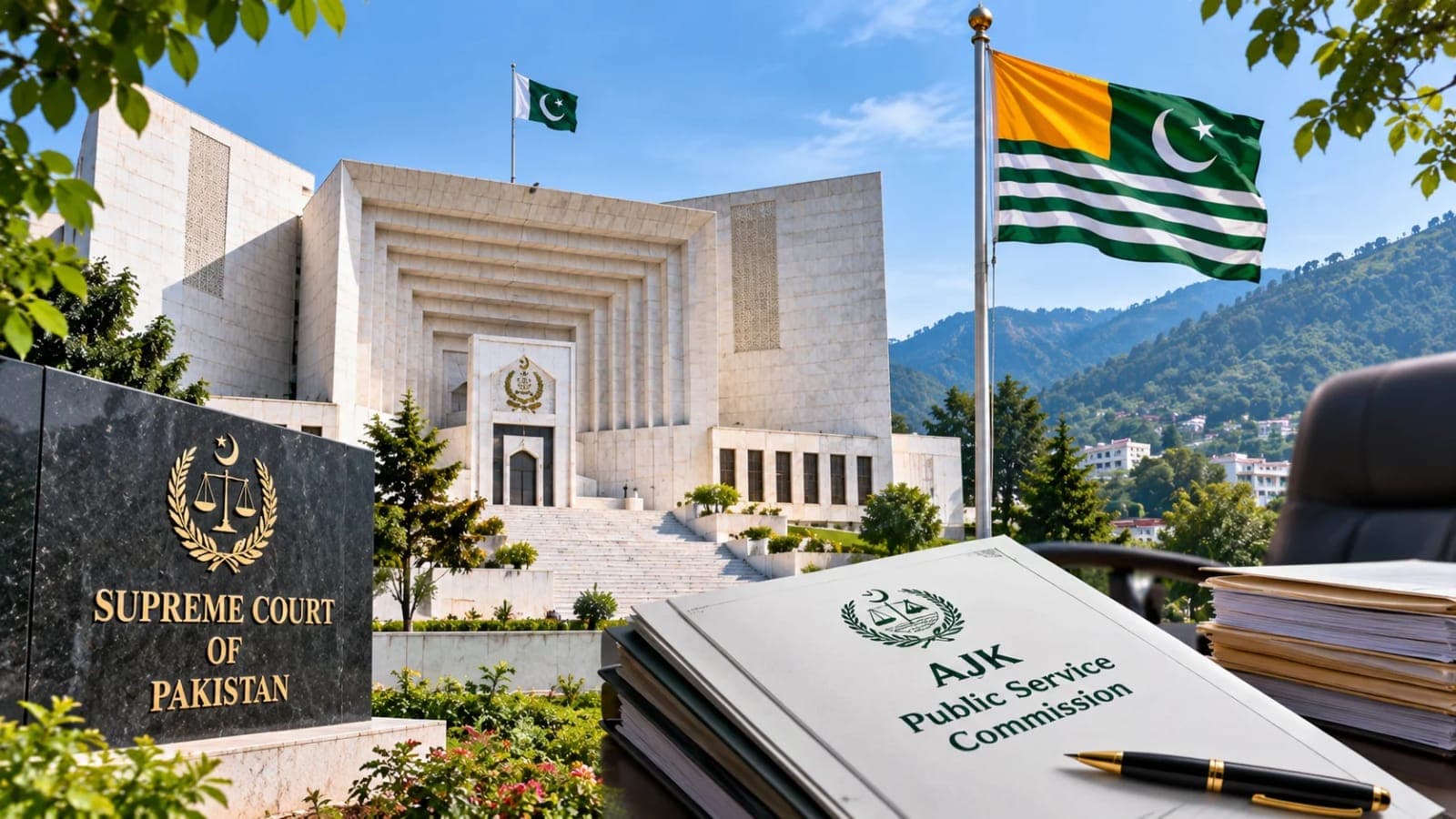
The AJK job quota case has reached a turning point after the Supreme Court of Azad Jammu and Kashmir set aside the blanket abolition of regional and refugee quotas in public employment. The court ruled that geographical preferences are not unconstitutional by themselves, but they must rest on law and on clear evidence that a region or group is underrepresented.
The judgement was announced on Wednesday by a division bench of Chief Justice Raja Saeed Akram and Justice Khalid Yousaf Chaudhary. It was authored by Chief Justice Akram. The bench also directed the Public Service Commission to resume and complete all pending recruitment processes that had been suspended since the high court verdict of August 16, 2025.
AJK job quota percentages not restored
The court stopped short of restoring the decades old AJK job quota percentages. Instead, it directed the government to carry out a comprehensive review of the existing regional and refugee allocations and bring them in line with constitutional and statutory requirements. The judges said the government's authority to provide representation was real but not unlimited, and old arrangements could not continue indefinitely without a rational and objectively verifiable justification.
Interim recruitment framework for AJK job quota posts
Until the review is complete, the court prescribed an interim geographical framework. Vacancies in grades 1 to 7 will ordinarily be filled through competition among candidates from the relevant constituency, while posts in grades 8 to 15 will be filled at the district level. Vacancies in grades 1 to 15 at divisional offices will be filled from the division concerned. Posts in state level institutions, at any grade, and all posts in grades 16 and above will be filled on open merit among State Subjects.
The court made clear that selection inside each geographical field will still depend on prescribed qualifications, suitability and merit. If no suitable candidate is available within the primary area, the process will be extended to a wider field under the applicable rules.
What happens to the refugee quotas
The AJK job quota verdict also dealt separately with the quota reserved for refugees settled in Pakistan. It observed that their status as State Subjects stands on its own and does not depend on any particular preferential allocation. The court held that neither the 19 percent quota for refugees who migrated in 1947 nor the 6 percent allocation for those who migrated in 1989 can be treated as a permanent entitlement without a continuing constitutional and statutory justification.
Why the high court verdict was set aside
The Supreme Court held that the high court had erred in treating every form of regional, area based or refugee related recruitment arrangement as inherently unconstitutional. The judgement noted that the AJK Civil Servants Act, 1976, and the Civil Servants Rules, 1977, recognise the government's authority to provide proper representation to the component units of the territory and to refugees settled in Pakistan. The court also held that the high court was not competent to declare the quota arrangements repugnant to the injunctions of Islam, since that jurisdiction rests with the Shariat Appellate Bench.
Admissions and settled appointments
On educational admissions, the court ruled that regional preferences must be examined separately from public sector recruitment. It set aside the high court directives on federal and provincial institutions and educational seats beyond the AJK government's competence. Appointments and admissions already finalised under the legal regime in force at the time will not be disturbed only because of this decision.
Background: the 2025 high court verdict
The AJK job quota dispute goes back to a high court judgement of August 2025, when Justice Sardar Muhammad Ejaz struck down the decades old quota system in government services and professional colleges and ordered recruitment and admissions on open merit. That verdict suspended recruitment processes across the region. The Supreme Court appeal has now partly reversed that position, keeping merit at the centre while allowing geography based representation where the law and evidence support it.
What applicants should watch next
For job seekers in Azad Kashmir, the immediate effect is that the Public Service Commission must restart the recruitment processes that were frozen after August 2025. The government must now review the quota allocations, and until that review is done the interim framework will apply. Candidates should watch for fresh PSC advertisements and for the government's review, which will decide the future shape of the AJK job quota system.
Frequently asked questions
What did the AJK Supreme Court decide on job quotas?
The AJK job quota ruling set aside the high court's blanket abolition of regional and refugee quotas. The court said geographical preferences are not unconstitutional by themselves, but they need legal backing and evidence of underrepresentation.
Have the old AJK job quota percentages been restored?
No. The court did not restore the old percentages. It ordered the government to review all regional and refugee allocations and bring them in line with the Constitution and the law.
When will PSC recruitment resume in AJK?
The court directed the Public Service Commission to resume and complete all pending recruitment processes that were suspended after the high court verdict of August 16, 2025.
What is the interim recruitment framework?
Grades 1 to 7 will be filled from the relevant constituency, grades 8 to 15 at district level, grades 1 to 15 in divisional offices from the division, and state level posts plus all posts in grades 16 and above on open merit among State Subjects.
What happens to the 19 percent and 6 percent refugee quotas?
The court held that neither allocation can be treated as a permanent entitlement without a continuing constitutional and statutory justification, though refugee status as State Subjects remains unaffected.
What happens next for national
We will keep this page updated as the story develops rather than publishing a near-duplicate at a new address. Follow National for related coverage.
Get the Verified Brief
One email each morning with the stories we checked overnight.
Spotted an error? Read our corrections policy and tell the newsroom.