

Blue Whale Found Dead on Gwadar Beach: 30-Foot Giant Washes Ashore
A blue whale, the world's largest animal, has been found dead on Gwadar's East Bay coastline, raising fresh concerns about marine life in Pakistan.

By News Desk · Verified Pakistan News Desk
Published · Updated · 5 min read
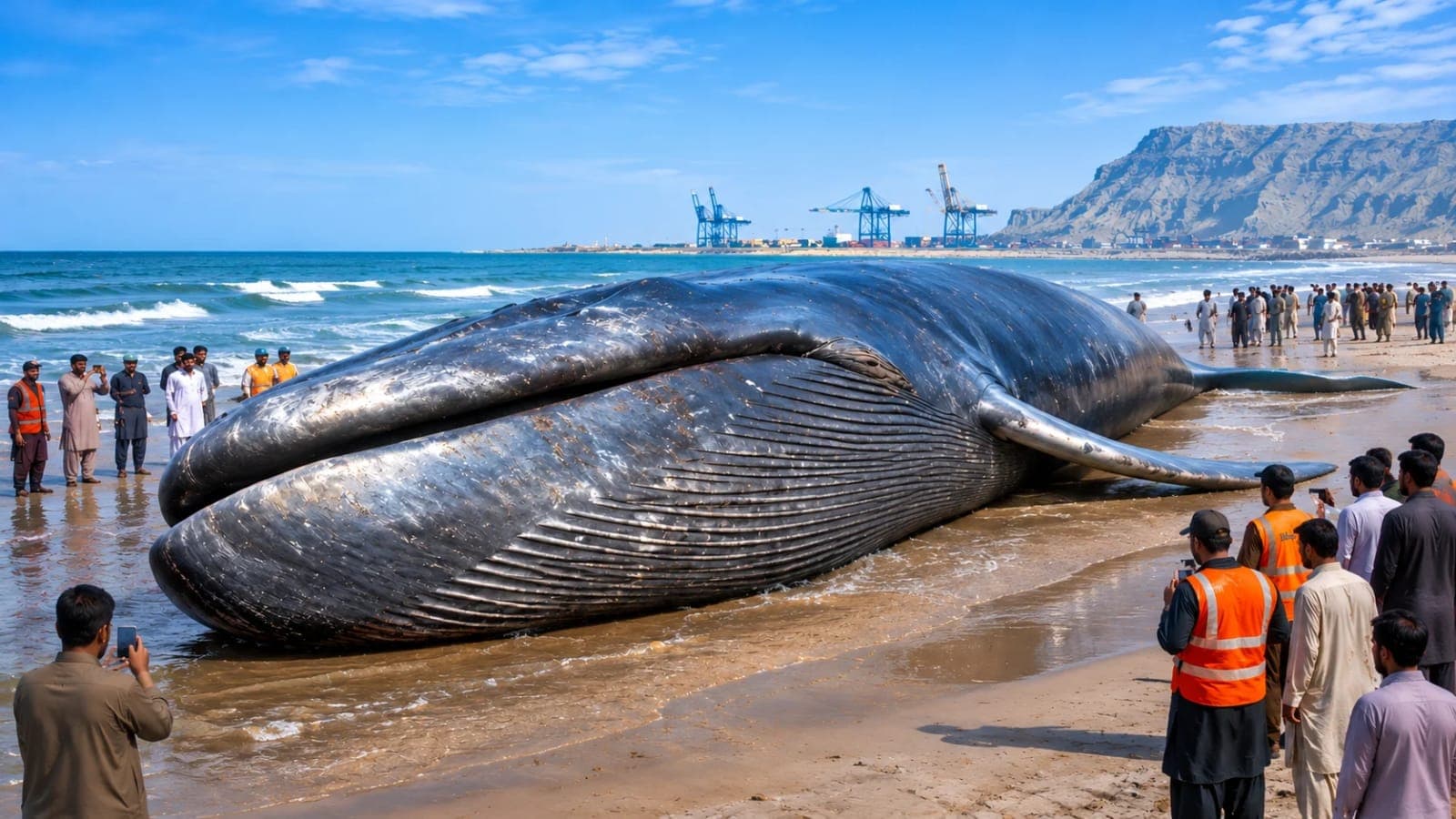
A blue whale, the world's largest animal, has been found dead along Gwadar's East Bay coastline, raising fresh concerns about marine life conservation in Pakistan.
The carcass of a blue whale, estimated to be around 30 feet long, washed ashore near the Coast Guard office at East Bay in Gwadar on Wednesday. According to local sources, the whale had been spotted swimming in different locations off Gwadar's coast for the past two days before eventually reaching shallow waters and becoming stranded along the shoreline.
Muhammad Moazzam Khan, Technical Adviser at WWF-Pakistan, said the whale may have lost its way after entering shallow waters, where its navigation could have been affected. He described the death of such a large marine mammal as a worrying development for marine biodiversity and confirmed that WWF-Pakistan had launched an investigation to establish the circumstances surrounding its death.
However, the exact cause of death has not yet been determined. Preliminary assessments suggest the animal may have entered shallow waters and drifted towards the coast, but WWF-Pakistan says further investigation is needed before any conclusion can be drawn.
The blue whale is the largest animal on Earth, and also one of the oldest living species. It is listed as endangered on the International Union for Conservation of Nature (IUCN) Red List, and its global population today stands at around 10,000 to 25,000. Every death of a blue whale is therefore a significant loss for global conservation efforts, not just for Pakistan.
Blue whale: a worrying pattern on Pakistan's coast
The latest incident is not the first time a large whale has been found dead along Pakistan's coastline, and that pattern is what worries conservationists most.
In April 2019, a 34-foot-long whale was found dead on a beach in Gwadar. It was quietly buried by municipality workers before its body could be examined by experts, and there were conflicting claims about its identity: WWF-Pakistan reported it as the calf of a blue whale, while a marine biologist working with the Gwadar Development Authority identified it as a Bryde's whale.
In May 2023, a blue whale was found dead near Bandari Beach in Jiwani, in Gwadar district. Fishermen found the lifeless body on the beach in the morning and reported it to the wildlife authorities. There were marks of injuries on the whale's tail, though the cause of death was never confirmed.
In November 2023, a 27-foot-long Bryde's whale was found dead near Pasni. And in June 2025, a blue whale measuring around 35 feet was discovered dead in the remote waters of Gwatar Bay, between Pakistan and Iran. A local fisherman, Ahmad Baloch, spotted it floating near Kuntani in Balochistan. WWF-Pakistan said the whale likely died a few days earlier in the open sea and drifted towards the bay, and suspected it may have become entangled in gillnets, a common hazard in Pakistan's coastal fisheries.
A 2025 research paper published in the Pakistan Journal of Zoology documented 20 cetacean species in Pakistani waters, including endangered blue whales, Arabian Sea humpback whales and Indian Ocean humpback dolphins. The research highlighted threats to marine mammals, including fishing nets, shipping traffic, coastal development and pollution.
Blue whale: what happens next
WWF-Pakistan has begun investigating the latest death, and its findings will matter for more than this one animal. If the whale died because it became entangled in fishing gear, that points to a problem that can be addressed. If it died because it lost its way in shallow water, that points to the need for better monitoring of coastal waters.
All cetacean species are protected under Sindh and Balochistan laws, and all whales fall in the Appendix 1 category of the Convention on International Trade in Endangered Species of Wild Fauna and Flora, which bans international trade in them. Protection on paper, however, has not stopped the strandings.
There are also signs of hope. A giant blue whale was spotted along with its baby off Churna Island, Balochistan, in the year before the 2019 stranding, in what was described as the first live sighting of the blue whale in Pakistani waters. The last blue whale sighting in Pakistan's waters was reported off Gaddani, Balochistan, in April 2024. The animals are still out there, using these waters, which is exactly why each death matters so much.
For Gwadar, the dead blue whale is a reminder that the port city's development is happening in one of the richest marine environments in the region. The question now is whether Pakistan can protect the whales that share its coast, or whether the strandings will keep coming.
Blue whale: frequently asked questions
Where was the blue whale found dead? The 30-foot blue whale washed ashore near the Coast Guard office at East Bay in Gwadar, Balochistan, on Wednesday.
How big was the blue whale? The whale was estimated to be around 30 feet long.
What killed the blue whale? The exact cause of death has not been determined. WWF-Pakistan is investigating. Preliminary assessments suggest the whale may have entered shallow waters, where its navigation could have been affected.
Has this happened before in Pakistan? Yes. Large whales have been found dead on Pakistan's coast in April 2019 in Gwadar, in May 2023 near Jiwani, in November 2023 near Pasni, and in June 2025 in Gwatar Bay.
Are blue whales endangered? Yes. Blue whales are listed as endangered on the IUCN Red List, with a global population estimated at around 10,000 to 25,000.
What happens next for national
We will keep this page updated as the story develops rather than publishing a near-duplicate at a new address. Follow National for related coverage.
Get the Verified Brief
One email each morning with the stories we checked overnight.
Spotted an error? Read our corrections policy and tell the newsroom.