
Ishaq Dar Leads Pakistan at SCO Heads of Government Meeting in Dushanbe
Ishaq Dar leads Pakistan's delegation at the SCO heads of government meeting in Dushanbe, where economic cooperation and bilateral talks are on the agenda.

By News Desk · Verified Pakistan News Desk
Published · Updated · 8 min read
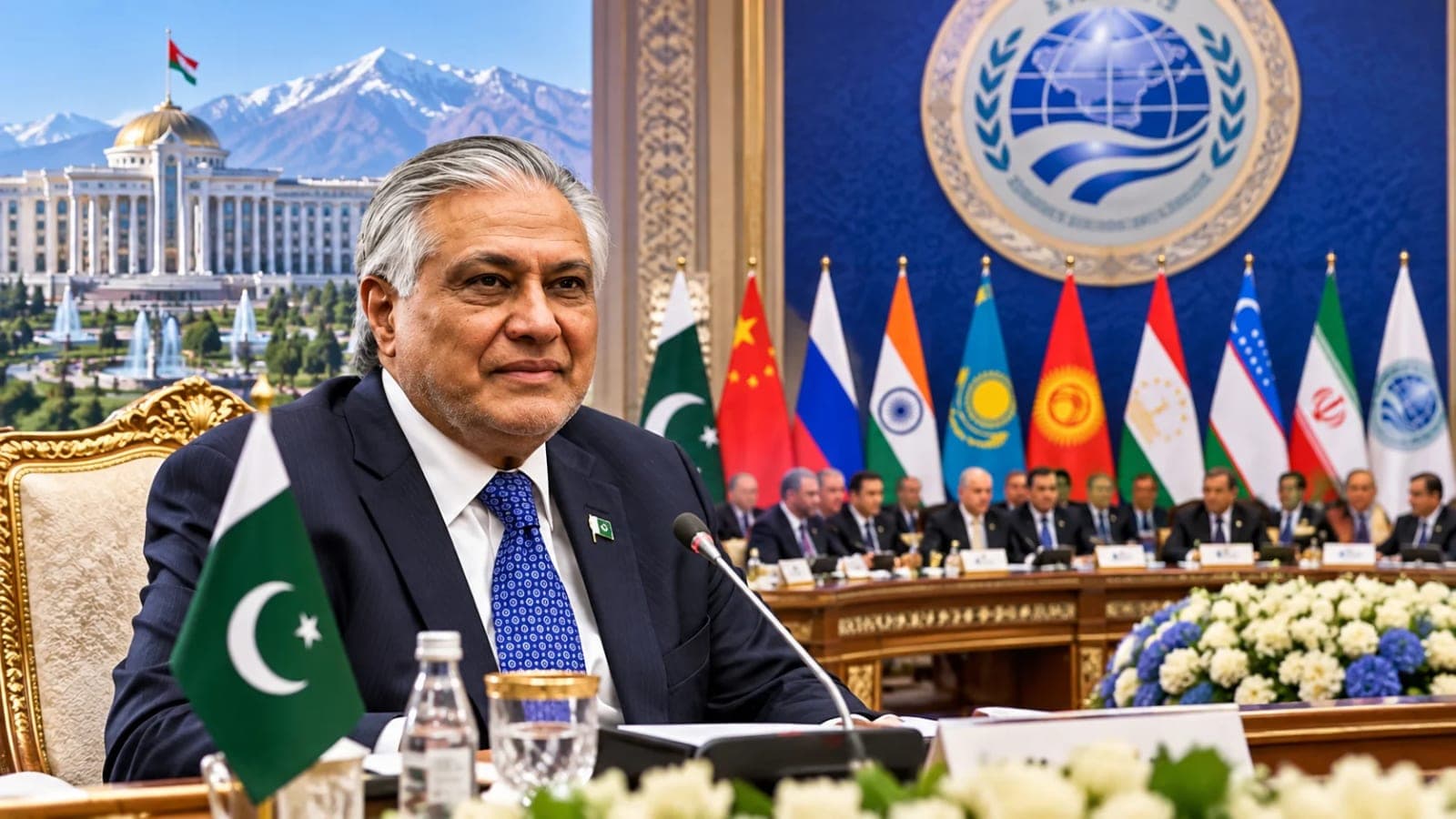
Deputy Prime Minister and Foreign Minister Mohammad Ishaq Dar is leading Pakistan's delegation to the Shanghai Cooperation Organisation's Council of Heads of Government meeting in Dushanbe, Tajikistan. The two-day gathering began on Monday, October 19, 2026. Dar departed for the Tajik capital to take part in the proceedings and meet leaders and counterparts on the sidelines, according to Radio Pakistan.
The meeting brings regional governments together around economic and administrative cooperation. Pakistan's participation is significant because the council considers trade, connectivity, finance and the organisation's budget. Yet the opening of a meeting is not the same as an agreed trade deal or a completed transport project. Any such outcome needs to be checked against the final documents and official announcements.
What is happening in Dushanbe?
The Council of Heads of Government, commonly shortened to CHG, is holding a two-day meeting in Tajikistan's capital starting October 19. Radio Pakistan reported that Dar would head the Pakistani delegation. Its later account said he had departed for Dushanbe and would participate in the meeting as well as meet Tajikistan's leadership and counterparts from other member states.
The advance report identifies the prime ministers of Belarus, China, Kazakhstan, Kyrgyzstan, Russia, Tajikistan and Uzbekistan among the participating representatives. It also lists Iran's vice president and India's external affairs minister. Representation at a multilateral gathering varies by country; the presence of those officials does not by itself reveal what each government will agree to.
What is expected from the council?
According to the October 19 report, the council provides guidance on economy, finance, trade, connectivity, commerce, social and economic cooperation, and the SCO's budget. A joint communiqué, statements and other decisions are expected. The precise language and any commitments should be judged when the final documents become available.
That distinction is especially useful for readers following a fast-moving meeting. An agenda describes subjects for discussion. A communiqué records what participants collectively say after deliberation. A bilateral meeting may produce a separate statement, or it may be an exchange without a new public agreement. These are related events, but they are not interchangeable.
Why this meeting matters for Pakistan
Pakistan's trade and connectivity ambitions depend in part on relationships across its wider region. A forum that includes major economies and Central Asian states gives officials a place to discuss practical barriers, possible routes and areas for cooperation. The CHG's remit makes economic issues central rather than incidental.
For Pakistani businesses, however, a discussion of connectivity is only an early step. A route becomes useful when border procedures, transport arrangements, infrastructure, security and commercial demand line up. A statement supporting cooperation can set direction; it does not immediately lower a shipper's costs or open a new service. Reporting should track concrete follow-up rather than assume it.
The same caution applies to investment language. Talks can help identify an opportunity, but a signed project, financing, implementation timetable and measurable operation are separate stages. The Dushanbe gathering may advance conversations, while the eventual impact will depend on what members actually decide and carry out.
Pakistan's meetings on the sidelines
The announced programme includes Dar's meetings with Tajikistan's president and prime minister and bilateral engagements with counterparts from SCO member states. Such meetings allow officials to address issues that matter specifically to two countries alongside the larger council's agenda.
Tajikistan is the host, making those meetings a natural part of the visit. Their subject matter and results should be reported from the two governments' subsequent readouts. As of the October 19 advance coverage used for this article, a scheduled meeting cannot be described as a concluded agreement.
Bilateral talks and a multilateral forum
The difference between the two tracks matters. The SCO council considers questions of common interest to its participating members. Bilateral discussions give two governments room to examine their own priorities. A proposal aired in one setting does not automatically become a decision of the other.
For readers, the best way to follow the visit is to look separately at the council's joint communiqué, Pakistan's official statement and any bilateral readouts. These records can show whether a subject was discussed, whether a pledge was made and whether an implementation mechanism was named.
How does the council fit into the SCO?
Radio Pakistan describes the Council of Heads of Government as the SCO's second-highest decision-making institution. Its work focuses heavily on economic cooperation and budgetary matters. That is distinct from the Council of Heads of State, whose summit operates at a different level.
Pakistan currently has a separate role in the SCO's heads-of-state process. The Foreign Office said the first meeting of the Council of National Coordinators under Pakistan's 2026–27 chairmanship of the Council of Heads of State took place in Islamabad from September 28 to 30. Dar met the participating coordinators on September 30 and outlined Pakistan's priorities for its chairmanship.
The Foreign Office has also reported preparations for a Council of Heads of State summit to be hosted in Islamabad in 2027. That future summit should not be confused with the October 2026 heads-of-government meeting hosted by Tajikistan. The names sound similar, but the host, date and council are different.
The broader regional context
SCO meetings bring together governments with different economic strengths, transport needs and diplomatic positions. A shared forum makes conversation possible; it does not erase those differences. That is one reason joint texts and specific decisions are more informative than a broad assertion that all members share a single policy.
For Pakistan, the council's economic remit offers a way to present its priorities in a regional setting. It may also help officials hear how neighboring and Central Asian governments view trade and movement across the region. The public record available at the start of the meeting, though, supports only the planned agenda and participation, not a forecast of success.
This is a useful point of discipline in news coverage. A minister's departure is a verifiable event. Scheduled talks are a verifiable plan. An agreement is a different claim requiring its own evidence. Readers should be able to see which stage a report describes.
What to watch after the meeting
The most direct test will be the joint communiqué and any formally announced decisions. Do they name particular economic initiatives, a process for follow-up or a timetable? Do they distinguish a general intention to cooperate from an operational measure? Those details determine what can fairly be reported as an outcome.
Pakistan's official account of Dar's remarks will add the country's own emphasis. Readouts from bilateral meetings may identify topics discussed with Tajikistan or other partners. If a project or commitment is announced, the next question is who is responsible for carrying it forward and what milestone can be checked later.
None of these future documents should be anticipated as a fact on October 19. This article will need updating when the meeting closes and the participating governments publish their accounts. Until then, it is a preview and explanation of Pakistan's participation.
A timeline of the current engagement
From September 28 to 30, Pakistan hosted the first Council of National Coordinators meeting under its 2026–27 chairmanship of the SCO Council of Heads of State. On September 30, the participating coordinators met Dar, according to the Foreign Office.
On October 19, Dar departed for Dushanbe to lead Pakistan at the two-day Council of Heads of Government meeting. The announced programme includes the main council proceedings and meetings on the sidelines. Separately, Pakistan is preparing to host the heads-of-state summit in Islamabad in 2027.
Putting these dates in order shows continued diplomatic activity, but it does not turn them into one event. Each meeting has its own participants, remit and record. Keeping the sequence straight also prevents an October 2026 meeting from being mislabeled as the 2027 summit.
Frequently asked questions
Who is leading Pakistan's delegation in Dushanbe?
Deputy Prime Minister and Foreign Minister Mohammad Ishaq Dar is leading it, according to Radio Pakistan's October 19 reports. He departed for Tajikistan to participate in the SCO Council of Heads of Government proceedings.
When is the SCO heads of government meeting?
The announced two-day meeting began in Dushanbe on October 19, 2026. Its results should be checked against the final communiqué and official statements after the proceedings.
What issues does the council handle?
Its stated areas include the economy, finance, trade, connectivity, commerce, social and economic cooperation, and the organisation's budget. These are areas of discussion and guidance; specific measures require separate confirmation.
Will Dar meet Tajikistan's leaders?
The advance programme says he is expected to call on Tajikistan's president and prime minister and meet counterparts from SCO member states. The content and results of those meetings should be verified from subsequent official readouts.
Is this the SCO summit Pakistan will host in 2027?
No. Dushanbe is hosting the Council of Heads of Government meeting in October 2026. Pakistan's preparations concern a separate Council of Heads of State summit planned for Islamabad in 2027.
Conclusion
Pakistan is taking part in a two-day SCO heads-of-government meeting that puts regional economic cooperation on the agenda. Dar's visit also includes planned bilateral meetings. The important next step for readers is to examine the final communiqué and official readouts for specific decisions. Until those are issued, the established facts are Pakistan's participation, the council's remit and the announced programme—not a presumed agreement or economic result.
What happens next for national
We will keep this page updated as the story develops rather than publishing a near-duplicate at a new address. Follow National for related coverage.
Get the Verified Brief
One email each morning with the stories we checked overnight.
Spotted an error? Read our corrections policy and tell the newsroom.