
Israel Election Deadlock: Netanyahu 53 Seats, No Majority and Arab Kingmakers
Israel election deadlock follows the 27 October vote, with Netanyahu's bloc on 53 seats, the opposition on 48, and Arab parties holding the balance with 19.

By News Desk · Verified Pakistan News Desk
Published · 5 min read
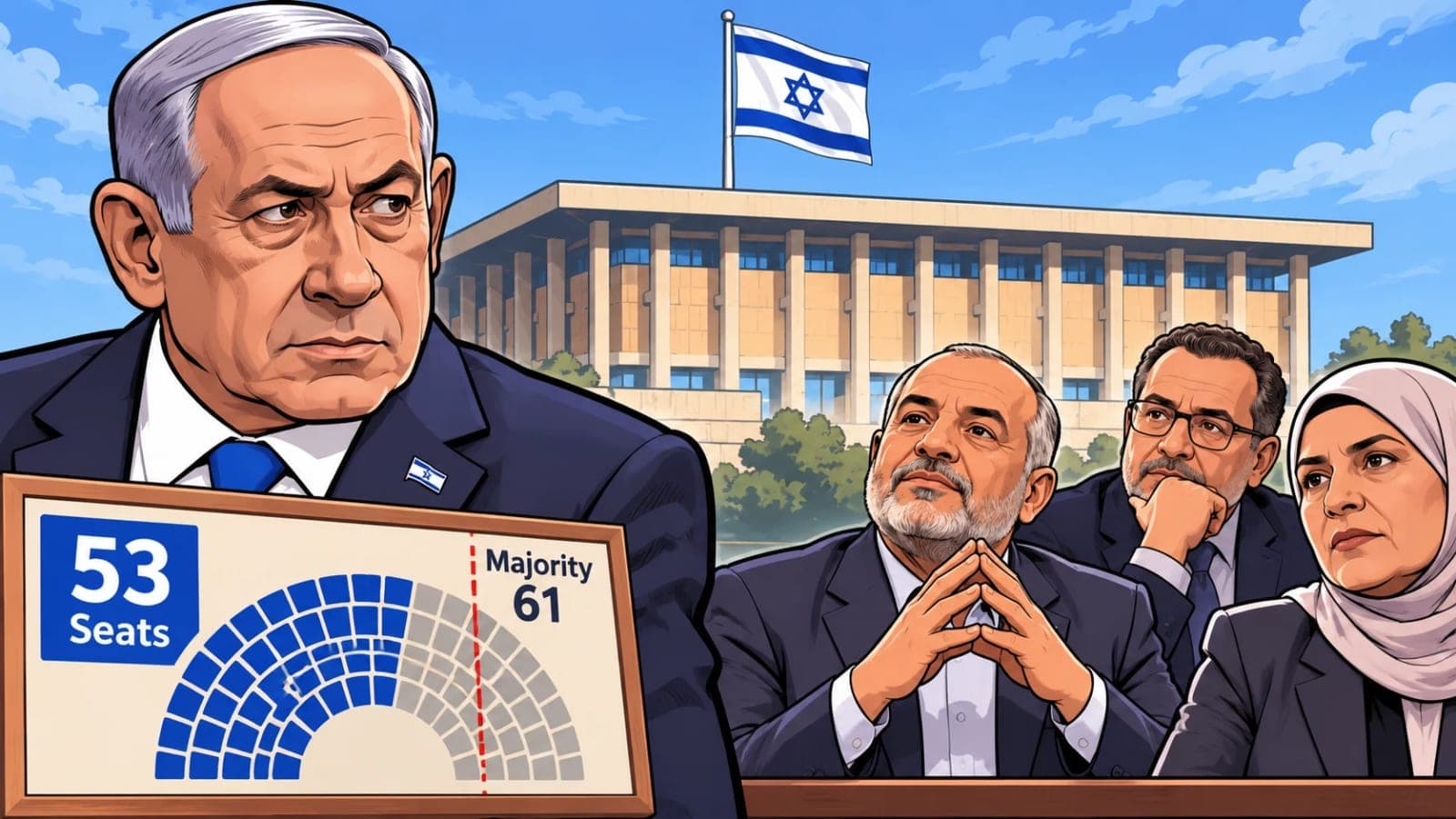
Israel election deadlock is the story of the 2026 vote, after final results left no bloc with the 61 seats needed to govern the 120-member Knesset.
Prime Minister Benjamin Netanyahu's bloc won 53 seats. The opposition bloc led by Gadi Eisenkot won 48. Arab-led parties won the remaining 19.
That arithmetic sets up weeks of coalition bargaining, with the Arab parties holding the balance of power.
Israel Election Deadlock: The Final Seat Count
The election was held on Tuesday 27 October 2026 for the 26th Knesset, and the Central Elections Committee published final results on Friday morning after all votes were counted.
Netanyahu's Likud emerged as the largest single party with 27 seats, ahead of Eisenkot's Yashar party with 21 seats.
Naftali Bennett's B'Yachad won 12 seats, and the Joint List won 11 seats.
The Democrats and Ra'am each secured eight seats, while Yisrael Beiteinu, United Torah Judaism and Otzma Yehudit won seven each, and Shas and Religious Zionism won six each.
The final tally gives Netanyahu's bloc 53 seats, the opposition bloc 48 seats, and Arab-led parties 19 seats.
A governing majority requires 61 seats, so Netanyahu's bloc falls eight seats short, and the opposition falls 13 seats short.
Turnout was 77.9 per cent, with 5,716,665 ballots cast, the highest since 1999.
Parties below the 3.25 per cent threshold, set at 184,947 votes, did not enter parliament.
The Stolen Vote Claim and Its Rejection
Netanyahu's Likud party alleged that the election was stolen and accused Arab-led parties of possible foreign interference, even after final results confirmed its bloc had only 53 seats.
The claim was rejected by Israel's election authorities. Central Elections Committee Chairman Justice Noam Sohlberg affirmed the integrity of the vote.
Yashar party leader Gadi Eisenkot said efforts by Netanyahu and Likud to discredit the results and steer the country toward another election had failed.
Eisenkot said the results were firm and clear, and welcomed the elections committee chairman's assurances.
"The people are sovereign, and they have spoken. The government of failure has no majority and has lost the election," Eisenkot said.
The election committee said the results remain subject to routine checks and minor corrections, as in every election.
Those checks cover polling stations, data-entry errors and complaints, but do not change the overall outcome.
The committee said the results will be submitted to President Isaac Herzog on Wednesday 4 November.
Israel Election Deadlock: Why Arab Parties Are Now Kingmakers
The Israel election deadlock turns on a simple fact: neither Jewish bloc can govern without Arab parties, or without each other.
In numerical terms, Eisenkot's bloc and the two Arab-led parties would hold 67 seats if they agreed to cooperate.
But that arithmetic does not amount to a coalition deal. Opposition parties remain divided over the possibility of relying on Arab parties' support.
The Arab-led parties, including Ra'am and the Joint List, sprang a surprise by securing 19 seats, positioning them as kingmakers in Tel Aviv.
That position is politically sensitive. Cooperation between Jewish opposition parties and Arab parties has historically been difficult, and this time is no exception.
Netanyahu faces a parallel problem. His bloc needs eight more seats, and the most obvious route, bringing Eisenkot and his right-leaning allies into his government, would give him a 67-seat majority on paper.
That route is equally difficult in practice, given that Eisenkot led the campaign against Netanyahu's government.
The result is a genuine impasse, not a temporary delay. No bloc has a ready-made majority, and every route to 61 seats requires a politically painful compromise.
Israel Election Deadlock: What Happens Next
The official results are due to be submitted to President Isaac Herzog on 4 November, after checks into possible errors or complaints.
Herzog will then consult the parties represented in the Knesset before deciding which lawmaker to task with attempting to form a government.
The newly elected Knesset is scheduled to be sworn in on 10 November.
After the swearing-in, Herzog is expected to give the responsibility to form a government by 11 November to a member of Knesset.
That member will then face the same arithmetic that produced the deadlock: 53, 48 and 19, with 61 needed.
If no coalition can be formed, Israel faces the possibility of fresh elections early next year.
The election was supposed to deliver a verdict on Netanyahu's leadership after the 7 October 2023 security failures. Instead, it produced a stalemate.
Stalemates in Israeli politics tend to favour the incumbent, especially one as skilled at survival as Netanyahu, but survival is not the same as a governing majority.
For now, Netanyahu continues as caretaker prime minister while the bargaining begins.
Frequently Asked Questions
What is the Israel election deadlock?
No bloc won the 61 seats needed to govern the 120-member Knesset: Netanyahu's bloc won 53, Eisenkot's won 48, and Arab-led parties won 19.
When was the Israel election held and when are results final?
The election was held on Tuesday 27 October 2026. Final results were published by the Central Elections Committee on Friday, and they are due to be submitted to President Isaac Herzog on 4 November.
Who are the kingmakers in the Israel election deadlock?
Arab-led parties, including the Joint List with 11 seats and Ra'am with 8 seats, hold 19 seats between them. Neither main bloc can reach 61 seats without them, or without each other.
Did Netanyahu claim the Israel election was stolen?
Yes. Likud alleged the election was stolen and accused Arab-led parties of possible foreign interference. The elections committee chairman affirmed the vote's integrity, and Eisenkot said the bid to discredit the results had failed.
When will Israel's new government be formed?
The new Knesset is scheduled to be sworn in on 10 November, and President Herzog is expected to give a lawmaker the mandate to form a government by 11 November. If no coalition reaches 61 seats, fresh elections early next year are possible.
What happens next for global
We will keep this page updated as the story develops rather than publishing a near-duplicate at a new address. Follow Global for related coverage.
Get the Verified Brief
One email each morning with the stories we checked overnight.
Spotted an error? Read our corrections policy and tell the newsroom.