
Lahore Smog Crisis: AQI 535, Punjab Cities and Health Warnings
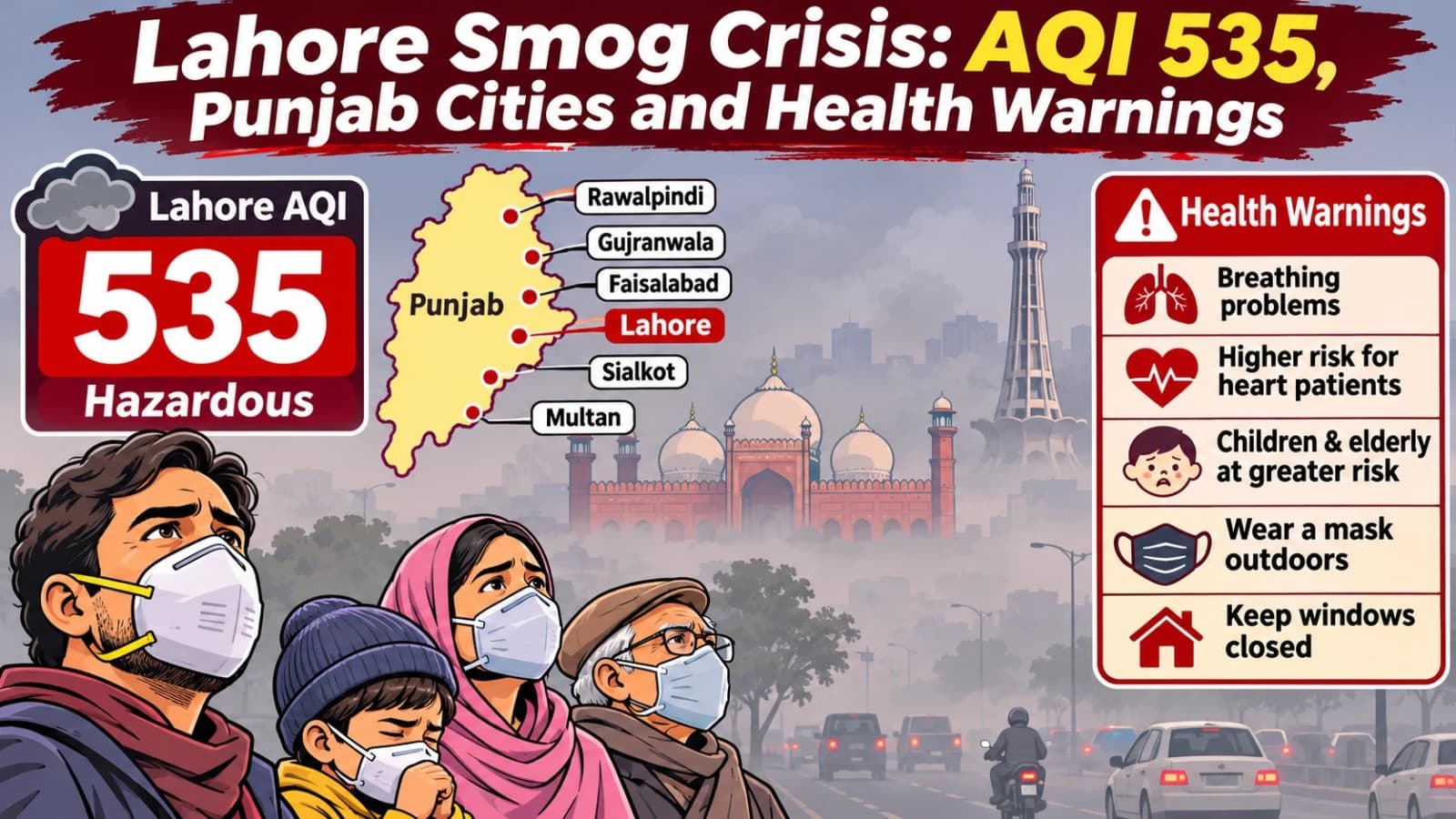
Lahore smog crisis returned to hazardous levels on 2 November, with Lahore AQI at 535, Gujranwala at 675, and Punjab cities dominating the most polluted list.

By News Desk · Verified Pakistan News Desk
Published · Updated · 5 min read
Lahore smog crisis returned to hazardous levels on Monday morning, 2 November 2026, as the city's Air Quality Index (AQI) crossed 530 and kept climbing.
At 8am, air monitoring platform IQAir recorded an AQI of 535 in Lahore, with fine particulate matter PM2.5 at 343 micrograms per cubic metre.
That level sits deep in the hazardous band, and it exposed millions of residents to dangerously polluted air at the start of the working week.
Lahore Smog Crisis: What the Numbers Show
The Lahore reading was not an isolated spike. Five Punjab cities were among Pakistan's six most polluted urban centres in IQAir's live ranking on Monday morning.
Gujranwala topped the list with an AQI of 606, followed by Lahore at 509 in the early snapshot, with Faisalabad and Multan at 310 each and Sialkot at 260.
Peshawar was sixth at 216. Readings changed quickly between hourly updates, and later in the morning Gujranwala climbed to 675 while Lahore reached 535.
Some Lahore localities recorded even higher readings. Reporting of local monitors put Iqbal Town at 902, Paragon City at 698, Chamman Park at 619, Burki Road at 569, Model Town at 471 and DHA Phase V at 412.
Lahore also topped IQAir's ranking of pollution levels in major cities in an early morning snapshot, although international rankings fluctuated through the day.
The Pakistan limit for PM2.5 cited in reporting is 35 micrograms per cubic metre, which puts Lahore's 343 reading at nearly ten times that level.
For context, the Punjab government had called October 2026 Lahore's cleanest October in five years, citing an average AQI of 180.5, down from 204.6 last year.
A separate analysis by the Pakistan Air Quality Initiative (PAQI) has questioned the extent of that improvement, and Monday's spike shows how quickly a monthly average can be overtaken by a single hazardous morning.
Lahore Smog Crisis: Why Smog Has Returned So Sharply
The deterioration coincides with a sharp rise in agricultural fires across Punjab.
NASA satellites detected 13,241 fire spots in Pakistani Punjab between 1 and 29 October, according to an analysis by the monitoring website HamariHawa.
About 92 per cent of those fire spots were on farmland, and the comparable figure for Indian Punjab in the same period was 3,158.
Crop residue burning after harvesting is a major seasonal contributor, alongside industrial emissions, vehicular pollution and construction dust.
The wider pollution belt around Lahore includes Sheikhupura, Kasur, Gujranwala, Nankana Sahib and other agricultural and industrial districts.
That geography matters. Smog in Lahore is not only a city problem, it is a regional problem driven by fires and emissions across the province.
The Punjab Environmental Protection Department (EPD) confirmed the IQAir reading, and EPD spokesperson Sajid Bashir said department efforts had helped improve air quality compared with October last year.
He added that authorities were still working hard to tackle the pollution situation.
The episode has raised fresh questions about the effectiveness of anti-smog operations, particularly as the same mix of causes returns every winter.
Lahore Smog Crisis: Health Warnings and What Residents Should Do
The Punjab Health Department has advised residents to stay at home and avoid going outside without reason.
Residents are advised to keep windows and doors closed and to use a face mask when they must go out.
The warning matters most for children, older people and anyone with asthma or heart conditions, who face the greatest risk from fine particulate matter.
PM2.5 particles are tiny enough to travel deep into the lungs and enter the bloodstream, which is why health authorities treat hazardous readings as a public health emergency rather than a mere inconvenience.
Reports on Monday described eye infections and breathing difficulties among residents as smog gripped the city.
Schools, offices and outdoor workers face the hardest choices on such mornings, balancing routine activity against air that is officially hazardous.
Until readings fall, the practical advice remains simple: limit outdoor time, mask up outside, and keep indoor air as clean as possible.
No Rain Relief in the Next 24 Hours
The Meteorological Department has forecast dry weather with no chance of rain during the next 24 hours.
That forecast removes the one natural factor that could quickly clear the air.
Without rain or strong winds, pollutants tend to linger, and morning readings can stay hazardous well into the day.
Residents should therefore expect the Lahore smog crisis to persist in the short term, even if hourly readings fluctuate.
The longer question is whether Punjab's anti-smog measures can prevent a repeat through the winter, or whether each calm, dry spell will bring another hazardous morning.
For now, the Lahore smog crisis pattern is familiar: a dry spell, a surge in farm fires, and a city waking up to air it cannot safely breathe.
Frequently Asked Questions
What was Lahore's AQI on 2 November 2026?
IQAir recorded Lahore's AQI at 535 at 8am on Monday 2 November 2026, with PM2.5 at 343 micrograms per cubic metre. Gujranwala recorded 606 in the early snapshot and later climbed to 675.
Which Punjab cities were most polluted on 2 November?
Five Punjab cities were among Pakistan's six most polluted: Gujranwala, Lahore, Faisalabad, Multan and Sialkot, with Peshawar sixth. Faisalabad and Multan recorded 310 each, and Sialkot recorded 260.
What is causing the Lahore smog crisis now?
Seasonal crop residue burning is a major contributor, with NASA satellites detecting 13,241 fire spots in Pakistani Punjab between 1 and 29 October. Industrial emissions, vehicular pollution and construction dust also contribute.
What health advice has been issued for Lahore smog?
The Punjab Health Department advised residents to stay home, avoid going outside without reason, keep windows and doors closed, and use a face mask when outside.
Will rain clear Lahore's smog soon?
No. The Meteorological Department forecast dry weather with no chance of rain during the next 24 hours, so no quick natural relief is expected.
What happens next for punjab
We will keep this page updated as the story develops rather than publishing a near-duplicate at a new address. Follow Punjab for related coverage.
Get the Verified Brief
One email each morning with the stories we checked overnight.
Spotted an error? Read our corrections policy and tell the newsroom.