
KP Markhor Hunting Permits 2026: Record Auction Revenue and Conservation Explained
KP markhor hunting permits 2026 raised $1.21 million through four auctions. Discover winning bids, community revenue sharing and conservation impact.

By News Desk · Verified Pakistan News Desk
Published · 13 min read
Khyber Pakhtunkhwa has raised approximately Rs. 335.7 million through the auction of four markhor trophy hunting permits, bringing renewed attention to Pakistan's controversial but financially significant wildlife conservation model.
The auction generated $1,211,800 in combined bids, with the highest offer reaching $335,600 for a permit in Chitral.
The provincial wildlife department says the majority of the money will support communities living near markhor habitats and help finance conservation activities.
Under the established revenue-sharing arrangement, 80% of the proceeds are allocated to community welfare and wildlife protection, while 20% goes to the provincial government.
The announcement has sparked interest because the markhor is Pakistan's national animal and an important symbol of the country's mountainous ecosystems.
Supporters believe regulated trophy hunting can provide local communities with a financial reason to protect wildlife. Critics argue that killing rare animals for sport raises ethical concerns and requires rigorous scientific oversight.
Here is what the latest auction means, how the system operates and why its conservation results matter.
KP Markhor Hunting Permits 2026: What Happened?
The Khyber Pakhtunkhwa Wildlife Department auctioned four exportable markhor hunting permits for designated conservation areas in Chitral and Kohistan.
The auction was supervised by Chief Conservator Wildlife Dr. Mohsin Farooqi.
The combined value of the successful bids reached $1.2118 million, equivalent to approximately Rs. 335.7 million at the exchange rate used in the reported figures.
These permits relate to regulated trophy hunting rather than unrestricted hunting across the province.
A permit authorizes a hunt under the applicable wildlife rules, location restrictions and other conditions.
The successful bidders have paid for the right to conduct approved hunts, subject to the relevant procedures.
Why the Auction Attracted Attention
The amount generated was substantial for a programme involving only four permits.
The highest individual bid also exceeded the previous year's top reported offer.
That suggests strong demand among trophy hunters willing to pay large sums for the opportunity to hunt a markhor in Pakistan.
However, the financial success of an auction should be evaluated separately from its conservation performance.
Revenue alone does not establish whether a wildlife population is being managed sustainably.
Complete Markhor Hunting Permit Auction Results
The four permits were associated with specific conservation areas.
| Conservation Area | Winning Bid |
|---|---|
| Toshi-II, Chitral | $335,600 |
| Toshi-I, Chitral | $320,600 |
| Kaigah Khwar, Kohistan | $295,600 |
| Gehrait Gol, Chitral | $260,000 |
| Total | $1,211,800 |
Toshi-II attracted the highest bid, followed by Toshi-I, Kaigah Khwar and Gehrait Gol.
The four figures add up to the reported total.
Which Markhor Permit Was the Most Expensive?
The Toshi-II permit secured $335,600, approximately Rs. 92.97 million.
This was higher than the previous year's top reported bid of $272,000.
The difference is $63,600.
Such an increase reflects the willingness of bidders to pay more for that particular permit, although it does not prove that every conservation area's market value increased.
Why Do Bids Differ Between Areas?
Several factors may influence the amount offered for a permit.
These can include the reputation of a hunting location, expected trophy characteristics, access arrangements and the preferences of individual bidders.
However, the auction report does not provide a detailed explanation of why each successful bidder offered a particular amount.
Any precise claim about the reason for the difference would therefore be speculative.
How Much Money Will Local Communities Receive?
The most important financial feature of the programme is its revenue-sharing formula.
Under the reported arrangement, 80% of auction proceeds are intended for community welfare and conservation.
The remaining 20% is allocated to the government treasury.
Based on the total auction value, the expected distribution is:
| Allocation | Percentage | Amount |
|---|---|---|
| Community welfare and conservation | 80% | $969,440 |
| Government treasury | 20% | $242,360 |
| Total | 100% | $1,211,800 |
Using the reported approximate rupee total, the community share would be around Rs. 268.6 million and the government share around Rs. 67.1 million.
These are calculated allocations, not confirmation that every payment has already been disbursed.
Why Community Revenue Sharing Matters
People living near wildlife habitats often face costs that outsiders do not experience.
Wild animals may compete with livestock for grazing areas or create other local management challenges.
Communities may also be asked to protect habitats, report illegal hunting and cooperate with wildlife officials.
Revenue sharing gives them a direct financial stake in conservation.
The effectiveness of this approach depends on whether the funds reach communities transparently and are used for the intended purposes.
What Is Markhor Trophy Hunting?
Trophy hunting is a regulated activity in which a hunter pays for permission to hunt an animal under specified conditions.
In Pakistan, markhor trophy hunting is managed through limited permits rather than general open hunting.
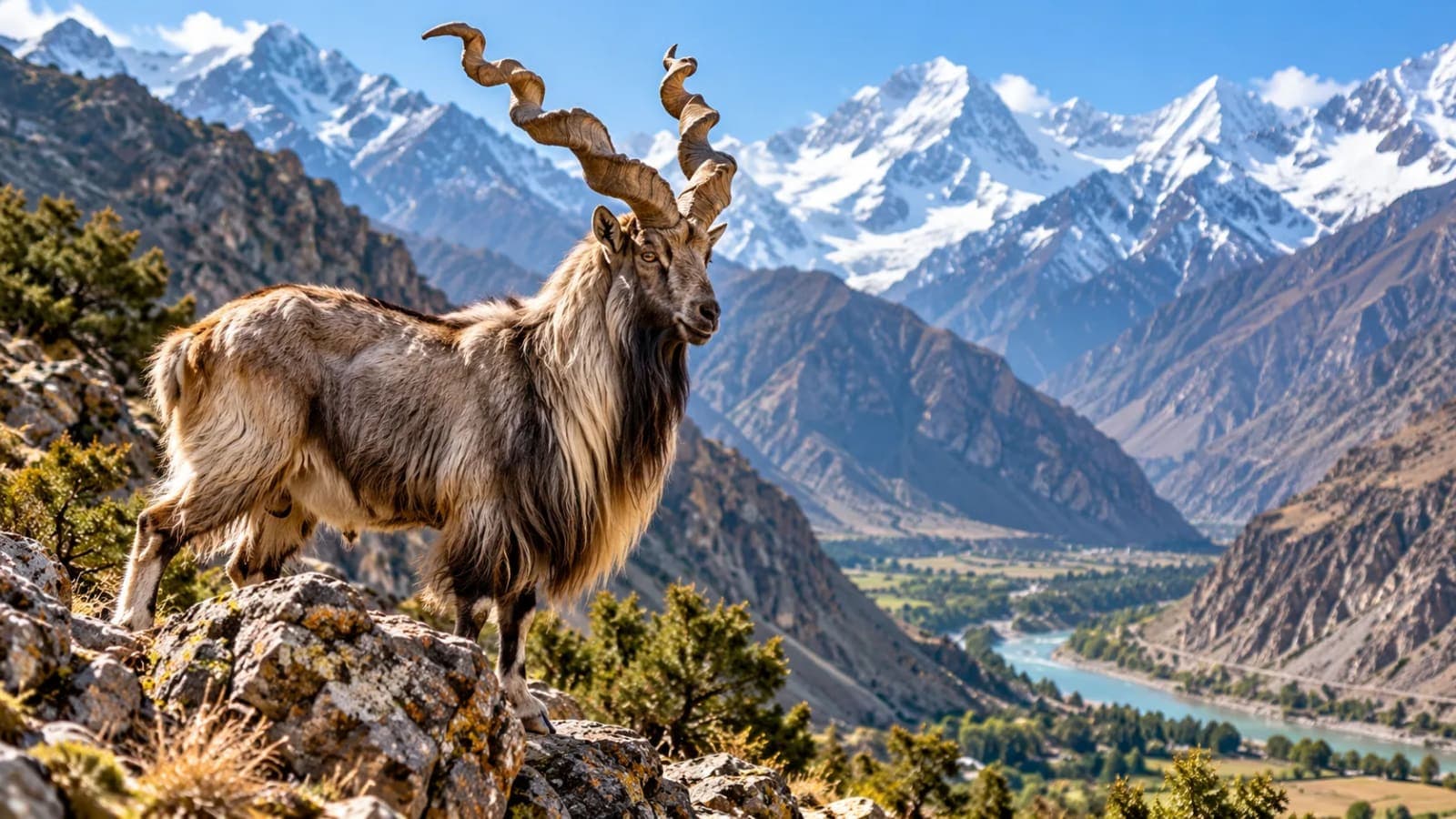
The markhor is a wild mountain goat known for its large, spiralling horns.
It inhabits rugged mountainous terrain, including parts of northern Pakistan.
What Does an Exportable Permit Mean?
An exportable permit relates to a hunt for which the trophy may be taken out of Pakistan, subject to applicable wildlife, customs and international trade requirements.
It does not mean that every animal part can be exported without documentation.
International trade involving protected wildlife may require permits under the Convention on International Trade in Endangered Species of Wild Fauna and Flora, commonly known as CITES.
The relevant requirements must be satisfied before any lawful export.
Why Is the Markhor Important to Pakistan?
The markhor is Pakistan's national animal.
It is recognised for its distinctive horns, climbing ability and adaptation to steep mountain environments.
The animal also forms part of the natural heritage of communities living in northern Pakistan.
Its survival depends on suitable habitat, protection from illegal hunting and the management of pressures affecting mountain ecosystems.
What Threats Do Markhor Face?
Potential threats include poaching, habitat disturbance and competition over grazing resources.
Changes in land use and human activity can also affect mountain wildlife.
The seriousness of these threats varies between regions.
For conservation planning, authorities need reliable information about local populations rather than relying only on national-level estimates.
Why Are Chitral and Kohistan Important?
Chitral and Kohistan contain mountainous habitats associated with markhor populations.
Their terrain includes steep slopes, valleys and relatively remote landscapes.
These environmental conditions can provide suitable habitat for wild mountain goats.
However, remoteness can also make wildlife monitoring and enforcement difficult.
Conservation Areas in Chitral
The Toshi and Gehrait Gol areas are associated with markhor conservation and regulated hunting programmes.
Local participation is important because residents often have regular contact with the surrounding landscape.
Community monitoring can support official conservation efforts when appropriate training and resources are available.
The Role of Kohistan
Kohistan is another important mountain wildlife region.
The Kaigah Khwar permit demonstrates that the provincial trophy hunting programme extends beyond Chitral.
Conservation strategies must reflect local ecological conditions rather than assuming that all mountain habitats face identical pressures.
How Does Community-Based Conservation Work?
Community-based conservation involves local residents in protecting natural resources and sharing some of the benefits.
Instead of treating nearby communities only as subjects of enforcement, the model gives them a role in wildlife management.
In Pakistan's markhor programme, village conservation committees are central to the revenue-sharing structure.
They can support conservation-related activities and community development projects.
What Can Conservation Revenue Support?
Depending on approved local arrangements, funds may support wildlife protection, community infrastructure and other welfare initiatives.
Potential projects include conservation monitoring, educational facilities or improvements to essential local services.
However, the October 2026 auction announcement does not provide a completed project-by-project spending report.
It would therefore be inaccurate to claim that specific new schools, roads or hospitals have already been funded by these auction proceeds.
Does Trophy Hunting Help Protect Markhor Populations?
This is one of the most debated questions surrounding the programme.
Supporters argue that tightly controlled hunting creates an economic incentive to protect wildlife from illegal killing.
If local communities receive substantial benefits, they may be more willing to invest time and resources in conservation.
Under this approach, revenue from a limited number of permitted hunts helps finance protection of a larger population.
However, that argument depends on several conditions.
Hunting quotas must be scientifically justified.
The animals selected must comply with applicable rules.
Wildlife populations must be monitored over time.
Revenue must reach the intended beneficiaries.
Why Population Monitoring Is Essential
A permit auction cannot substitute for ecological research.
Authorities need credible surveys to understand the size, age structure and distribution of markhor populations.
Monitoring should also examine whether hunting affects breeding patterns or population recovery.
Without reliable data, it is difficult to judge whether a particular quota is sustainable.
Why Some Conservationists Oppose Trophy Hunting
Not everyone accepts trophy hunting as an appropriate conservation strategy.
Some critics object to killing wild animals for recreation, regardless of the revenue generated.
Others question whether the financial benefits justify potential ecological risks.
Concerns may also arise about transparency, the selection of animals and the distribution of funds.
Ethical Questions
The central ethical debate concerns whether the deliberate killing of an animal can be justified as a means of protecting a species.
Supporters emphasise the possible benefits for habitats and communities.
Opponents argue that conservation should prioritise non-lethal approaches.
Both positions raise questions that deserve serious consideration.
Accountability Concerns
Even where a programme is legally authorised, independent scrutiny remains important.
Public reporting can help establish whether quotas were followed and how revenue was spent.
A transparent system should be able to demonstrate conservation outcomes rather than relying solely on auction totals.
How Are Markhor Hunting Permits Regulated?
Wildlife management in Pakistan involves provincial authorities and, in relevant circumstances, federal and international requirements.
The Khyber Pakhtunkhwa Wildlife Department administers the provincial programme.
Permits are linked to approved hunting areas and applicable quotas.
Export-related permissions may involve additional requirements.
Why Quotas Matter
A quota limits the number of animals that may be hunted legally.
It is intended to prevent unrestricted exploitation.
The appropriate quota should be based on credible population information and conservation objectives.
A quota that is too high can create risks even if each permit generates significant revenue.
Is Every Markhor Hunt Legal?
No.
A lawful trophy hunt must satisfy the relevant permit and regulatory conditions.
Hunting without authorisation, outside the permitted area or in violation of applicable rules may constitute an offence.
Possession of a general hunting licence does not necessarily authorise the hunting of protected wildlife.
How Does the 2026 Auction Compare With Previous Years?
The highest successful bid in the latest auction was $335,600.
The previous year's highest reported bid was $272,000.
That represents an increase of $63,600 in the top individual offer.
The comparison suggests increased bidding for the leading permit.
However, it is not enough to establish a comprehensive trend in total programme revenue.
A proper year-on-year analysis would require comparable records covering all permits, exchange rates and auction conditions.
Why Exchange Rates Can Affect Rupee Totals
Auction values are reported in US dollars.
Their equivalent in Pakistani rupees changes with the exchange rate.
A higher rupee figure can therefore reflect both stronger bidding and currency movements.
Comparing dollar-denominated bids is generally more useful when assessing changes in auction prices.
Could Wildlife Tourism Provide an Alternative?
Wildlife tourism offers a different way to generate economic benefits from protected animals.
Visitors may pay for guided trips, accommodation and opportunities to observe animals in their natural habitats.
Such activities can support local employment without requiring animals to be hunted.
However, tourism also has costs and limitations.
Remote areas may require investment in access, visitor safety and environmental management.
Poorly controlled tourism can disturb wildlife and damage habitats.
Can Both Approaches Be Evaluated?
Yes.
Policymakers can compare the financial and ecological results of different conservation models.
That includes examining how much money reaches local communities and whether wildlife populations remain healthy.
The strongest evidence would come from transparent monitoring rather than assumptions about either approach.
What Should Happen to the Auction Revenue?
The reported 80% community allocation creates an opportunity for meaningful local investment.
To maintain public confidence, spending should be documented clearly.
Communities should understand how funds are distributed and what projects are approved.
Independent oversight can help reduce the risk of misuse.
Measuring Conservation Success
Financial records alone are not enough.
Authorities should also evaluate wildlife population trends, illegal hunting incidents and habitat conditions.
Community participation and satisfaction are additional indicators.
A programme can generate substantial revenue yet still require improvements in governance or ecological management.
What Happens After the Auction?
Winning bids establish the financial value of the permits.
The actual hunts must still comply with the relevant rules, schedules and permissions.
Officials and conservation committees may be involved in monitoring authorised activity.
Exportable trophies must satisfy applicable documentation requirements.
The announcement of auction results should not be confused with confirmation that all four hunts have already taken place.
What to Watch Next
Future developments include the implementation of the permits, revenue distribution and official conservation reporting.
Any updated markhor population surveys will also be important.
Such information can help determine whether the programme is delivering the benefits claimed by its supporters.
Conclusion
The KP markhor hunting permits 2026 auction has generated approximately $1.21 million, placing renewed attention on the financial value of regulated wildlife hunting in northern Pakistan.
The four permits were awarded for conservation areas in Chitral and Kohistan, with Toshi-II securing the highest bid.
The reported revenue-sharing formula directs 80% of proceeds toward local communities and conservation activities.
That provides a potentially valuable source of funding for regions where protecting wildlife can involve significant costs.
Nevertheless, financial success should not be treated as proof of conservation success.
The long-term value of the programme depends on scientifically supported quotas, transparent revenue distribution and reliable monitoring of markhor populations.
Pakistan's national animal deserves a conservation strategy judged by measurable ecological results as well as auction revenue.
Frequently Asked Questions
1. How much did KP earn from markhor hunting permits in 2026?
The four permits attracted combined bids of $1,211,800, equivalent to approximately Rs. 335.7 million.
2. Which markhor hunting permit received the highest bid?
The Toshi-II permit in Chitral attracted the highest bid of $335,600.
3. How much auction revenue goes to local communities?
Under the reported arrangement, 80% is allocated to community welfare and conservation, while 20% goes to the government treasury.
4. Is markhor trophy hunting legal in Pakistan?
It can be legal under applicable quota-based permit arrangements. Hunting outside the relevant legal requirements is not automatically permitted.
5. Does the auction mean four markhors have already been hunted?
No. The auction concerns permits. The announcement does not establish that the corresponding hunts have already occurred.
Editorial Disclaimer: Auction figures reflect reporting available on October 9, 2026. Calculated revenue shares are allocations based on the announced formula, not proof of completed disbursements. Conservation outcomes require separate verification.
What happens next for national
We will keep this page updated as the story develops rather than publishing a near-duplicate at a new address. Follow National for related coverage.
Get the Verified Brief
One email each morning with the stories we checked overnight.
Spotted an error? Read our corrections policy and tell the newsroom.