
Loan App Fraud Crackdown: NCCIA Arrests 154 in Twin Cities Raids
NCCIA has arrested 154 people in raids on two illegal call centres in Islamabad and Rawalpindi over loan app fraud and blackmail. Here is what happened, and how to stay safe.

By News Desk · Verified Pakistan News Desk
Published · Updated · 8 min read
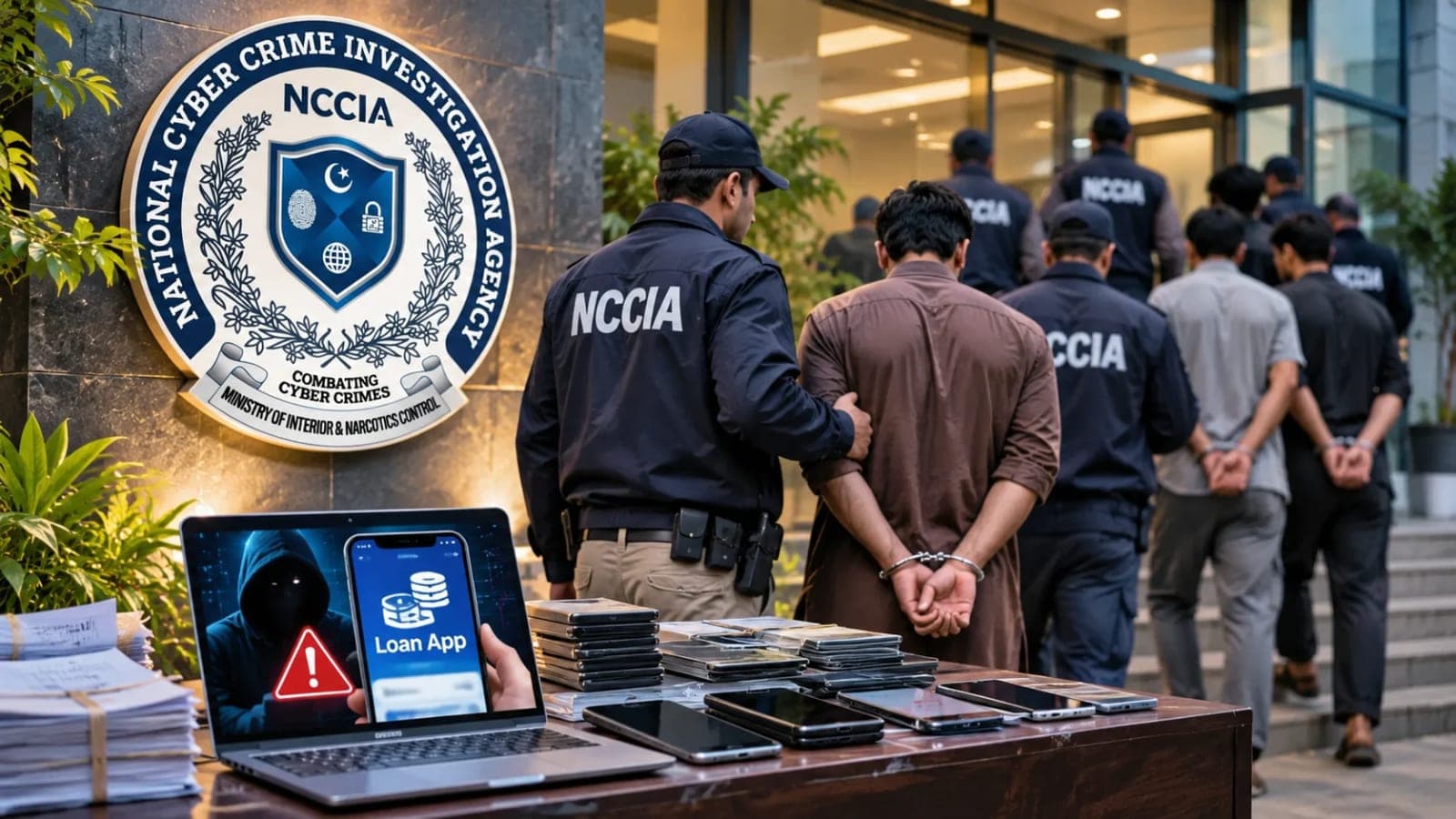
Loan app fraud has led to one of the biggest cybercrime arrests of the year in Pakistan. The National Cyber Crime Investigation Agency, known as the NCCIA, says it arrested 154 people after raiding two illegal call centres in Islamabad and Rawalpindi.
The suspects are accused of running a loan app fraud network that targeted citizens of South Asian countries. According to the agency, the call centres used fake loan apps to steal personal information and then blackmail victims with their private photos and videos.
The arrests were announced at a press conference in Islamabad on Saturday, 14 November. The story appeared in the print editions of Dawn and The Nation on Sunday, 15 November.
What happened in the twin cities raids
The NCCIA raided two illegal call centres in the Islamabad and Rawalpindi zone during a three day operation. The agency arrested 154 suspects in total, including 53 women.
In Islamabad, officers arrested 143 people, including 43 women, from one call centre. In Rawalpindi, they arrested 11 people, including 10 women, from the second call centre.
NCCIA Additional Director Muhammad Shoaib Khan, who heads the Islamabad and Rawalpindi zone, briefed reporters about the operation on Saturday. He said the centres were involved in international cyber fraud and online blackmail.
A case was registered on 13 November at the NCCIA Cyber Crime Reporting Centre in Islamabad. The complaint was filed by the state through Inspector Adeel Ahmed Sheikh, who is also the investigating officer.
According to The Nation, the call centre at the centre of the case operated under the name Born CC, also called NZ Corporation. The report says the centre used a loan app to recover money for several international online loan apps.
How the loan app fraud worked
Loan app fraud usually starts with a simple promise. An app offers a small, quick loan with little paperwork, often through an advertisement on social media or a text message.
Once a person installs the app, it asks for permission to read the phone gallery and contacts. That is the trap. A genuine lender does not need your photos or your contact list to lend you money, but a loan app fraud network does, because that data is what it uses to frighten people later.
The NCCIA says the call centre staff then used the stolen personal information to pressure borrowers. Victims were threatened that their private photos and videos would be shared with their family and contacts unless they paid more money.
The agency says the network targeted citizens of South Asian countries, not only Pakistanis. The callers allegedly posed as loan recovery agents and used the threat of public shame to extract payments.
The suspects also allegedly opened bank accounts in the names of fake companies. Those accounts were then used to receive and move the money collected from victims of the loan app fraud.
What the court decided
The arrested people were produced before a court in Islamabad on Saturday. Senior Civil Judge and Judicial Magistrate (West) Malak Aman heard the case through a video link.
The suspects were produced in two batches, 112 men and 42 women. The court granted three days of physical remand for the men, who will be produced again on 17 November. The women were sent to Adiala Jail on judicial remand until 28 November.
It is important to remember that an arrest is not a conviction. The people arrested are suspects, and the allegations against them have not yet been proved in court. The case will now move through the legal process.
NCCIA wants tighter checks on fake companies
At the same press conference, the NCCIA called for stricter rules on company registration and bank account verification. The agency says weak checks are being exploited by illegal call centres, online betting operators and international fraud networks.
According to Dawn, NCCIA officials said fake companies were being registered through weak verification procedures. Bank accounts opened in the names of those companies were then linked to loan applications, betting and gaming portals to receive and transfer illicit funds.
The agency wants the registration and banking system tightened so that fraud networks cannot hide behind paper companies. Closing those gaps would make loan app fraud harder to run at scale.
Part of a wider crackdown
The twin cities raids are not a one off operation. They are part of a wider NCCIA campaign against illegal call centres across the country.
Earlier this month, on 4 November, the NCCIA raided a call centre on Sharea Faisal in Karachi and arrested 273 people, including women and juveniles. The agency seized 339 laptops, 152 mobile phones and four computers. That case involved the alleged theft of credit card data through spoofed calls, and by 10 November all 273 people had been granted bail. Bail does not mean acquittal, and the case is still before the court.
In October, the NCCIA arrested 39 people at a call centre in a private housing society in Lahore. The agency said the centre was involved in loan app blackmail, the same pattern seen in the twin cities raids.
The pattern is now clear. Illegal call centres are being run from major cities, staffed by young operators, and aimed at victims in Pakistan and abroad. The NCCIA has made these centres a priority, and more raids are likely.
How to spot a fake loan app
Most victims do not realise they are dealing with a fake lender until the threats begin. There are simple checks that can protect you from loan app fraud.
First, check the Securities and Exchange Commission of Pakistan, or SECP, whitelist of digital lending apps. The SECP publishes a list of lending apps run by licensed companies. If an app is not on that list, do not install it.
Second, look at the permissions the app asks for. A loan app does not need access to your gallery, your contacts or your messages. If it asks for those permissions, delete it.
Third, be wary of loans advertised with instant approval and no documents. Licensed lenders ask for identification and check your ability to repay. An app that skips those steps is a warning sign.
Fourth, never pay extra charges to release a loan. Genuine lenders deduct any fee from the loan itself. Demands for advance payments are a classic sign of loan app fraud.
How to report loan app fraud
If a loan app has threatened you, do not pay and do not reply to the threats. Paying rarely ends the blackmail, and the same people often ask for more money.
Save everything. Take screenshots of every message, note the phone numbers used, and keep the app installed until you have saved the evidence.
Then report the loan app fraud to the NCCIA. The agency runs a 24 hour helpline on 1799, and complaints can be filed online at complaint.nccia.gov.pk. You can also visit a regional NCCIA reporting centre with your CNIC and the evidence you have saved.
If the lender is unlicensed, you can also file a complaint with the SECP. That helps the regulator act against the company behind the app.
If money has already been taken from your bank account or mobile wallet, contact your bank or wallet provider at once and ask them to block the transaction and freeze the account.
Loan app fraud questions answered
What is loan app fraud? Loan app fraud happens when an unlicensed app offers a quick loan, then uses the phone permissions it collected to steal personal data and blackmail the borrower. The app may demand more money than was borrowed, and threaten to share private photos with the victim's family and contacts.
How many people were arrested in the twin cities raids? The NCCIA arrested 154 people, including 53 women, in raids on two illegal call centres in Islamabad and Rawalpindi. Of those, 143 were arrested in Islamabad and 11 in Rawalpindi.
What were the call centres accused of doing? According to the NCCIA, the centres ran a loan app fraud network that targeted citizens of South Asian countries, stole their personal information, and used manipulated photos and videos to harass and blackmail them into paying money.
What happened in court after the arrests? The suspects were produced before Senior Civil Judge and Judicial Magistrate (West) Malak Aman through a video link. The men were given three days of physical remand and will be produced again on 17 November. The women were sent to Adiala Jail on judicial remand until 28 November.
How can I check if a loan app is legal in Pakistan? Check the SECP whitelist of digital lending apps on the SECP website. Only apps run by licensed lending companies appear on the list. If the app you are using is not on the list, it is operating illegally and you should not install it or take a loan from it.
Where do I report loan app blackmail? Report it to the NCCIA on its 24 hour helpline 1799, or file a complaint online at complaint.nccia.gov.pk. Keep screenshots of the threats and the numbers used, and do not delete the app until you have saved the evidence.
What happens next for national
We will keep this page updated as the story develops rather than publishing a near-duplicate at a new address. Follow National for related coverage.
Get the Verified Brief
One email each morning with the stories we checked overnight.
Spotted an error? Read our corrections policy and tell the newsroom.