

Modders Find a Way to Make Nvidia's Older GPUs 2x Faster
Nvidia RTX AI unlock work by community modders has doubled some AI test scores on older GeForce cards, yet gaming is unchanged and the method carries real risks.

By News Desk · Verified Pakistan News Desk
Published · Updated · 5 min read
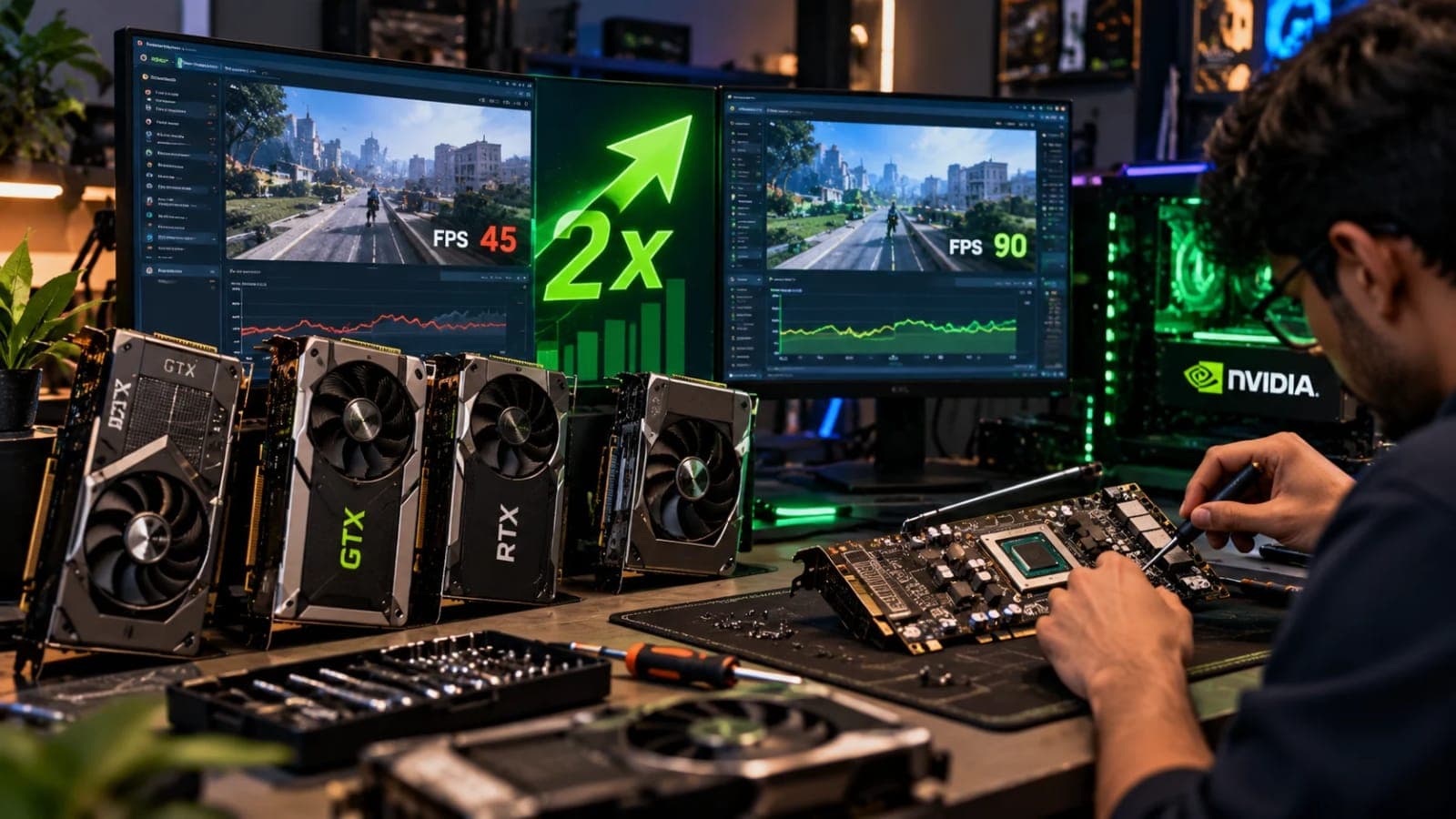
Community modders have found a way to lift a long standing speed limit on older Nvidia graphics cards, and the early results look striking. The Nvidia RTX AI unlock uses open source tools to change low level GPU settings before the driver starts, and in specific AI tests some cards have roughly doubled their measured throughput.
That headline needs a clear warning first. These are benchmark figures for specific AI operations, not overall or gaming performance, which is unaffected. The method is experimental, not an official Nvidia feature, and anyone who tries it does so at their own risk. Back up first.
The work matters because many older GeForce cards are still in daily use, and a free change could extend their life for students, creators and small developers. But gains depend heavily on task, card and settings.
How the Nvidia RTX AI unlock works
Nvidia limits a specific calculation on consumer cards: on GeForce RTX 20, 30 and 40 series cards, FP16 and BF16 calculations using FP32 accumulation run at half speed. Professional cards do not have the same limit.
The Nvidia RTX AI unlock targets that restriction. It changes low level GPU settings before the driver starts, allowing the card to run the affected calculations at full speed in supported tests. The changes are temporary and are cleared when power is lost, so users would need to repeat the process after a full power cut.
Most tools so far are aimed at Linux users. Experimental Windows versions are in development, not finished or stable releases. The RTX 50 series is not covered by confirmed methods reported so far.
Nvidia RTX AI unlock test results
The most eye catching result comes from the RTX 4090. In one specific FP16 Tensor Core test, throughput rose from 165.6 TFLOPS to 331.6 TFLOPS, about double.
The RTX 3090 Ti is more mixed. Its BF16 matrix multiplication rose from 87.5 TFLOPS to 157.4 TFLOPS, about 80 percent up. Its FP16 rose from 87.46 to 118.39 TFLOPS, up 35 percent. Its TF32 rose from 42.58 to 82.61 TFLOPS, up 94 percent. TweakTown reported those figures from the project results.
The RTX 4070 Ti Super also produced large test gains in experimental reporting. Its FP16 result rose from 95 TFLOPS to 189.9 TFLOPS, while its BF16 result rose from 95 TFLOPS to 189.7 TFLOPS. These are specific test figures, not a general speed rating for the card.
Other cards reported as working include the RTX 3060, 3070 and 3080, plus selected RTX 40 models. The method has not been validated for every variant.
One result needs a separate warning. The RTX 2080 Ti figure rose from 59.9 TFLOPS to 111 TFLOPS, but that card had also been physically modified with 22GB of VRAM, unrelated to the software unlock.
Real world gains are smaller
For the Nvidia RTX AI unlock, practical gains are smaller than headline test numbers. On an RTX 3090, prompt processing for a large language model improved by roughly 14 percent to 36 percent in reported testing. That is a real improvement, but it is far from a doubling.
Token generation, the step producing text word by word, was largely unchanged. It is often limited by memory bandwidth, not by the calculation limit the mod removes.
Image generation shows a middle ground. In ComfyUI, image model throughput on the RTX 3090 Ti was roughly 56 to 59 percent higher in BF16 in reported testing, still short of doubled benchmark figures.
People should therefore judge this work by the task they actually run, not by the largest number in any single test.
Should you try it? The risks come first
The Nvidia RTX AI unlock is not an official Nvidia feature and should never be presented as one. Users cannot expect official support if something goes wrong.
Reported risks include system crashes, startup and boot failures, possible hardware problems, and a warranty that may be voided. This is community software working at a low level, before the driver starts, so a problem can affect more than a single app.
For most owners, the sensible approach is to wait for wider testing, clearer Windows support and more reports from people with the same card model. If you do experiment, use a system you can afford to break and back up first.
But a crashed system, a boot failure or a voided warranty can cost far more than the time saved, especially on a machine needed for work or study.
Frequently Asked Questions
Will games run faster?
No. Gaming performance is unaffected. The change targets specific AI calculation limits, so frame rates in games should not be expected to rise.
Is the Nvidia RTX AI unlock official?
No. It is a community project using open source tools. It is not an Nvidia official feature, and it does not come with official support.
Which cards have been reported to work?
Reports mention the RTX 20, 30 and 40 series, with specific results for the RTX 4090, 3090 Ti and 4070 Ti Super, and reported success on the RTX 3060, 3070 and 3080 and selected RTX 40 models. Not every variant is validated, and the RTX 50 series is not covered by confirmed methods.
Why are real world gains smaller than benchmark gains?
Benchmarks can isolate one calculation type, while real workloads mix many steps. Prompt processing improved roughly 14 percent to 36 percent on an RTX 3090, and token generation was largely unchanged because it is often limited by memory bandwidth.
What are the main risks?
System crashes, startup or boot failures, possible hardware problems, and a warranty that may be voided. The Nvidia RTX AI unlock is experimental, so try it only at your own risk and back up first.
What happens next for tech
We will keep this page updated as the story develops rather than publishing a near-duplicate at a new address. Follow Tech for related coverage.
Get the Verified Brief
One email each morning with the stories we checked overnight.
Spotted an error? Read our corrections policy and tell the newsroom.