
Pakistan's First Astronaut Mission: November Plan and the Bigger Space Ambition
Planning Minister Ahsan Iqbal says Pakistan's first astronaut is due to fly from China in November 2026. Here is the timeline and what remains unclear.

By News Desk · Verified Pakistan News Desk
Published · 10 min read
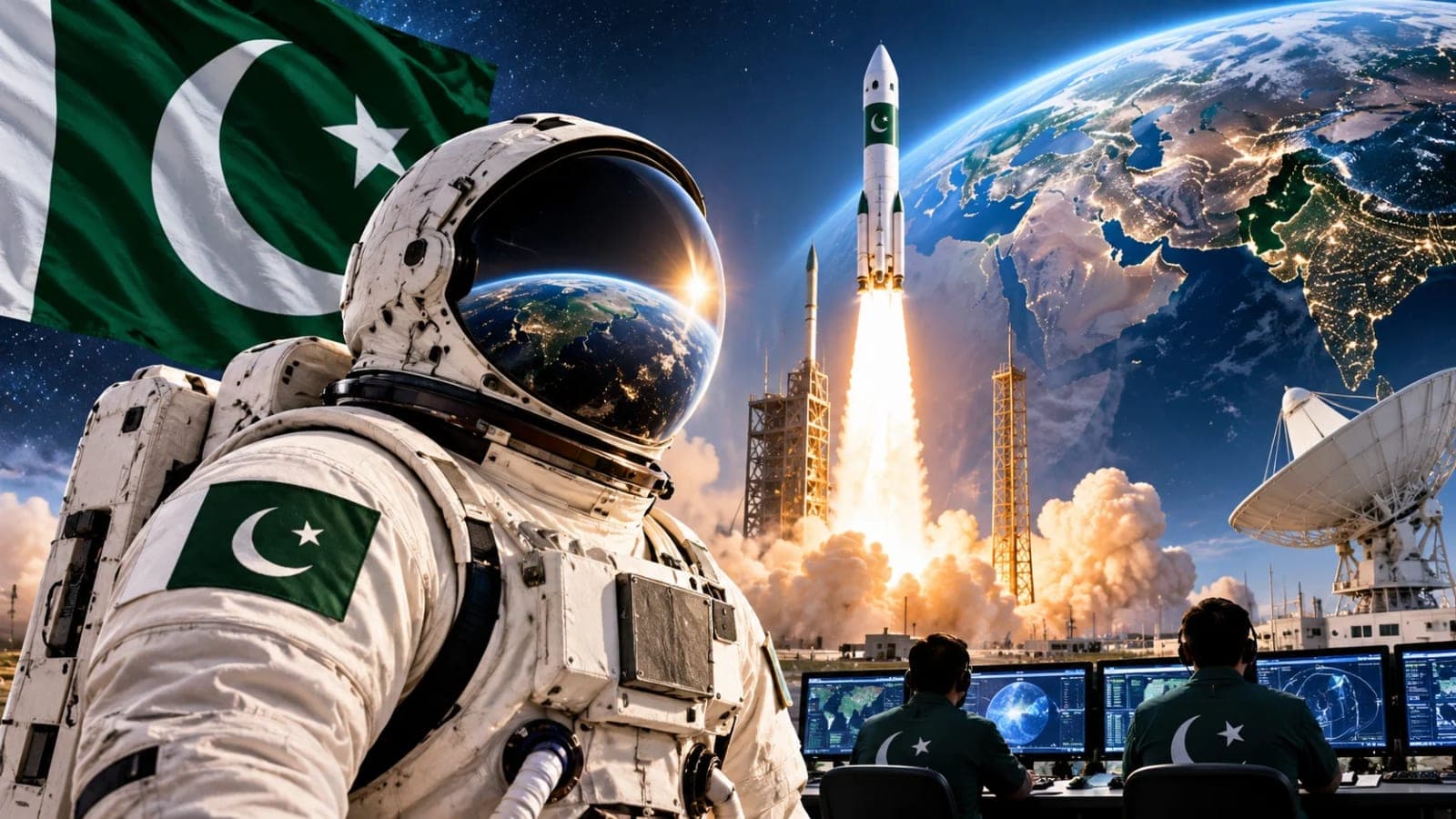
Pakistan's planning minister has put a date on a major national space ambition. Speaking at the closing ceremony of World Space Week in Narowal, Ahsan Iqbal said the country's first astronaut would set out on a space mission from a Chinese space centre on 25 November 2026. He also spoke of an ambition to achieve a lunar landing by 2035 and announced plans for a Space Museum at the University of Narowal.
As of 19 October, the astronaut mission is a future event described by the minister. Radio Pakistan's account of his remarks does not identify the astronaut, spacecraft, destination or duration. It is therefore important to keep the news in the right tense: an announced plan with a target date, not a launch that has already happened.
The story nevertheless speaks to a larger question. What would a first Pakistani astronaut mean for the country's scientific institutions, young people and cooperation with China? A careful answer begins with the actual announcement and separates it from what may come later.
The announced date and venue
Radio Pakistan reported on 18 October that Ahsan Iqbal expected Pakistan's first astronaut to embark on a mission from China's space centre on the 25th of the following month. That makes the stated date 25 November 2026. The remark was delivered at World Space Week's concluding ceremony in Narowal.
The report does not name a specific Chinese facility or give a launch time. Nor does it provide a crew manifest, mission name or technical description. A first astronaut could be central to the mission's public identity, but no individual should be named on the basis of this brief account.
For anyone planning coverage or educational activities, official mission confirmation will matter. Spaceflight schedules can depend on technical readiness, safety reviews and operations. The minister's date is newsworthy, yet it should be checked again against a detailed announcement closer to launch.
What has and has not been announced
The explicit claim is that Pakistan's first astronaut will embark from a Chinese space centre on 25 November. The same report associates the plan with cooperation between Pakistan and China. It does not say the person will land on the Moon in November, take part in a specific experiment, or visit a named orbital station.
The 2035 lunar landing goal is a separate long-range ambition. Combining the November astronaut plan and the lunar target into one mission would misrepresent the remarks. These are different horizons with very different technical and financial requirements.
Why a first astronaut matters
Human spaceflight is more than the image of a person in a flight suit. A successful mission depends on selection, medical preparation, training, mission planning, operational coordination and a safe return. Countries can also learn from work around payloads, communications and scientific outreach, depending on their specific role in a mission.
The public value of a national first can be considerable. A visible space milestone may inspire students who have rarely encountered local examples of careers in physics, engineering and earth observation. That inspiration is most durable when it connects to education, research facilities and jobs rather than ending with a single ceremony.
The planned mission's scientific contribution cannot yet be assessed from the minister's remarks. The report does not list experiments, data-sharing arrangements or a programme of follow-up flights. Those details would determine how directly the flight supports research and domestic capacity.
A useful set of questions for later updates
Who is the astronaut, and what was the selection and training process? What is the spacecraft and destination? How long will the mission last? Will Pakistan have an experiment or other payload aboard? What will institutions and students be able to learn from the mission afterwards?
These are questions, not missing facts to fill with guesses. Answers from the relevant Pakistani and Chinese space authorities would turn the announcement into a more complete public record.
Pakistan-China space cooperation in the minister's remarks
Iqbal said cooperation with China would help Pakistan advance in space exploration. The immediate reason this partnership is in the news is his assertion that the astronaut mission would begin from a Chinese space centre. The Radio Pakistan report offers no terms of a new agreement or a breakdown of responsibilities for this particular flight.
International partnerships can provide access to capabilities that take time and large resources to develop independently. A country may contribute people, science, engineering or funding under different arrangements. The arrangement relevant to this mission should be described once the partners publish it, rather than inferred from the planned launch location.
For Pakistan, the longer-term test is whether cooperation strengthens skills at home. Training scientists and engineers, creating educational materials, and sharing usable scientific results could leave a lasting legacy. Those outcomes require specific programmes; the mere fact of an overseas launch does not establish them.
The 2035 lunar landing ambition
The minister also said Pakistan aims to achieve a lunar landing by 2035. An ambition is a policy direction, not a confirmed mission manifest. Radio Pakistan's account does not state whether the proposed landing would involve a robotic craft or people, or describe financing, hardware and milestones.
The distinction is particularly important because “lunar landing” can mean very different things. A robotic probe designed to land on the lunar surface is a different undertaking from sending astronauts there. Until officials specify what is intended, neither should be asserted as the approved 2035 mission architecture.
Nine years between the 2026 remarks and 2035 leave room for planning, partnerships and changes. Public progress would become clearer through named programmes, technical milestones, budgets and test results. An achievable space roadmap would explain how near-term activity builds toward the stated lunar goal.
How to evaluate a long-range space goal
Look for a sequence rather than a slogan: programme authorization, research teams, mission design, technology development, testing, launch arrangements and independent reporting of outcomes. The precise sequence depends on what type of lunar mission is envisaged.
In the meantime, the November astronaut date and the 2035 ambition should be tracked separately. Success or delay in one does not, by itself, prove success or failure in the other. Clear milestones help the public judge both fairly.
World Space Week in Narowal
The remarks came at the closing event of World Space Week in Narowal. According to the Radio Pakistan account, the celebration took place there for the first time in 2026 in collaboration with the Space and Upper Atmosphere Research Commission, or SUPARCO. Its stated purpose was to raise awareness among young people of space science, research and modern technology.
Science events can open doors when they help students ask questions and meet the people who work in technical fields. A one-off event, however, cannot replace sustained access to teachers, laboratories, libraries and opportunities to practice. The value of the Narowal programme will be easier to see if it leads to regular activities and wider participation.
Regional visibility matters, too. Bringing a national space conversation to Narowal places it near students who might otherwise encounter it only through online clips. Schools and universities could use the astronaut announcement to explain how space missions combine mathematics, materials, medicine, communications and teamwork.
A proposed Space Museum at the University of Narowal
Iqbal announced plans to establish Pakistan's first Space Museum at the University of Narowal. The stated purpose is to promote scientific awareness and encourage a new generation to study space science and technology. The report does not give a construction budget, opening date, exhibition plan or confirmation that the institution is already operating.
A museum could make difficult concepts tangible through models, interactive displays and accounts of real missions. Its educational impact would depend on what it offers, whether schools can visit, and how accurately it presents both successes and the work behind them. The announcement is a starting point for those practical decisions.
There is also an opportunity to tell a broad story. Space-related skills are relevant to weather observation, communications and the study of Earth, not only astronaut flights. Exhibits could help visitors see why scientific institutions need technicians, teachers, designers and analysts alongside astronauts. Any specific museum programme, though, awaits an official plan.
What students can do now
Students do not need to wait for a launch or museum opening to engage with space science. Mathematics, physics, computing and clear scientific writing all build useful foundations. Local science clubs, public lectures and university outreach can provide chances to learn how experiments are designed and checked.
It is also healthy to ask for evidence. A good space story distinguishes a planned flight from a completed one, a concept from a funded programme, and an inspiring goal from a tested spacecraft. That habit is part of science itself.
The next confirmation to watch
As the announced 25 November date approaches, a formal mission briefing would answer the immediate questions about crew, spacecraft, venue and schedule. A later post-flight account could explain what took place and what Pakistan gained. In between, updates from the responsible agencies will be more reliable than speculation circulated on social media.
If plans change, accurate coverage should say so plainly. Space missions are complex, and a revised date would not erase the scientific value of a carefully conducted programme. The key is that readers receive timely, specific information from accountable sources.
Pakistan's larger space ambitions will likewise need repeated evidence of progress. Education initiatives, mission participation and a future lunar project each deserve their own reporting. Connecting them thoughtfully can help the public understand the opportunities and the work still ahead.
Frequently asked questions
When is Pakistan's first astronaut expected to embark on the mission?
Planning Minister Ahsan Iqbal said 25 November 2026, according to Radio Pakistan's report of his 18 October remarks. The mission had not taken place as of this article's 19 October update.
Has the astronaut been named?
The cited report does not identify the astronaut. A name, selection details and crew assignment should be checked with an official mission announcement.
Will the November mission land on the Moon?
The report does not say that. The minister's 2035 lunar landing ambition is separate from the November 2026 astronaut mission, whose destination was not specified in the account.
Where is the planned Space Museum?
Iqbal announced plans for a Space Museum at the University of Narowal. The report does not provide an opening date or say that the museum has already opened.
What role did SUPARCO have in the Narowal event?
Radio Pakistan says World Space Week 2026 was celebrated in Narowal in collaboration with SUPARCO to promote awareness of space science, research and technology among younger people.
Conclusion
The minister's November date offers a focal point for Pakistan's first astronaut mission, while his 2035 lunar ambition describes a longer journey. Both deserve accurate follow-up. The immediate facts are an announced 25 November departure from a Chinese space centre, a Narowal science event and a proposed university museum. The crew, mission design and later milestones still require official detail.
What happens next for tech
We will keep this page updated as the story develops rather than publishing a near-duplicate at a new address. Follow Tech for related coverage.
Get the Verified Brief
One email each morning with the stories we checked overnight.
Spotted an error? Read our corrections policy and tell the newsroom.