New Solar Panel Technology Can Charge Electric Vehicles Anywhere
GoSun EV Solar Charger offers up to 1,100W solar output and 20 miles of daily range. Check real-world performance, battery and price.

By News Desk · Verified Pakistan News Desk
Published · 11 min read
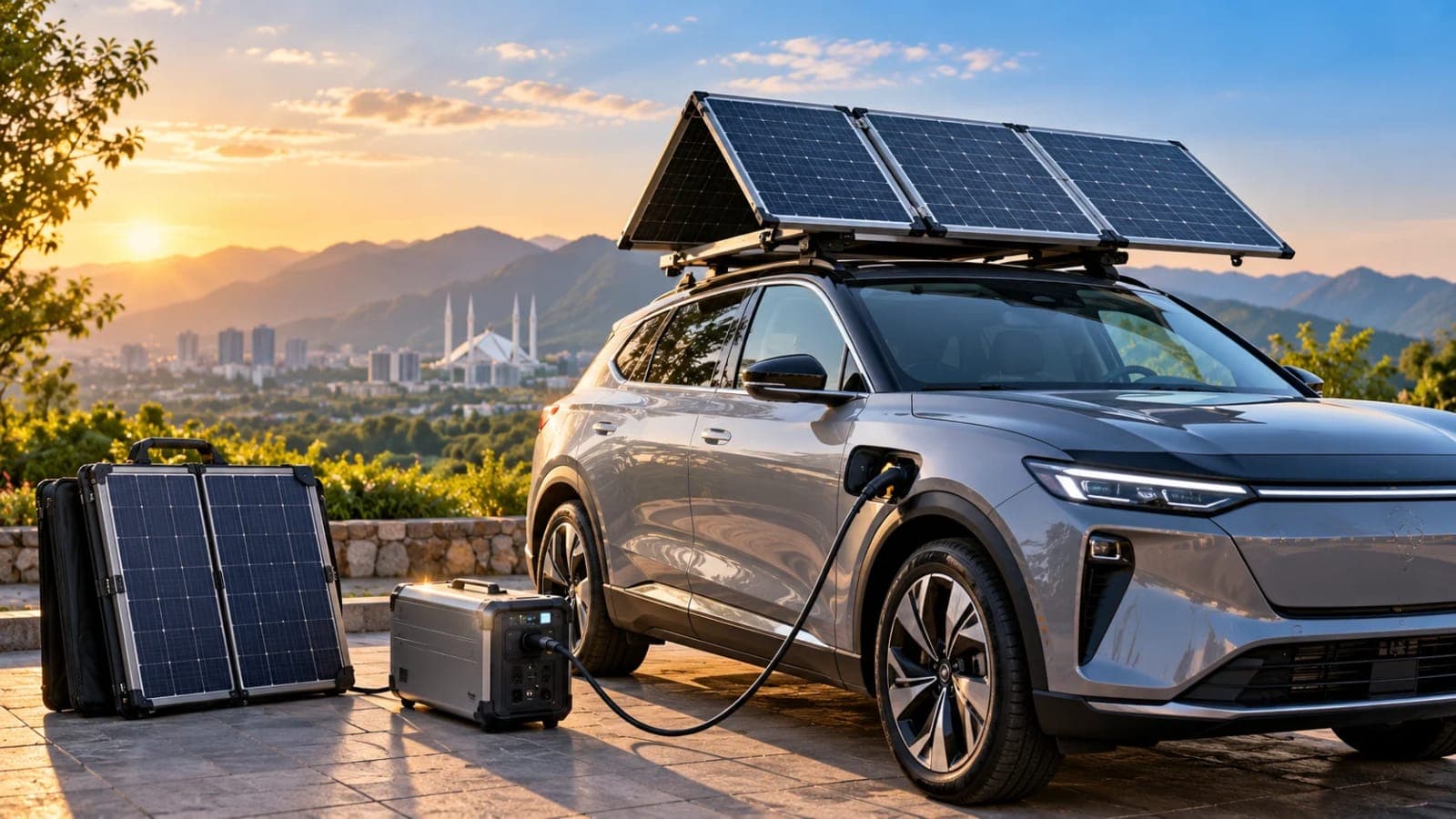
A rooftop solar charging system is attracting attention after an electric vehicle owner reported using sunlight to meet his entire vehicle charging requirement for two weeks.
The technology, known as the GoSun EV Solar Charger, uses foldable solar panels mounted on a vehicle's roof to collect energy and store it in a portable battery before transferring electricity to the vehicle.
Michael Apple, an electric vehicle owner, demonstrated the system at the Montgomery Farmers Market while appearing with the New Jersey Electric Vehicle Association.
He said the solar charger had supplied all his vehicle charging needs during approximately two weeks of use.
According to his experience, the system added around 15 to 20 miles of driving range each day.
The manufacturer, GoSun, advertises a maximum solar output of 1,100 watts when the panels are fully deployed.
Apple reported recording a peak output of approximately 1,054 watts, bringing his observed maximum close to the company's advertised figure.
The system also includes a 2,400Wh lithium iron phosphate battery, an inverter for Level 1 EV charging, and solar panels that fold into a compact rooftop enclosure.
GoSun lists the charger at $3,999.
Although the system offers another way to obtain electricity for an electric vehicle, its actual performance depends on conditions, and the reported two-week experience should not be treated as proof that every EV owner could eliminate conventional charging.
GoSun EV Solar Charger Demonstrated in Real-World Use
The GoSun EV Solar Charger was demonstrated by Michael Apple at the Montgomery Farmers Market.
Apple appeared with the New Jersey Electric Vehicle Association and discussed his experience using the rooftop charging system.
His account provided an example of how the technology performs outside a product demonstration.
Two Weeks Without Conventional Charging
Apple said he had used the system for approximately two weeks.
During that period, he reported that the solar charger supplied all the electricity he needed to charge his vehicle.
He also said the system was adding roughly 15 to 20 miles of driving range each day.
This is an individual owner's reported experience rather than a controlled comparison involving several electric vehicles.
The report does not identify the exact vehicle model used during the demonstration.
It also does not provide the owner's total daily driving distance or a detailed charging log.
Those details remain [verify].
What Does the Demonstration Show?
The demonstration provides an example of a rooftop solar charger contributing meaningful energy to an electric vehicle.
For Apple, the amount of energy generated was sufficient to meet his charging needs over the reported period.
However, his experience does not establish that the same result will occur with every electric vehicle.
The source does not include independent performance testing across different vehicles, locations, or weather conditions.
GoSun Solar Charger Produces Up to 1,100 Watts
One of the system's main specifications is its maximum solar output.
GoSun rates the charger for up to 1,100 watts when its panels are deployed.
Apple said the highest output he had recorded was approximately 1,054 watts.
That figure is close to the advertised maximum.
Manufacturer Claim vs Real-World Output
The manufacturer's rated maximum and Apple's recorded peak are different types of information.
GoSun provides the 1,100W figure as a product specification.
Apple's 1,054W reading reflects the highest output he said he had personally observed.
The reported peak does not establish how much electricity the charger produces throughout an entire day.
Solar generation can vary over time, and the source does not provide a complete daily energy-production record.
Can the Charger Produce 1,100W All Day?
The report does not claim that the charger continuously produces its maximum rated output.
The 1,100W figure represents the stated maximum output when the system is deployed.
Apple's reported peak also does not establish continuous operation at that level.
The amount of energy available for vehicle charging depends on the electricity collected and stored by the system.
The report does not provide a daily average output in kilowatt-hours.
How the Foldable Rooftop Solar Panels Work
The GoSun system uses solar panels that can be folded into an enclosure mounted on the vehicle's roof.
When the panels are not fully deployed, they remain inside the rooftop housing.
When the vehicle is parked, the panels can be unfolded to create a larger solar array.
This design allows the solar equipment to remain mounted on the vehicle instead of requiring a separate ground-mounted installation.
Folded Position
When folded, the panels occupy a smaller area inside the rooftop enclosure.
GoSun says the system can continue generating around 200 watts while closed.
Apple also reported observing electricity generation while the panels were folded.
This is an important feature because the system does not need to remain fully deployed to collect some solar energy.
Expanded Position
When the vehicle is parked, the panels can be opened to expose a larger solar collection area.
The expanded configuration is associated with the system's maximum rated output of 1,100 watts.
The larger solar array allows the equipment to collect more energy under suitable conditions.
The source does not provide the full dimensions of the expanded panels.
It also does not describe the exact procedure required to unfold or secure them.
Can GoSun Charge an EV While Driving?
The distinction between generating electricity and charging the vehicle's main battery is important.
Apple reported that the folded rooftop system continued producing electricity while the vehicle was being driven.
However, that energy was directed into the included power station.
The report does not establish that the EV's traction battery was being charged directly during driving.
Solar Energy Collection on the Move
GoSun says the closed system can produce around 200 watts.
This means the rooftop equipment can continue collecting energy without the panels being fully expanded.
Apple's experience supports the claim that the folded panels can generate electricity.
The collected energy can be stored for later use.
Charging the Vehicle Battery
The system uses an intermediate battery and inverter.
Solar energy is first stored in the included lithium iron phosphate battery.
An inverter then supplies electricity for Level 1 EV charging.
The report therefore describes an indirect charging arrangement rather than solar panels feeding fluctuating power directly into the vehicle.
GoSun Uses a 2,400Wh LFP Battery
The charger includes a 2,400Wh lithium iron phosphate battery.
This battery is an essential part of the system's operation.
Instead of transferring changing solar output directly to the electric vehicle, the equipment stores collected energy.
The stored electricity is then supplied through an inverter.
Why Is an Intermediate Battery Used?
Solar output can change while panels are operating.
The GoSun arrangement separates solar collection from the electricity delivered to the vehicle.
The included battery acts as an energy storage component.
This allows the system to collect electricity before it is used for vehicle charging.
The source does not provide the battery's usable capacity after conversion losses.
It also does not identify the battery's cycle-life rating or warranty.
Those specifications remain [verify].
Level 1 EV Charging
The report identifies Level 1 charging as the method used to transfer energy to the vehicle.
The inverter supplies the electricity needed for that charging process.
The source does not specify the exact charging voltage, current, connector type, or compatibility requirements for individual vehicle models.
It would therefore be inaccurate to claim universal compatibility with every electric vehicle without additional technical confirmation.
How Much Extra EV Range Can the Charger Provide?
GoSun advertises the ability to add up to 20 miles of driving range per day under suitable conditions.
Apple's reported experience was broadly consistent with that claim.
He said the system added approximately 15 to 20 miles of range each day.
Daily Range in Kilometers
The reported distances are approximately equivalent to:
| Reported distance | Approximate kilometers |
|---|---|
| 15 miles | 24.1 km |
| 20 miles | 32.2 km |
These are distance conversions, not separate driving-test results.
The actual additional range would depend on how efficiently a particular electric vehicle uses the electricity collected by the charger.
The source does not provide a vehicle-by-vehicle comparison.
Can Solar Charging Replace Plug-In Charging?
Apple said the system met his charging requirements for two weeks.
That result demonstrates what was possible for his reported use.
However, it does not prove that the system can replace conventional charging for every driver.
The report does not identify his exact daily energy consumption.
It also does not provide sufficient information to calculate whether the same result would be possible for drivers covering substantially greater distances.
The technology should therefore be understood as a potential supplementary charging option, with the possibility of meeting some drivers' daily needs under suitable conditions.
GoSun EV Solar Charger Price
GoSun lists the EV Solar Charger at $3,999.
This is the price stated in the October 15 report.
The source does not specify a Pakistani retail price.
It also does not confirm local availability, import charges, or installation costs for Pakistan.
Is the Charger Available in Pakistan?
The report does not announce an official launch in Pakistan.
It also does not identify an authorized Pakistani distributor.
Local availability remains [verify].
Pakistani EV owners interested in the technology would need confirmed information about vehicle compatibility, installation requirements, and local purchasing options.
Does the Price Include Installation?
The source identifies the listed price but does not provide a detailed breakdown of installation charges.
It also does not specify whether every required accessory is included in the advertised amount.
Those details remain [verify].
GoSun EV Solar Charger Specifications
| Specification | Reported information |
|---|---|
| Product | GoSun EV Solar Charger |
| Maximum deployed solar output | 1,100W |
| Highest output reported by Apple | 1,054W |
| Folded output | Around 200W |
| Included battery | 2,400Wh |
| Battery chemistry | Lithium iron phosphate |
| Vehicle charging method | Level 1 through inverter |
| Manufacturer's daily range claim | Up to 20 miles |
| Owner-reported daily range | 15–20 miles |
| Installation location | Vehicle roof |
| Mounting requirement | Compatible roof crossbars |
| Listed price | $3,999 |
| Pakistan availability | [verify] |
The reported specifications show how the product combines rooftop solar collection, energy storage, and vehicle charging.
They also highlight the difference between maximum solar output and the amount of additional driving range that can be achieved.
Frequently Asked Questions
1. What is the GoSun EV Solar Charger?
It is a rooftop solar charging system that uses foldable panels, an included battery, and an inverter to provide electricity for Level 1 EV charging.
2. How much driving range can the charger add?
GoSun claims up to 20 miles per day under suitable conditions. Michael Apple reported receiving approximately 15 to 20 miles of additional range daily.
3. Can it generate electricity while the vehicle is moving?
Yes. The report says the folded rooftop panels can continue generating electricity and charging the included power station while the vehicle is being driven.
4. How much does the GoSun EV Solar Charger cost?
GoSun lists the product at $3,999.
5. Can the system charge every electric vehicle?
The report does not provide a complete vehicle compatibility list. The system uses Level 1 charging and requires compatible roof crossbars for mounting, so compatibility should be confirmed before purchase.
Conclusion
The GoSun EV Solar Charger offers a way for electric vehicle owners to collect solar energy using equipment mounted on their vehicles.
Michael Apple's reported two-week experience provides an example of the system supplying enough electricity to meet one driver's charging needs.
The technology combines foldable rooftop solar panels, a 2,400Wh LFP battery, and an inverter for Level 1 EV charging.
GoSun advertises up to 1,100W of deployed solar output and as much as 20 miles of additional daily driving range under suitable conditions.
Although the technology offers an alternative source of charging energy, its effectiveness will depend on individual use and operating conditions.
The reported $3,999 price and the absence of confirmed Pakistani availability are also important considerations for potential buyers.
What This Means
The GoSun rooftop solar charger could reduce reliance on conventional EV charging for drivers whose daily energy needs can be met through solar generation.
Its reported performance is promising, but vehicle compatibility, local availability, and real-world results still require individual verification.
What happens next for tech
We will keep this page updated as the story develops rather than publishing a near-duplicate at a new address. Follow Tech for related coverage.
Get the Verified Brief
One email each morning with the stories we checked overnight.
Spotted an error? Read our corrections policy and tell the newsroom.