
Quail Farming Emerges as Growing Business in Punjab
Quail farming in Pakistan is emerging as a profitable niche business in Punjab, with hotels in Lahore, Gujranwala and Multan driving demand. Meat sells at Rs1,450 per kg.

By News Desk · Verified Pakistan News Desk
Published · Updated · 5 min read
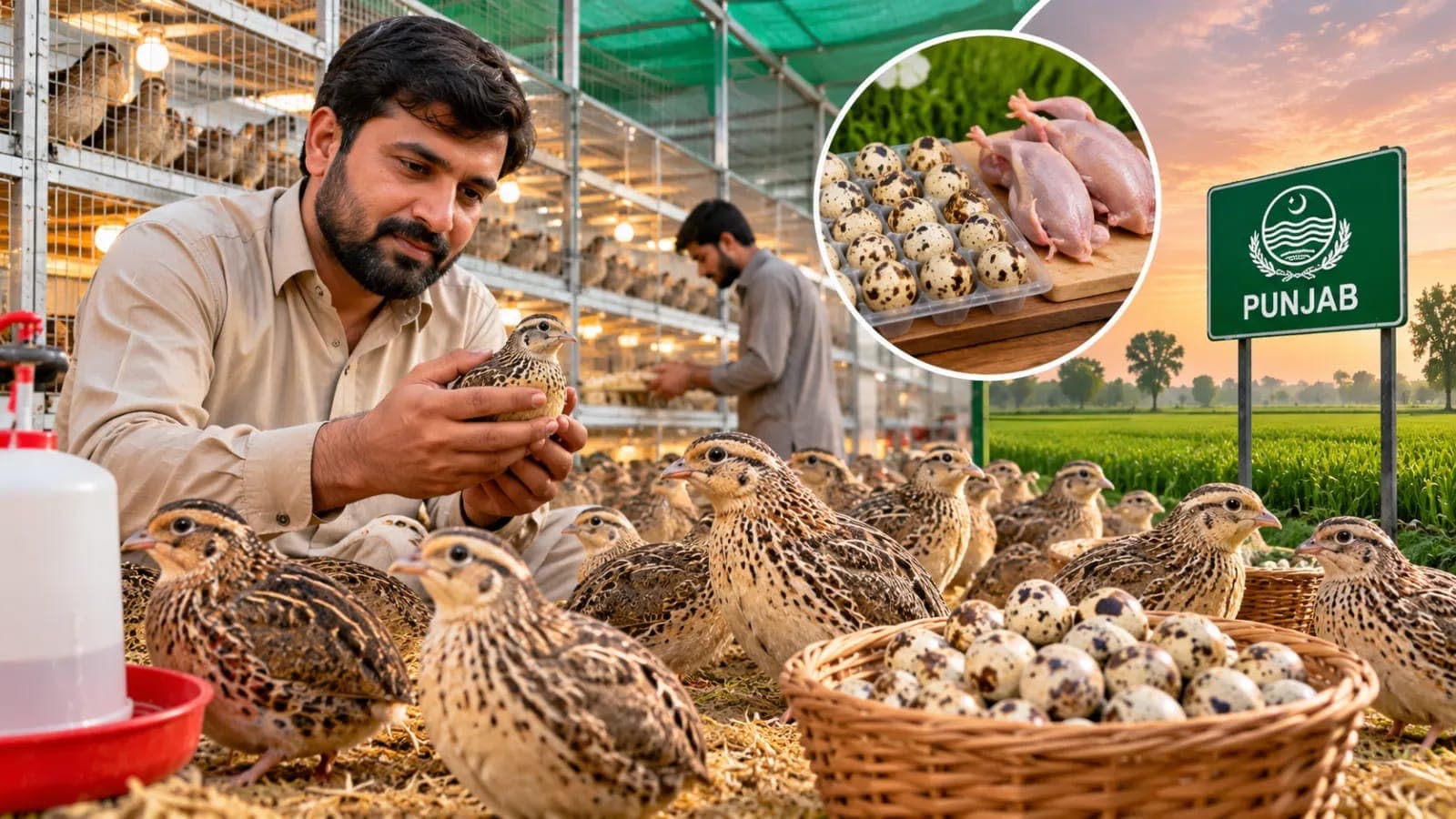
Quail farming in Pakistan is emerging as a profitable niche livestock business in Punjab, where rising demand from hotels and restaurants is drawing in farmers with its short production cycle, low space requirements and relatively modest start-up costs.
Farmers are setting up small-scale quail farms in rural and suburban areas as eateries in Lahore, Gujranwala and Multan look for steady supplies of quail meat.
"Quail meat is considered a luxury food item and is mainly consumed in major urban centres, where people have greater purchasing power," said Dr Faizan Rashid, who runs a quail farm in Pattoki, near Lahore.
Quail farming in Pakistan: why farmers are switching
Despite having a nutritional profile comparable to mutton, quail meat costs almost half as much as lamb, which is exactly why it is finding buyers.
Speaking to Wealth Pakistan, Dr Rashid said quail meat is selling for around Rs 1,450 per kilogram, against Rs 2,400 per kilogram for mutton. That makes it a comparatively affordable option for consumers looking for specialty meat.
Dr Rashid said quail farming needs substantially less investment than conventional poultry farming, mainly because of the birds' short production cycle and limited space needs.
"A room measuring 100 square feet can accommodate up to 1,000 birds," he said.
The economics: low cost, quick returns
The numbers explain the attraction. A day-old chick costs around Rs 17, while a mature bird can fetch between Rs 70 and Rs 100, depending on its size and market demand.
Feed is the biggest recurring expense in quail production. Profitability, Dr Rashid said, largely depends on efficient flock management, feed consumption, mortality control and access to reliable buyers.
The initial rearing process, including brooding and general management, is broadly similar to conventional poultry. Temperature control is particularly important in the first few days, though quails are generally hardier and more resistant to disease.
Unlike conventional poultry, quails do not routinely need vaccination under certain farming practices, though disease prevention and veterinary care remain essential, and antibiotics can be given when prescribed for bacterial infections.
A Japanese-breed quail chick weighs around eight to nine grams at birth and can reach approximately 100 grams at maturity.
UVAS develops jumbo quail breed
Research is pushing the sector forward. The Avian Research and Training Centre at the University of Veterinary and Animal Sciences (UVAS), Lahore, has developed a jumbo quail breed to improve bird size and meat yield.
The initiative increased egg weight from 9.5 grams to 12 grams and the weight of day-old chicks from 6.5 grams to eight grams.
"The live weight of birds at 28 days of age has increased from 100 grams to 200 grams. Consequently, the dressed weight has increased from 50 grams to 100 grams," Dr Rashid said.
However, the jumbo variety has yet to win over hotel and restaurant operators, who generally prefer smaller birds for serving customers. "The UVAS breed is popular among consumers who purchase the birds and cook them at home," he added.
Experts warn: demand uncertainty remains
Dr Farhan Afzal, director of the Poultry Research Institute Punjab, called quail farming an attractive emerging business opportunity, citing compact housing, limited land requirements, early maturity and a short production cycle.
But he cautioned that uncertain demand, price fluctuations and limited access to regular buyers were holding back the sector's commercial expansion.
"These potential advantages do not automatically guarantee profitability. Reliable buyers, feed costs, chick quality, mortality rates and farm management practices determine the commercial viability of quail farming," he said.
Dr Afzal said the Punjab Livestock Department supported the sector through broader poultry research, extension services, farmer training, veterinary diagnostics and regulation, rather than through a dedicated quail-farming assistance programme.
The sector's growth, he said, depends on tackling market uncertainty, controlling production costs, improving stock quality and building a reliable value chain.
Frequently asked questions
Is quail farming profitable in Pakistan? It can be, a chick costing Rs 17 can sell for Rs 70-100 at maturity. But experts stress profitability is not automatic; it depends on flock management, feed costs, mortality control and, above all, reliable buyers.
How much does it cost to start quail farming? Start-up costs are modest compared to poultry farming. The main figures: day-old chicks around Rs 17 each, and a 100 sq ft room can house up to 1,000 birds. Feed is the biggest running expense.
How much space do quails need? Very little, a room measuring 100 square feet can accommodate up to 1,000 birds, according to farmers in Punjab.
Where do quail farmers sell their birds? Mainly to hotels and restaurants in Lahore, Gujranwala and Multan. The jumbo UVAS breed is more popular with home consumers who buy and cook the birds themselves.
Does the government support quail farming? The Punjab Livestock Department supports it through general poultry research, extension services, farmer training and veterinary diagnostics, but there is no dedicated quail-farming assistance programme.
What happens next for business
We will keep this page updated as the story develops rather than publishing a near-duplicate at a new address. Follow Business for related coverage.
Get the Verified Brief
One email each morning with the stories we checked overnight.
Spotted an error? Read our corrections policy and tell the newsroom.