
Solar Panel Money Laundering: Senate Points to Bank Staff in Rs140bn Scam
Solar panel money laundering of Rs140 billion was laid before the Senate, which now wants the State Bank governor to explain how banks let it happen.

By Suleman Mirza · Reporter
Published · 5 min read
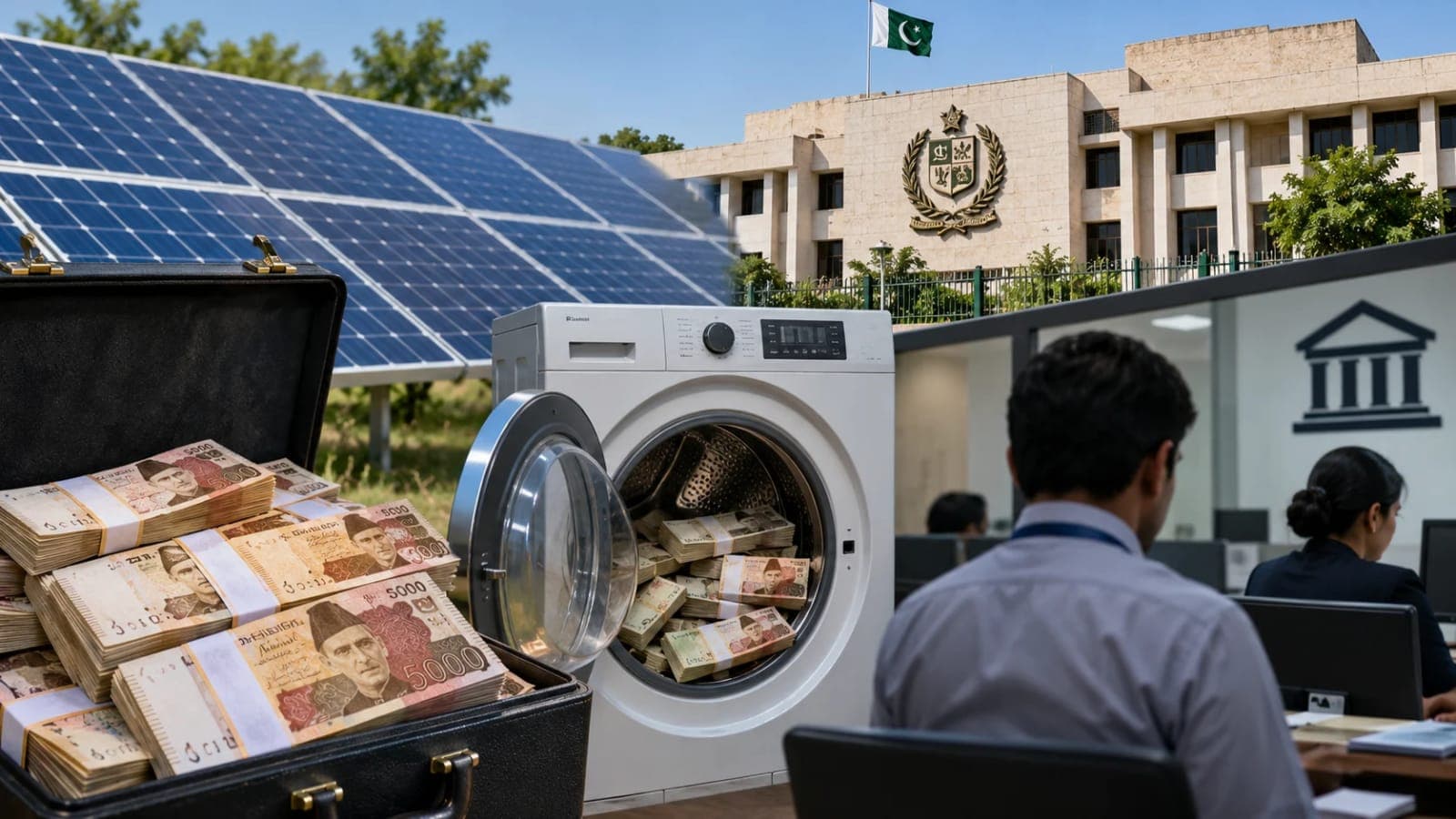
Solar panel money laundering worth Rs140 billion was discussed in the Senate on Wednesday, after the country's anti-money laundering chief told a committee that bank staff must have helped move the money.
Mushtaq Ahmed Sukhera, chairman of the National Anti-Money Laundering and Counter Financing of Terrorism Authority, told the Senate Standing Committee on Cabinet Secretariat that two brothers, Rab Nawaz and Ahmed Nawaz, used over-invoicing, a network of seven shell companies in Peshawar and Lahore, and dual transactions to launder billions of rupees. Business Recorder reported that he put the figure at Rs140 billion.
Sukhera told the committee the brothers had registered a company in Peshawar and deposited Rs120 billion in cash in commercial banks in Lahore. He said such large transactions and cash deposits could not have taken place without the involvement of banking staff.
How the solar panel money laundering worked
According to Sukhera, a wider network of solar import firms inflated the declared value of imported Chinese solar panels to Rs120 billion, against an actual landed value of about Rs85 billion. Panels that cost around 15 US cents per watt were declared at 35 to 70 US cents per watt, a mark-up of up to 500 percent, to move capital out of Pakistan illegally.
Over-invoicing works by declaring a higher price for imported goods than their real value. The extra money paid abroad then stays outside the country, while the goods are sold locally at their real price. In this case, the inflated declarations let the importers send billions of rupees out of Pakistan under the cover of legitimate trade.
Senate wants the State Bank governor to answer
Committee chairman Rana Mahmood-Ul-Hassan and other members said money laundering on this scale was not possible without the involvement of managers and other employees of commercial banks. They said the State Bank of Pakistan should take action against the banks and bring reforms to stop such activity.
The committee decided to invite the governor of the State Bank to its next meeting to discuss banking sector reforms, including stricter penalties for those involved and measures to curb illicit financial activity. Cabinet Division Secretary Kamran Ali Afzal said he would write to the governor to bring the matter to his attention and urge him to act against those involved.
Afzal told the committee the State Bank is an autonomous body with enough powers to monitor commercial banks, take action against them, and introduce the needed reforms.
A scandal that goes back years
Solar panel money laundering is not a new problem in Pakistan. An official inquiry into imports between 2017 and 2022 found that about 6,232 import documents were over-invoiced and around Rs69.5 billion was moved out of the country through solar panel imports.
In August 2025, the Customs Adjudication Authority imposed a penalty of Rs111 billion on 13 solar panel import companies after finding they had funnelled Rs120 billion abroad through over-invoicing. The Post Clearance Audit filed 13 FIRs against 45 people, including company owners and facilitators. In May 2026, Prime Minister Shehbaz Sharif set up a supervisory committee to monitor disciplinary action against officials who failed to detect the scam.
The Senate committee's latest hearing on solar panel money laundering shows the issue is still unresolved, and the focus has now shifted to the role of bank staff. The inquiry had found that the State Bank's inspections of commercial banks were ineffective and that banks cleared over-invoiced payments for years without proper checks.
What happens next
The State Bank governor is expected to appear before the committee at its next meeting, where members will press for action against the banks involved and for reforms in how banks check import payments. The committee also discussed other matters, including the Upper Kohistan financial scandal, in which more than Rs37 billion was withdrawn from provincial accounts.
For now, the Rs140 billion figure in the solar panel money laundering case remains a claim made by the anti-money laundering chief before the committee, not a proven finding. The committee has not named any bank or bank employee, and no bank has responded publicly to the allegation so far.
Questions people are asking
Q: What is solar panel money laundering? A: Solar panel money laundering means using fake or inflated import bills for solar panels to move money out of Pakistan illegally. Importers declare a higher price than the real one, pay the extra money abroad, and keep it there.
Q: How much money was laundered through solar panel imports? A: The anti-money laundering chief told the Senate committee that two brothers laundered Rs140 billion. An earlier official inquiry put the figure at about Rs69.5 billion for imports between 2017 and 2022.
Q: How did the importers over-invoice solar panels? A: Panels costing about 15 US cents per watt were declared at 35 to 70 US cents per watt, up to five times the real price. The declared value of the panels was shown as Rs120 billion, while their actual landed value was about Rs85 billion.
Q: What did the Senate committee decide? A: The committee decided to invite the governor of the State Bank of Pakistan to its next meeting and asked for banking reforms and stricter penalties. The Cabinet Division secretary said he would write to the governor about the matter.
Q: Were banks involved in the solar panel money laundering? A: The committee alleged that bank staff must have been involved, because such large cash deposits and transactions could not happen without their help. No bank or employee has been named, and the allegation has not been tested in court.
What happens next for business
We will keep this page updated as the story develops rather than publishing a near-duplicate at a new address. Follow Business for related coverage.
Get the Verified Brief
One email each morning with the stories we checked overnight.
Spotted an error? Read our corrections policy and tell the newsroom.