
Succession Certificate From NADRA: How Legal Heirs Apply
A succession certificate from NADRA names the legal heirs of a deceased person. This guide covers the fee, the documents, the 14 day notice period and the full process.

By Suleman Mirza · Reporter
Published · Updated · 8 min read
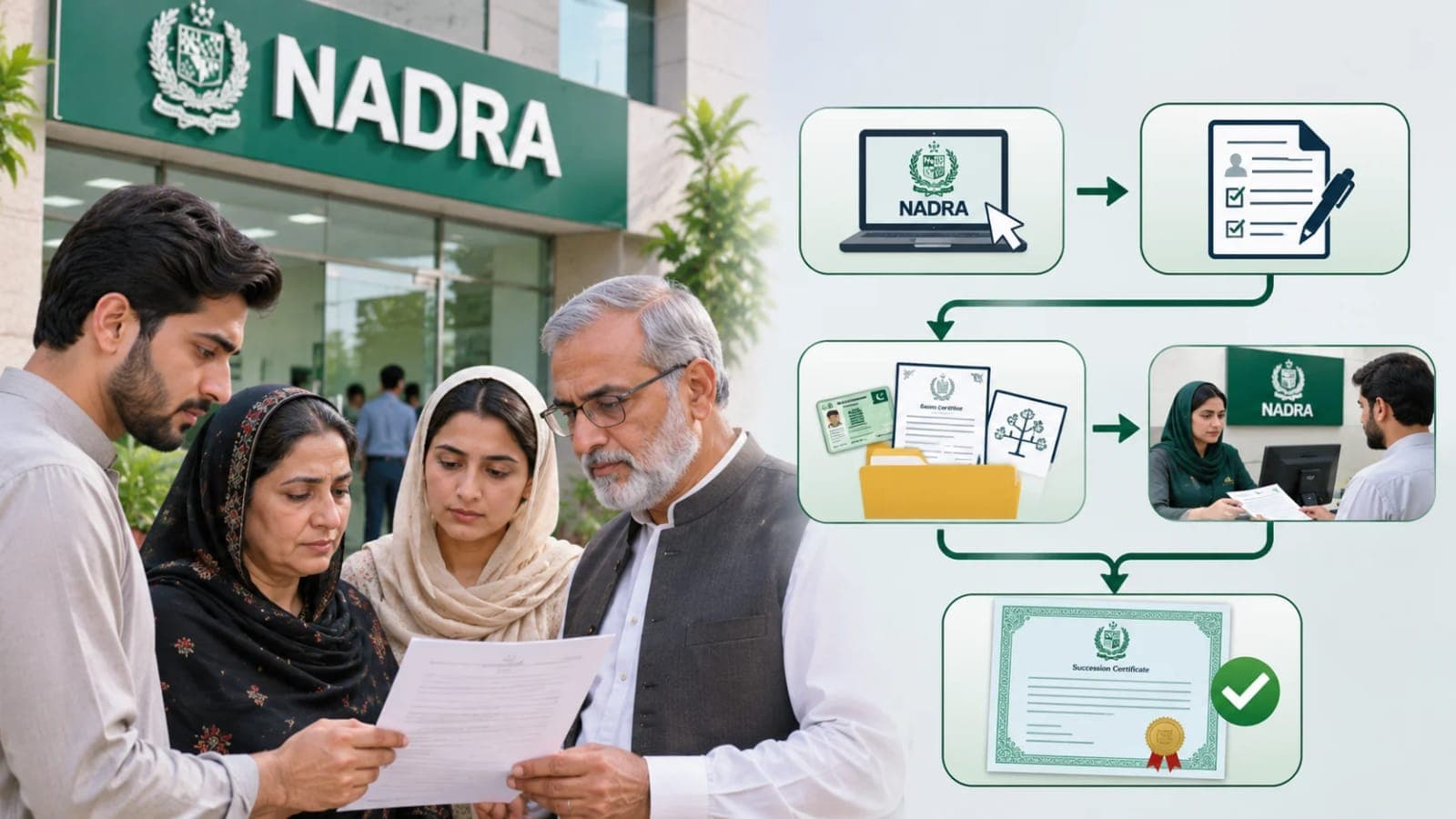
A succession certificate is the official document that names the legal heirs of a person who has died, and NADRA issues a succession certificate through its Succession Facilitation Units when all heirs agree and there is no dispute.
Families usually need this paper before a bank releases the balance of the deceased, before shares or a vehicle are transferred, and before any office accepts that the heirs are the lawful owners.
The good news is that most uncontested cases no longer need a civil court.
NADRA has handled these cases since 2021 under the Letters of Administration and Succession Certificates laws, and the process is built around its own family records.
Quick facts:
Service: Succession Facilitation Units at designated NADRA centres across Pakistan
Fee: Rs 10,000 when assets are under Rs 100,000, Rs 20,000 at or above that value, Rs 22,000 in Sindh
Public notice period: 14 days before the succession certificate is issued
Key documents: death certificate, CNIC cancellation certificate, Family Registration Certificate, CNICs of all heirs
Guidance website: succession.nadra.gov.pk, with a chatbot that builds a document checklist for your case
What a succession certificate covers
A succession certificate covers the movable assets of the deceased.
That means bank balances, savings certificates, shares, prize bonds, vehicles and similar property that can be moved or transferred on paper.
Land, a house or a plot is immovable property, and NADRA covers that through a second document called a Letter of Administration.
Both documents come from the same Succession Facilitation Units, and many families need the pair.
If the family only holds land, the Letter of Administration is the document to ask for first.
If the family only needs a bank account released, a succession certificate alone is usually enough.
NADRA can only act in uncontested cases.
Every legal heir must agree, no heir can be a minor or unable to decide, and the matter must not be pending in a court.
Where heirs disagree, or a minor is involved, NADRA will direct the family to the civil court instead.
Who can apply for a succession certificate
Any one legal heir can apply for a succession certificate on behalf of the whole family.
The deceased and every heir must be Pakistani citizens, and the assets must be located in Pakistan.
The applicant must visit a NADRA centre in person so the authority can record biometric verification.
In Sindh and Balochistan, NADRA routes the application through a lawyer, who appears on the family's behalf.
Heirs who live abroad are not left out.
According to NADRA, overseas heirs can complete their biometric verification online through the Pak ID facility, so one travelling heir does not hold up the whole case.
The authority checks the family tree against the Family Registration Certificate, so every heir must appear correctly in that record before the family applies.
If a name is missing from the FRC, fix that record first, because a wrong family record is the most common reason these applications stall.
Documents you need for a succession certificate
NADRA lists a short set of documents, and two of them are often missing on the first visit.
The first is the death certificate of the deceased, issued by the union council, municipal authority or cantonment board.
The second is the CNIC cancellation certificate, which NADRA issues when the deceased person's identity card is cancelled after death.
The family also needs the Family Registration Certificate, which shows how every heir is related to the deceased.
Along with it, carry a list of all legal heirs with copies of their CNICs.
You also need details of the property: bank names and account numbers, vehicle registration details, share certificates, and plot or khasra numbers for land.
Where one heir applies for everyone, NADRA asks for a letter of authorisation from the other heirs, attested by an oath commissioner.
Original property documents are checked, so bring originals rather than only photocopies.
If any heir is under 18, a guardianship certificate from the court is needed, and such cases usually move to the court route anyway.
NADRA's revamped succession website now offers a free chatbot in Urdu and English.
It asks a few questions about the deceased, the heirs and the assets, then produces the exact steps and document list for that case.
It also warns the family early if the case belongs in court.
How the application moves, step by step
First, register the death and get the CNIC of the deceased cancelled, because both certificates come from that step.
Second, visit a NADRA centre that runs a Succession Facilitation Unit and submit the application with the fee.
NADRA says the service is available at these designated centres across the country, regardless of where the property sits.
Third, complete biometric verification for the heirs, in person or through Pak ID for heirs abroad.
Fourth, NADRA publishes a public notice of the application on its portal and in newspapers, and waits 14 days for any objection.
Sindh requires three newspaper advertisements, while other jurisdictions require two.
If nobody objects within that period, NADRA issues the succession certificate to the heirs.
Reports put the total processing time at roughly 15 to 30 days for a straightforward case, most of it taken by the notice period.
Families claiming a share of family land in Punjab face a related but separate process, explained in our guide to how women can claim their inheritance share in family land online.
Once you hold the certificate, the land record itself can be checked through the Punjab Land Records Authority, as explained in our online fard check guide.
Fee for a succession certificate and what changes it
The fee depends on the total value of the assets in the application.
For assets under Rs 100,000, NADRA charges Rs 10,000.
For assets of Rs 100,000 or more, the fee is Rs 20,000, and Rs 22,000 in Sindh.
A duplicate certificate costs less, and a declined application can still carry a processing charge, so check every paper before you file.
Fees are set by NADRA and can change, so confirm the current amount at the centre or on the succession website before you pay.
Even at the higher slab, the NADRA route is far cheaper than a contested court case with lawyer fees on top.
Succession certificate, Letter of Administration and the court
These three routes confuse many families, so here is the simple split.
A succession certificate from NADRA covers movable assets when the heirs agree.
A Letter of Administration from NADRA covers immovable property such as land and houses, again only when the heirs agree.
A civil court handles everything else: disputes between heirs, cases with minor heirs, and matters already under litigation.
The court route takes longer and costs more, but its orders carry the same legal force.
If NADRA refuses your case, the refusal is not the end of the road.
It simply means your case needs a judge, and the documents you gathered for NADRA will still serve you in court.
Questions people ask about the succession certificate
How can I get a succession certificate in Pakistan?
One legal heir applies at a NADRA Succession Facilitation Unit with the death certificate, CNIC cancellation certificate, FRC and the heirs' CNICs. NADRA publishes a public notice, waits 14 days for objections, and then issues the succession certificate if the case is uncontested.
What is the NADRA fee for a succession certificate?
The fee is Rs 10,000 when the assets are worth under Rs 100,000 and Rs 20,000 when they are worth Rs 100,000 or more. In Sindh the higher slab is Rs 22,000. Confirm the current fee before applying, because NADRA can revise it.
Does a succession certificate cover land and houses?
No. A succession certificate covers movable assets such as bank balances, shares and vehicles. Land and houses need a Letter of Administration, which NADRA issues through the same units in uncontested cases.
How long does NADRA take to issue a succession certificate?
The public notice period alone is 14 days, and reports put the full process at about 15 to 30 days for a simple case. Disputes, missing documents or a wrong FRC record can make it longer.
Can NADRA refuse to issue a succession certificate?
Yes. NADRA only handles uncontested cases where all heirs agree and no heir is a minor. If heirs dispute the shares, or the matter is already in court, the family must apply to the civil court instead.
What if one heir lives abroad?
The case can still move. NADRA allows heirs living abroad to complete biometric verification online through the Pak ID facility, and the applicant in Pakistan can file with an attested letter of authorisation from the other heirs.
What happens next for national
We will keep this page updated as the story develops rather than publishing a near-duplicate at a new address. Follow National for related coverage.
Get the Verified Brief
One email each morning with the stories we checked overnight.
Spotted an error? Read our corrections policy and tell the newsroom.