
Domicile Certificate in Pakistan Fees Documents and Process
A domicile certificate proves your district in Pakistan. This guide covers the fee, documents and province wise process for Punjab, Sindh, KP and Balochistan.

By Suleman Mirza · Reporter
Published · Updated · 8 min read
When a government job, a university admission or a provincial quota seat asks for proof of where you belong, most people in Pakistan reach for one paper first. A domicile certificate is that paper.
It states the district and province you belong to, and offices across the country treat it as the standard proof of local residence and origin. If you have never applied for one, the process can look confusing, because each province runs it a little differently. This guide walks through the domicile certificate process in plain words, so you know what to carry, where to go and what to expect before you leave home.
Who needs a domicile certificate
Students need it for admission on a provincial or district quota, and for scholarships that are reserved for residents of a certain area. Job seekers need it for government posts where a provincial or district quota applies, and for some jobs in public sector banks and corporations.
Parents often apply for a child when the child turns 18, or when a CNIC is being made, because the CNIC record and the domicile should agree. People who have moved to a new city sometimes need a fresh one, because the certificate is tied to the district where you and your family live, not to the city where you happen to work for a few months.
Documents required for a domicile certificate
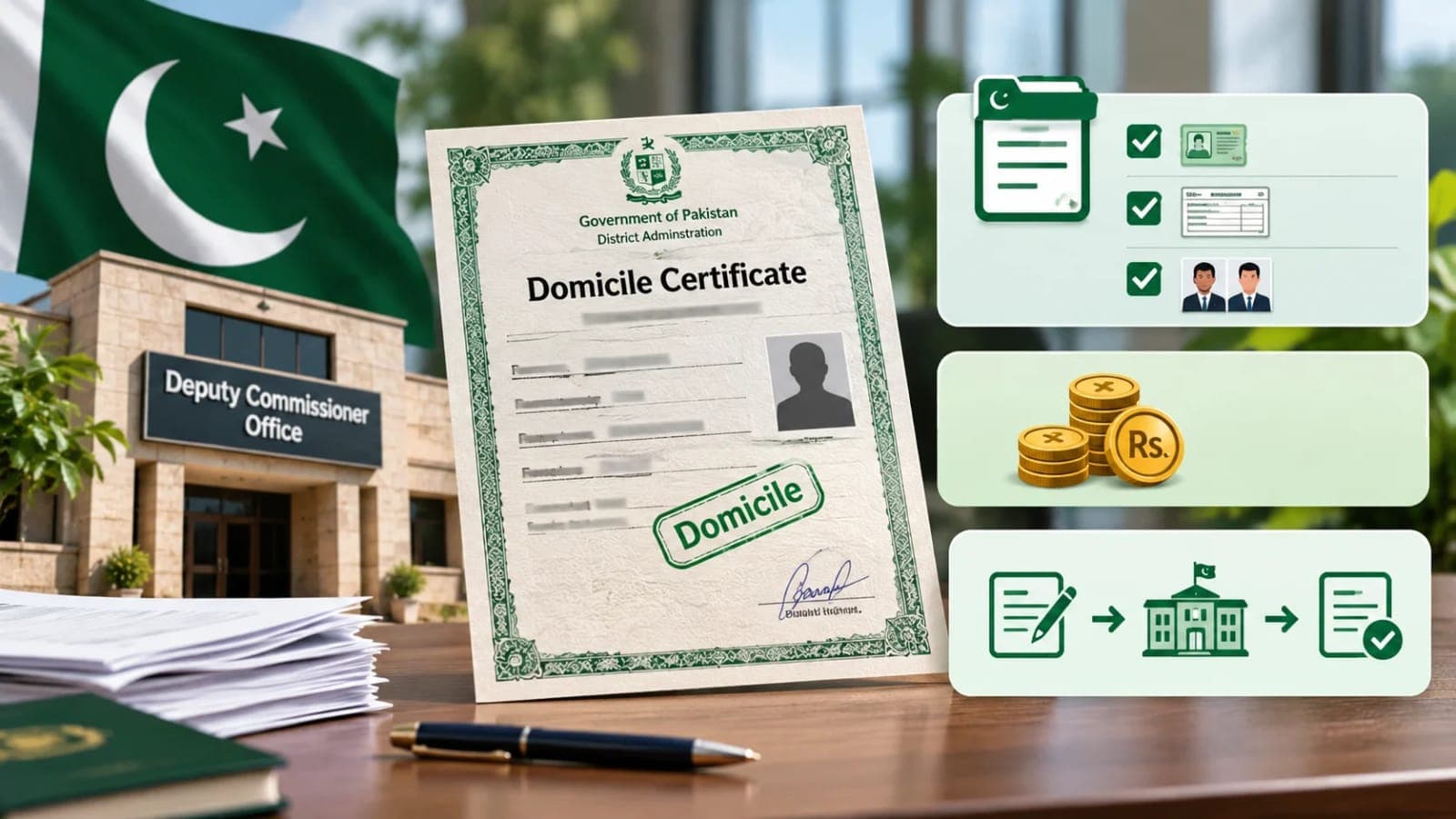
Offices ask for the same core papers almost everywhere, so gather these before you go. A copy of your CNIC, or your B-Form if you are under 18, comes first. You will also need your father's CNIC copy, and your mother's CNIC copy where the office asks for it.
Bring two recent passport size photographs, a copy of your birth certificate where you have one, and proof of residence such as a utility bill, a rent agreement or a property paper in your name or your father's name. Students should also carry their school or college leaving certificate, because it shows where you studied, and that helps the office confirm your district.
- CNIC copy, or B-Form for applicants under 18
- Father's CNIC copy, and mother's CNIC copy where asked
- Two passport size photographs
- Birth certificate copy, where available
- Proof of residence, such as a utility bill or rent agreement
- School or college certificate for students
Take the originals with you as well as the copies. The officer at the counter will check the originals, stamp the copies and hand the originals back.
If a paper is missing, most offices will tell you on the spot and give you a token or a date to return, so a second trip is common. It is better to go with a full file than to argue at the counter, because the verification depends on what you can show that day.
How to apply in Punjab
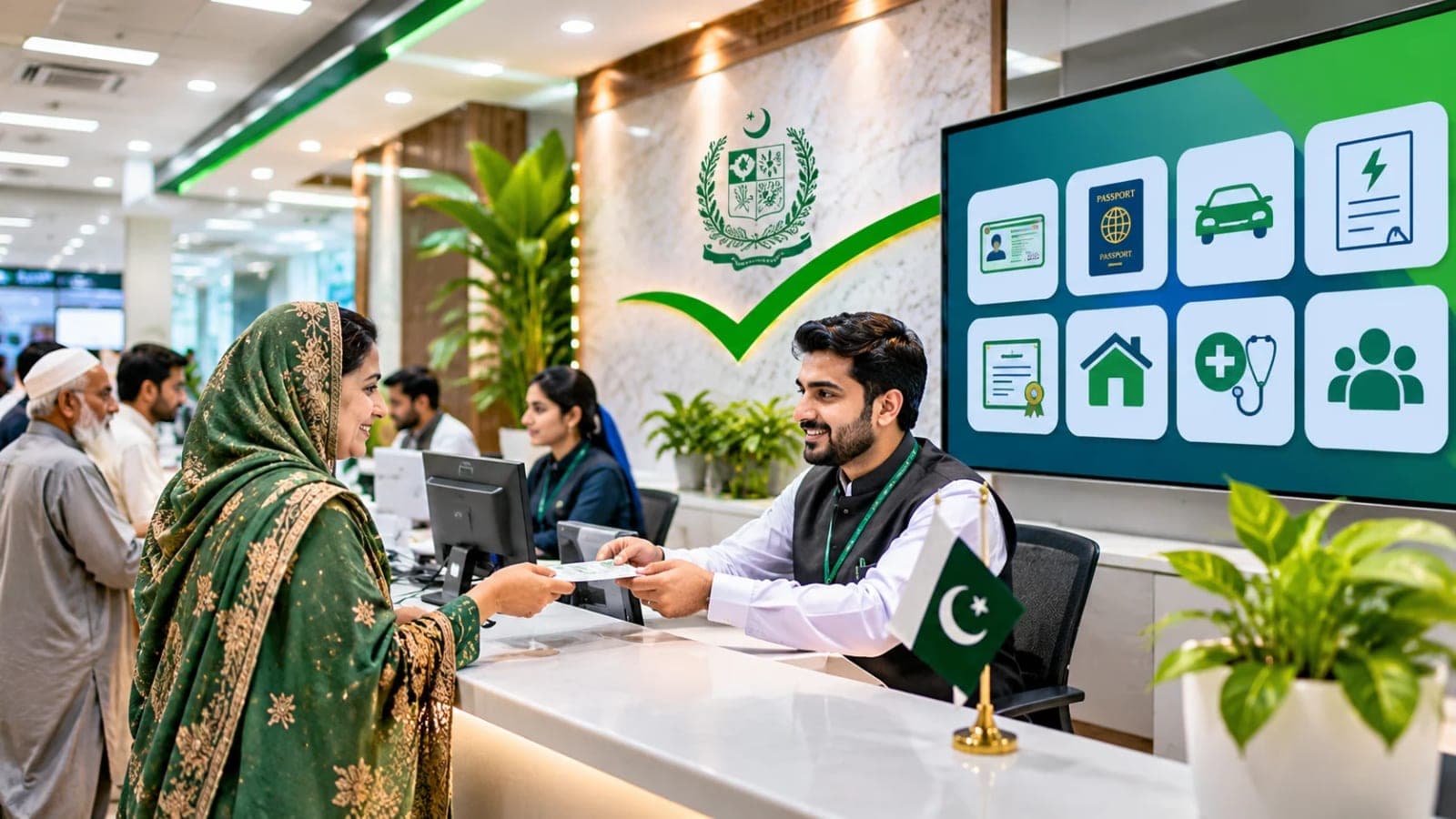
In Punjab, most people apply through an e-Khidmat Markaz or the office of the deputy commissioner of their district. At an e-Khidmat centre, you submit the form and the documents at one window, pay the fee at the counter and receive a receipt with a tracking number.
The centre then sends your domicile certificate file to the deputy commissioner's office for verification. In districts without a nearby centre, you can go straight to the deputy commissioner's office and submit the same file there. Ask at the reception which window handles domicile cases, because the room changes from district to district, and the queue is shorter in the morning.
How to apply in Sindh, Khyber Pakhtunkhwa and Balochistan
Sindh runs the process through the deputy commissioner's office, and in Karachi through the relevant district office. You submit the form with your documents, the office checks your residence record, and your domicile certificate is issued after verification.
In Khyber Pakhtunkhwa, the deputy commissioner's office handles applications in the same way, and applicants in some districts can start the process at a citizen facilitation centre. In Balochistan, the deputy commissioner's office is again the main office, and applicants from far off districts should allow extra days for the file to move between offices. Wherever you apply, keep your receipt safe, because it is the only proof that your file is in the system.
Domicile certificate fee and processing time
The fee for a domicile certificate is set by the province, so it is not the same everywhere, and it can change. In most districts it is a modest amount, usually a few hundred rupees, paid at the office counter or at the e-Khidmat centre when you submit the file.
Always ask for a printed receipt and check the amount on it before you leave. Do not pay anyone who offers to speed up the file for extra money, and do not hand your original documents to a person outside the office. If an office quotes a fee that sounds far higher than what other applicants paid, ask to see the fee notice on the wall or the printed schedule at the counter.
Processing usually takes from a few working days to two or three weeks, depending on how busy the office is and how quickly your residence is verified. Punjab e-Khidmat centres often give a date on the receipt, and that date is a fair guide.
You can collect your domicile certificate in person on the date given, with your receipt and your CNIC. If the date passes and you hear nothing, go back with your receipt and ask at the same window. Do not start a new application while the first one is still in the system, because two files for the same person can slow both of them down.
Domicile certificate and PRC, what is the difference
In Sindh, people often hear two names, domicile and PRC, which stands for Permanent Residence Certificate. A domicile certificate says which district you belong to. A PRC says you are a permanent resident of Sindh, and it is often asked for with the domicile when you apply for a Sindh government job or a seat on the Sindh quota.
In Punjab, Khyber Pakhtunkhwa and Balochistan, the domicile on its own is usually enough, and there is no separate PRC in common use. If a job advertisement in Sindh asks for both, apply for both at the same office, and carry the same set of documents for each.
Common problems and how to avoid them
The most common problem is a mismatch in names or dates. If your father's name is spelled one way on your CNIC and another way on your school certificate, the office may stop the file and ask for a correction first.
Check every paper before you go, and get small errors fixed at NADRA or at your school before you apply. The NADRA CNIC fees guide on this site explains what a CNIC correction or renewal costs. Another common problem is a wrong district. People who were born in one district and grew up in another sometimes apply where they were born, when the office wants the district where the family lives now. If your family moved years ago, use your current district and your current proof of residence.
Lost receipts cause trouble too. Without a receipt, the office has to search for your file by name, and that can take days. Take a photo of the receipt on your phone as soon as you get it, and keep the paper copy in a safe place.
If your certificate has a spelling mistake when you collect it, point it out at the counter at once, because a correction is easier on the same day than after a week.
Frequently asked questions
Can I apply for a domicile certificate online? In Punjab, e-Khidmat centres take the file in person, and some districts let you track it with the receipt number. There is no single online form for the whole country, so most applicants still visit an office once to submit the papers.
How long does a domicile certificate take? Most offices take a few working days to two or three weeks. The date on your receipt is the best guide, and a busy office or a verification delay can push it to the later end of that range.
Is a domicile certificate the same as a CNIC? No. Your CNIC proves your identity, while your domicile proves the district you belong to. Many jobs and admissions ask for both, so keep them together in your file.
Do children need a domicile certificate? Children under 18 can apply with a B-Form, and many parents get one made for school admission or for a passport. The documents are the same, with the father's CNIC and proof of residence carrying most of the weight.
Sources
Facts in this guide were checked on 28 November 2026 against the Government of Punjab portal and the NADRA website.
What happens next for national
We will keep this page updated as the story develops rather than publishing a near-duplicate at a new address. Follow National for related coverage.
Get the Verified Brief
One email each morning with the stories we checked overnight.
Spotted an error? Read our corrections policy and tell the newsroom.