
How to Start a Home-Based Pickle Business in Pakistan with Rs 30,000
Start a home-based pickle business in Pakistan with Rs 30,000. Learn key costs, packaging, pricing, licensing, hygiene and selling tips for beginners.

By News Desk · Verified Pakistan News Desk
Published · 8 min read
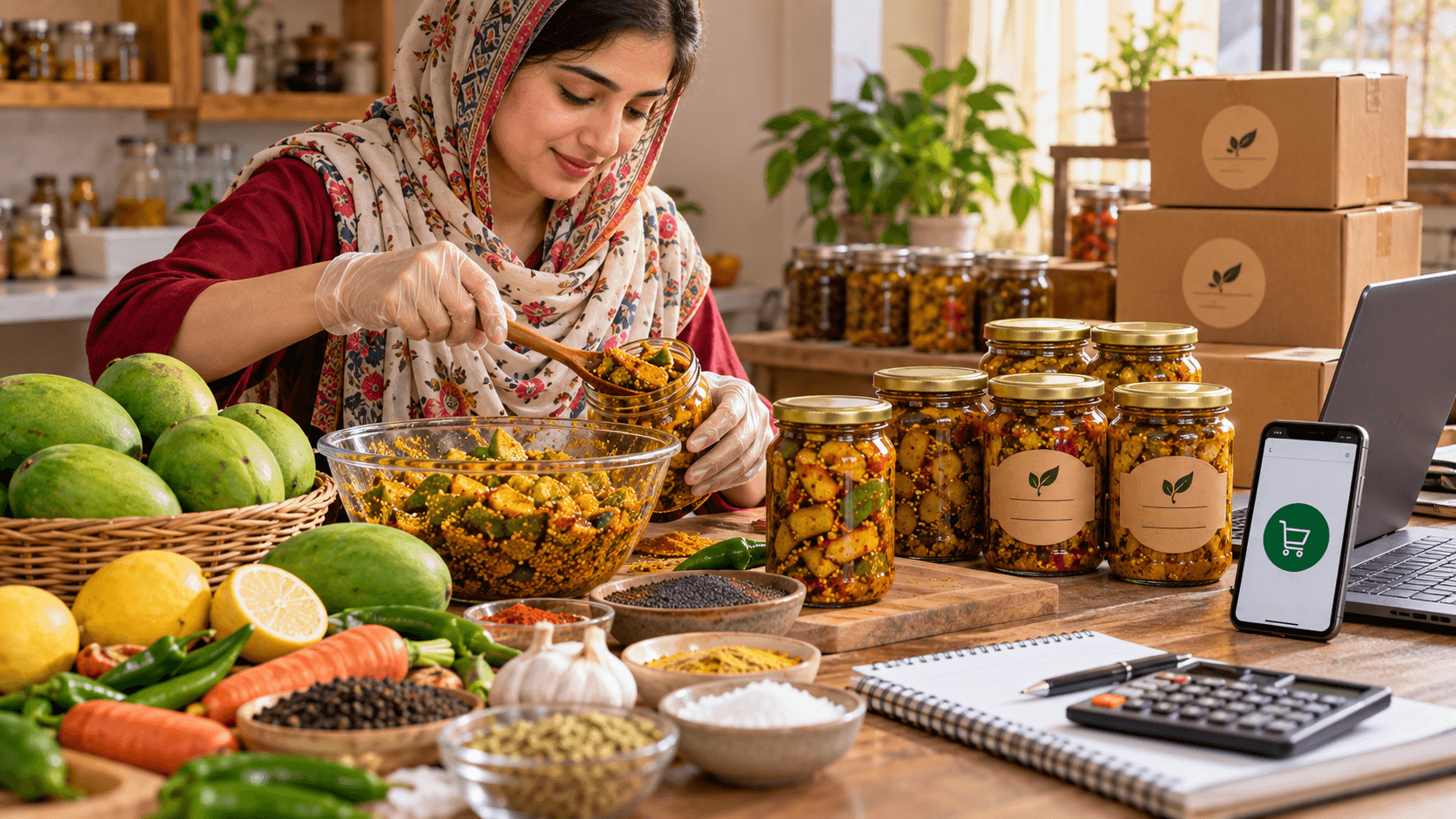
Starting a home-based pickle business in Pakistan can be a practical option for someone who loves making traditional achar and wants to earn from home without renting a shop. A small setup doesn't necessarily require expensive machinery, a commercial kitchen, or a large team.
In fact, a home-based pickle business in Pakistan can be tested on a small scale with around Rs 30,000 for ingredients, jars, basic packaging, and initial marketing. The key is to start with a limited product range, maintain consistent taste and hygiene, and avoid spending heavily before you know what customers actually want.
Here is a practical way to turn homemade achar into a small food brand.
Start With Two or Three Pickle Flavours
Don't launch ten varieties on your first day.
Start with two or three recipes that you can prepare consistently. Mango achar is an obvious choice because it already has a large customer base in Pakistan.
You could begin with:
- Mango pickle
- Mixed vegetable pickle
- Lemon pickle
Later, you can introduce chilli, garlic, carrot or other regional varieties based on customer demand.
Before selling anything, prepare small test batches and give them to friends, neighbours or potential customers. Ask about salt, spice level, oil, aroma and overall taste.
The recipe that receives the best response should become your main product.
A Sample Rs 30,000 Startup Budget
You don't need to spend the entire amount on ingredients. Packaging and marketing matter too.
A simple starting budget could look like this:
Raw mangoes, lemons and vegetables: Rs 6,000
Oil, vinegar, salt and spices: Rs 5,000
Food-grade jars and containers: Rs 6,000
Labels and basic packaging: Rs 2,500
Kitchen utensils and hygiene supplies: Rs 2,500
Photography and initial online promotion: Rs 3,000
Delivery and miscellaneous expenses: Rs 2,000
Emergency or working-capital reserve: Rs 3,000
Total: Rs 30,000
These are planning estimates rather than fixed market prices. Ingredient and packaging prices vary considerably by city, season, quantity and supplier.
Importantly, this Rs 30,000 example doesn't include every possible licensing, product-registration or laboratory expense. Check the requirements of your provincial food authority before finalising your investment.
Calculate the Cost of Every Jar
Many new sellers make one simple mistake: they look only at the cost of mangoes and spices.
Your real cost includes much more.
Suppose a 500-gram jar costs you Rs 230 after including ingredients, oil, container, label and basic packing.
Selling it for Rs 250 would leave almost no room for delivery expenses, spoiled stock, marketing or profit.
Instead, calculate:
Ingredient cost + packaging + labour + wastage + marketing + delivery contribution = actual cost
After calculating your actual cost, add a reasonable profit margin.
Maintain a simple spreadsheet or notebook showing exactly how much each batch costs. It'll become particularly useful when ingredient prices change.
Buy Ingredients in Small Quantities First
Wholesale buying can reduce costs, but don't rush into buying huge quantities.
During the first month, your goal isn't maximum production. Your goal is finding out whether people are willing to pay for your product.
Visit local vegetable markets and compare prices with wholesale suppliers. Spices can also become cheaper when purchased in larger packets rather than small retail packs.
However, quality shouldn't be sacrificed to save a few rupees.
One bad batch can damage customer trust much faster than a small saving can improve your profit.
Make Hygiene Your Biggest Priority
A pickle business is still a food business, even when production happens inside your home.
Use a clean and dedicated preparation area. Wash ingredients properly and make sure jars, utensils and working surfaces are clean.
Keep raw ingredients away from household waste and possible contamination.
Anyone handling the food should maintain good personal hygiene as well.
The Punjab Food Authority publishes dedicated standard operating procedures for different food businesses, including pickle production, which can be useful for understanding expected food-safety practices.
Check Food Business Licensing Before Selling
Food businesses in Pakistan are regulated at the provincial level, so requirements depend on where you're operating.
For example, the Punjab Food Authority provides an e-licensing system for food businesses. Its current licensing guidance says applicants generally submit an applicant photograph, CNIC images and a business image. The premises may then be verified as part of the licensing process.
Punjab's rules can also involve product registration. PFA currently states that food products being manufactured, processed, stored, packaged or sold in Punjab need registration, and its product-registration page lists a Rs 5,800 registration fee.
In Sindh, the Sindh Food Authority specifically includes pickle manufacturing among businesses that should apply for a food-business licence. Its licensing process can involve document review and inspection of the premises.
Khyber Pakhtunkhwa also has its own licensing system through the KP Food Safety & Halal Food Authority.
Therefore, don't assume that operating from home automatically removes licensing or registration requirements. Check your province's latest rules before commercial sales.
Create Simple but Professional Packaging
Customers see the jar before they taste the achar.
You don't need luxury packaging at the beginning, but the product should look clean and trustworthy.
Your label can include the brand name, product name, net weight, ingredients, manufacturing information, storage instructions and contact details, subject to the labelling requirements applicable to your product and province.
Pakistan Standards and Quality Control Authority lists a national standard covering the labelling of prepackaged foods, while provincial authorities can have additional requirements.
Before printing hundreds of labels, confirm the applicable requirements with your food authority.
Sell Through WhatsApp and Social Media
Your first customers don't need to come from a supermarket.
WhatsApp can be one of the easiest starting points.
Take clear photographs of your pickle jars near a window or in natural light. Create a simple price list and share it through WhatsApp Status, Facebook and Instagram.
Instead of spending heavily on advertisements immediately, try selling through your existing network first.
You could offer a small introductory bundle, such as two different pickle flavours at a combined price.
Customer reviews can then become useful social proof for future buyers.
Target Nearby Customers First
Delivery can quickly eat into the profit of a low-priced food product.
That's why starting locally makes sense.
If you're based in Lahore, for example, initially targeting customers within Lahore can make delivery easier than immediately accepting orders from every city in Pakistan.
You can gradually expand once your packaging is strong enough for courier transportation and you understand the additional delivery costs.
Offer Small Trial Jars
Someone seeing your brand for the first time may hesitate to purchase a large jar.
A smaller trial pack can solve this problem.
For example, you might offer 250g and 500g options. The smaller pack allows customers to test the flavour without spending too much.
If they like it, they can move to larger quantities on their next order.
Don't create too many sizes at the start, though. Every additional jar size increases packaging complexity and inventory requirements.
Keep Records From Day One
Even a tiny home business needs basic records.
Write down how much you spend on ingredients, packaging, deliveries and advertising. Record the number of jars produced and sold from every batch.
This helps you understand whether the business is actually profitable.
Imagine earning Rs 40,000 in sales during a month. That figure sounds impressive until you discover that ingredients, packaging, deliveries and advertising cost Rs 34,000.
Revenue isn't the same thing as profit.
Good record keeping makes pricing decisions much easier.
Reinvest Instead of Expanding Too Quickly
If your first batches sell successfully, resist the temptation to spend all the profit.
Put some money back into the business.
You could improve packaging, purchase ingredients in slightly larger quantities, add another flavour or invest in better product photography.
Growth should follow demand.
If 20 jars are selling consistently, move toward 40. If 40 sell comfortably, consider 70 or 80.
This approach reduces the risk of producing large quantities that remain unsold.
Can Rs 30,000 Really Be Enough?
Rs 30,000 can be enough to test a small home-based pickle business in Pakistan when you already have basic kitchen facilities and begin with limited production.
However, think of this amount as a starter production and marketing budget rather than a guaranteed all-inclusive business setup cost.
Regulatory fees, testing, product registration, special packaging, delivery and equipment can increase the required investment depending on your location and business model.
The smartest approach is to start small, test demand and calculate every rupee carefully.
A good recipe may bring someone to your business once. Consistent flavour, clean packaging, fair pricing and reliable service are what can turn that first buyer into a regular customer.
External Fact-Checking Sources
Punjab Food Authority — Business licensing guidance and requirements.
Punjab Food Authority — Food product registration requirements and current registration information.
Punjab Food Authority — Food-business SOPs, including pickle production.
Sindh Food Authority — Licensing requirements for food businesses, including pickle manufacturing.
KP Food Safety & Halal Food Authority — Food-business registration and licensing information.
Pakistan Standards and Quality Control Authority — Standards for prepackaged food labelling.
Last Updated: September 28, 2026
What happens next for startup
We will keep this page updated as the story develops rather than publishing a near-duplicate at a new address. Follow Startup for related coverage.
Get the Verified Brief
One email each morning with the stories we checked overnight.
Spotted an error? Read our corrections policy and tell the newsroom.