KSE-100 Plunges 1,965 Points as KP Governor's Rule Sparks Political Storm
The KSE-100 index tumbled 1,964.87 points on 12 October 2026 after the federal government imposed emergency and governor's rule in Khyber Pakhtunkhwa, wiping Rs209.7 billion off market capitalisation.

By News Desk · Verified Pakistan News Desk
Published · Updated · 7 min read
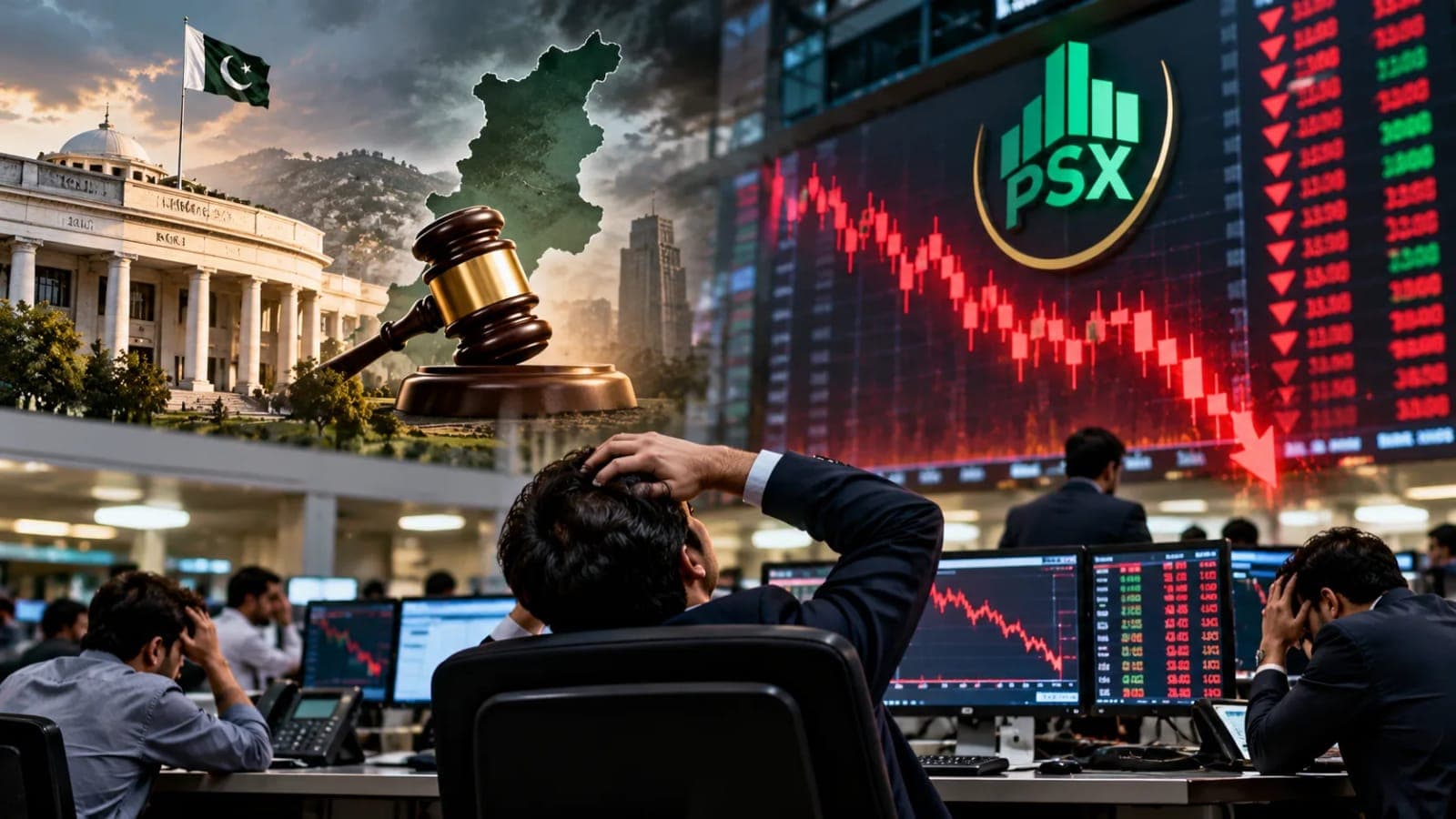
The KSE-100 index recorded a steep 1,964.87-point decline on Monday, 12 October 2026, closing at 165,124.41 after the federal government's emergency declaration in Khyber Pakhtunkhwa unsettled investors (Dawn). The benchmark lost 1.18 percent in a session that was dominated by political selling from the first minutes of trade.
The day had opened on a hopeful note at 166,988.32, but sentiment collapsed quickly. Nearly 900 points were wiped out in the opening minutes as heavyweights came under pressure.
By the closing bell, market capitalisation had shrunk by Rs209.7 billion to Rs18.359 trillion. Share volumes rose 17.3 percent to 362.95 million, while traded value dropped 6.02 percent to Rs14.508 billion, a sign that sellers were willing to accept lower prices to exit.
How the KSE-100 index fell apart on Monday
The opening shock
The early strength did not last. Selling pressure surged through the banking and energy counters, and the index gave up almost 900 points within minutes of the open.
Political selling dominated the session from the first minutes of trade. Traders described the move as pure panic, and stop-loss orders were triggered across the board.
Retail investors joined the rush to sell. Brokerage houses reported heavy volumes in smaller counters as well, though the damage stayed concentrated in the index heavyweights.
The closing picture
The benchmark ended the day at 165,124.41, down from the prior close of 167,089.28. The 1.18 percent fall marked one of the sharpest single-day declines of the year.
Losers overwhelmed gainers on the main board. The absence of any buyer interest in the final hour showed how deep the fear ran.
The rupee also felt the pressure during the day. Currency dealers said political uncertainty kept the dollar bid firm in the open market.
Why investors panicked
Governor's rule in KP
The trigger was political. On 11 October 2026, the federal government imposed emergency under Article 232 and governor's rule under Article 234 in Khyber Pakhtunkhwa. Governor Faisal Karim Kundi will run the province with the help of an 11-member advisory council.
Such a move had been discussed for weeks, but the formal announcement still caught investors off guard. Pakistan's equity market has a long history of reacting sharply to constitutional crises.
Questions remain about how long the arrangement will last and what happens next. The advisory council will assist the governor in running day-to-day affairs, but the political fog is thick.
Past episodes of political turmoil have produced similar market reactions. Each time, the index recovered once the headlines faded, but the short-term damage was severe.
PTI plans a court challenge
The Pakistan Tehreek-i-Insaf rejected the decision as unconstitutional and announced plans to challenge it in court. A legal battle now looks certain.
Markets dislike uncertainty, and a court fight between the centre and the province guarantees weeks of it. Foreign and local investors alike moved to the sidelines.
Oil prices, regional tensions and the IMF
The gloom spread beyond borders. Houthi attacks on Saudi airports and energy infrastructure raised fears of disruption around the Strait of Hormuz.
Brent crude held at $106.79 a barrel and WTI at $93.54. For an oil-importing country like Pakistan, sustained high crude prices threaten the import bill, inflation and the rupee.
Even the IMF staff-level agreement, which could release $1.2 billion for Pakistan, failed to lift the mood (Business Recorder). In calmer times, such news would have supported the market.
But political headlines drowned out the economic positive. Analysts said the episode showed how far sentiment had detached from fundamentals.
Which stocks and sectors suffered most
Banks lead the decline
Commercial banks were the single biggest drag. UBL, HBL and MEBL fell sharply as investors worried about the economic fallout of prolonged political turmoil.
Together with OGDC and Lucky Cement, five heavyweight stocks accounted for roughly 645 points of the index's fall. When index heavyweights fall in unison, the benchmark has little defence.
Cement, energy and power in the red
Cement stocks sank as traders priced in weaker construction activity. Oil and gas exploration companies fell alongside the crude-linked counters.
Oil marketing companies and power sector stocks also closed deep in negative territory. Auto assemblers joined the list of the day's worst performers.
The volume story
An interesting split emerged in the data. The number of shares traded jumped 17.3 percent to 362.95 million, yet the value of those trades fell 6.02 percent to Rs14.508 billion.
That combination means sellers outnumbered buyers and accepted lower prices to exit. It is the classic signature of a fear-driven session.
What analysts expect from here
Voices from the dealing rooms
Nawaz Ali of JS Global said the selloff was driven more by fear than by company results. Political shocks often create short-term dislocations that reverse once clarity returns, he noted.
Fawad Basir of KTrade said investors sold first and asked questions later. In his view, panic of this kind usually unwinds as soon as the political fog lifts.
Levels to watch
Saad Hanif of Ismail Iqbal Securities pointed to 165,000 as the near-term support for the KSE-100 index. A decisive break below it could invite further selling, he warned.
On the upside, any sign of political compromise could trigger a sharp relief rally. Markets have bounced hard from political selloffs many times before.
Advice for investors
Analysts advised caution over courage for now. Leveraged positions should be avoided until the KP situation becomes clearer.
Long-term investors were told to watch quality stocks rather than chase the falling knife. Cash, they said, remains a sensible position in a political storm.
Intraday traders were told to stay light. Sharp two-way moves are common in politically driven markets, and overnight positions carry extra risk.
The market will reopen on Tuesday with all eyes on Islamabad and Peshawar. Any statement from the governor's office or the PTI leadership could set the tone for the session.
Frequently asked questions
How much did the KSE-100 index fall on 12 October 2026?
The KSE-100 index fell 1,964.87 points, or 1.18 percent, to close at 165,124.41. It had opened higher at 166,988.32 before losing nearly 900 points in the opening minutes. The fall wiped Rs209.7 billion off market capitalisation.
What caused the market crash?
The main trigger was the federal government's decision to impose emergency and governor's rule in Khyber Pakhtunkhwa on 11 October 2026. The PTI rejected the move as unconstitutional and vowed to challenge it in court. Regional tensions and high oil prices added to the negative sentiment.
Which stocks dragged the KSE-100 index down the most?
Five heavyweight stocks, UBL, OGDC, HBL, MEBL and Lucky Cement, accounted for roughly 645 points of the decline. Commercial banks, cement, oil and gas exploration, oil marketing, power and auto assemblers were the worst-hit sectors.
Did the IMF agreement help the market?
No. The recent IMF staff-level agreement, which could release $1.2 billion, failed to lift investor sentiment. Political headlines completely overshadowed the positive economic development, showing how far sentiment had detached from fundamentals.
What should investors do now?
Analysts advise caution and recommend avoiding leveraged positions until political clarity emerges. The 165,000 level is seen as near-term support for the index. Long-term investors may watch quality stocks but should wait for the political fog to lift.
What happens next for business
We will keep this page updated as the story develops rather than publishing a near-duplicate at a new address. Follow Business for related coverage.
Get the Verified Brief
One email each morning with the stories we checked overnight.
Spotted an error? Read our corrections policy and tell the newsroom.