

M-6 Motorway: Two Hyderabad-Sukkur Sections Approved Under PPP
The M-6 motorway took a big step forward today as the P3A board approved two Hyderabad-Sukkur sections under PPP, cutting the journey to about three hours.

By Suleman Mirza · Reporter
Published · 5 min read
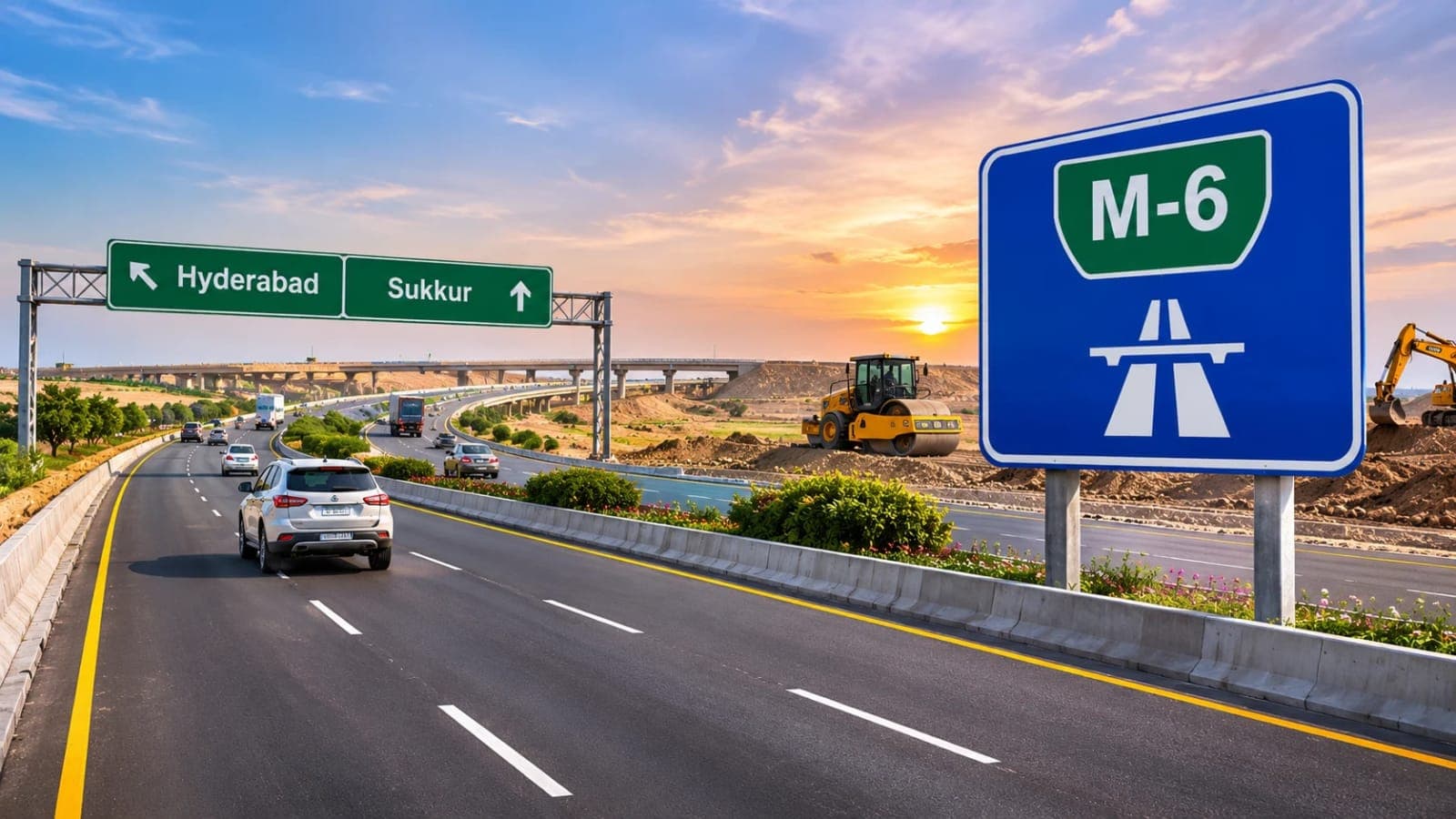
The M-6 motorway moved a step closer to construction on Wednesday after the Public Private Partnership Authority approved the first two sections of the Hyderabad-Sukkur route under a public-private partnership.
The P3A board gave the approval at its 46th meeting, chaired by Muhammad Ali, the Adviser to the Prime Minister on Privatisation and the Chairman of the Privatisation Commission, who also chairs the P3A board. The two sections cover about 121 kilometres and will be developed under separate concession agreements.
Under the approved plan, private investors will build and operate each section for 25 years and recover their investment through toll collections before handing the motorway back to the National Highway Authority. The Asian Development Bank is the transaction adviser for both sections, and the NHA will invite bids from local and foreign investors.
What the approval covers
The M-6 motorway is planned as a 306 kilometre, six-lane, access-controlled motorway from Hyderabad to Sukkur, divided into five sections. The two approved sections run from Hyderabad towards Nawabshah.
The National Highway Authority told a parliamentary committee in October that Section I, from Hyderabad to Tando Adam, is 57 kilometres long and estimated to cost about Rs81 billion, while Section II, from Tando Adam to Nawabshah, spans 63 kilometres at about Rs70 billion. The full project is estimated to cost about Rs359 billion.
Why the PPP model was chosen
The government will provide viability gap funding for Section I only, to make the project commercially viable and keep toll charges affordable for road users. The idea is to build a modern motorway without paying the whole upfront cost from the public budget.
The remaining three sections, from Nawabshah to Sukkur, are being financed through sovereign loans from the OPEC Fund and the Islamic Development Bank, and are currently in procurement. The Islamic Development Bank has signed a 475 million dollar loan agreement for Sections IV and V, while the OPEC Fund board has approved 230 million dollars for Section III, according to the NHA briefing in October.
What happens next
The NHA had told the committee in October that tendering for Sections I and II under the PPP model was planned for November 6, with bids expected by December 30 and the concession award targeted for February 4, 2027. The revised PC-I of Rs364 billion has already been approved by the Executive Committee of the National Economic Council, and land acquisition for the main motorway corridor has been completed.
Once the M-6 motorway is complete, it will link the M-9 Karachi-Hyderabad motorway with the M-5 Multan-Sukkur motorway. The journey from Hyderabad to Sukkur, which now takes about six hours by road, is expected to fall to about three hours.
Why the M-6 motorway matters for travellers and trade
The route passes through some of the busiest districts of Sindh, including Tando Adam and Nawabshah, and carries heavy passenger and freight traffic between Karachi and upper Sindh. A six-lane motorway should cut travel time and ease congestion on a stretch where the existing national highway is often crowded.
For trade, the M-6 motorway will give a faster link for goods moving between the port city of Karachi and the rest of the country. The project has faced long delays, and a Senate committee reviewed the hold-up in October, calling for a clear construction timeline.
Frequently asked questions
When will the M-6 motorway be built? The P3A board approved Sections I and II on November 18, 2026. The NHA said in October that bids are expected by December 30, 2026, with the concession award targeted for February 4, 2027. Construction dates for the other sections depend on the loan-funded procurement now under way.
How long is the M-6 motorway? The M-6 motorway is 306 kilometres long, from Hyderabad to Sukkur. It is planned as a six-lane, access-controlled motorway divided into five sections.
What is the route of the M-6 motorway? The route runs from Hyderabad through Tando Adam and Nawabshah to Sukkur. Section I covers Hyderabad to Tando Adam, Section II covers Tando Adam to Nawabshah, and the remaining three sections continue from Nawabshah to Sukkur.
How much will the M-6 motorway cost? The full project is estimated to cost about Rs359 billion, according to the NHA briefing to a parliamentary committee in October 2026. Section I is estimated at about Rs81 billion and Section II at about Rs70 billion.
Will there be tolls on the M-6 motorway? Yes. Private investors will operate each section for 25 years and recover their investment through toll collections. The government will provide viability gap funding for Section I only, to keep tolls affordable.
What about the other three sections of the M-6 motorway? Sections III, IV and V, from Nawabshah to Sukkur, are being financed through sovereign loans from the OPEC Fund and the Islamic Development Bank. The Islamic Development Bank has signed a 475 million dollar loan for Sections IV and V, and the OPEC Fund has approved 230 million dollars for Section III, the NHA said in October. These sections are currently in procurement.
What happens next for business
We will keep this page updated as the story develops rather than publishing a near-duplicate at a new address. Follow Business for related coverage.
Get the Verified Brief
One email each morning with the stories we checked overnight.
Spotted an error? Read our corrections policy and tell the newsroom.