
Pakistan Maths Scores Average 38% in Nationwide Study
Pakistan maths scores averaged 38 per cent in an AKU study, with science at 47 per cent, as researchers link the private-public gap to classroom teaching.

By Suleman Mirza · Reporter
Published · Updated · 5 min read
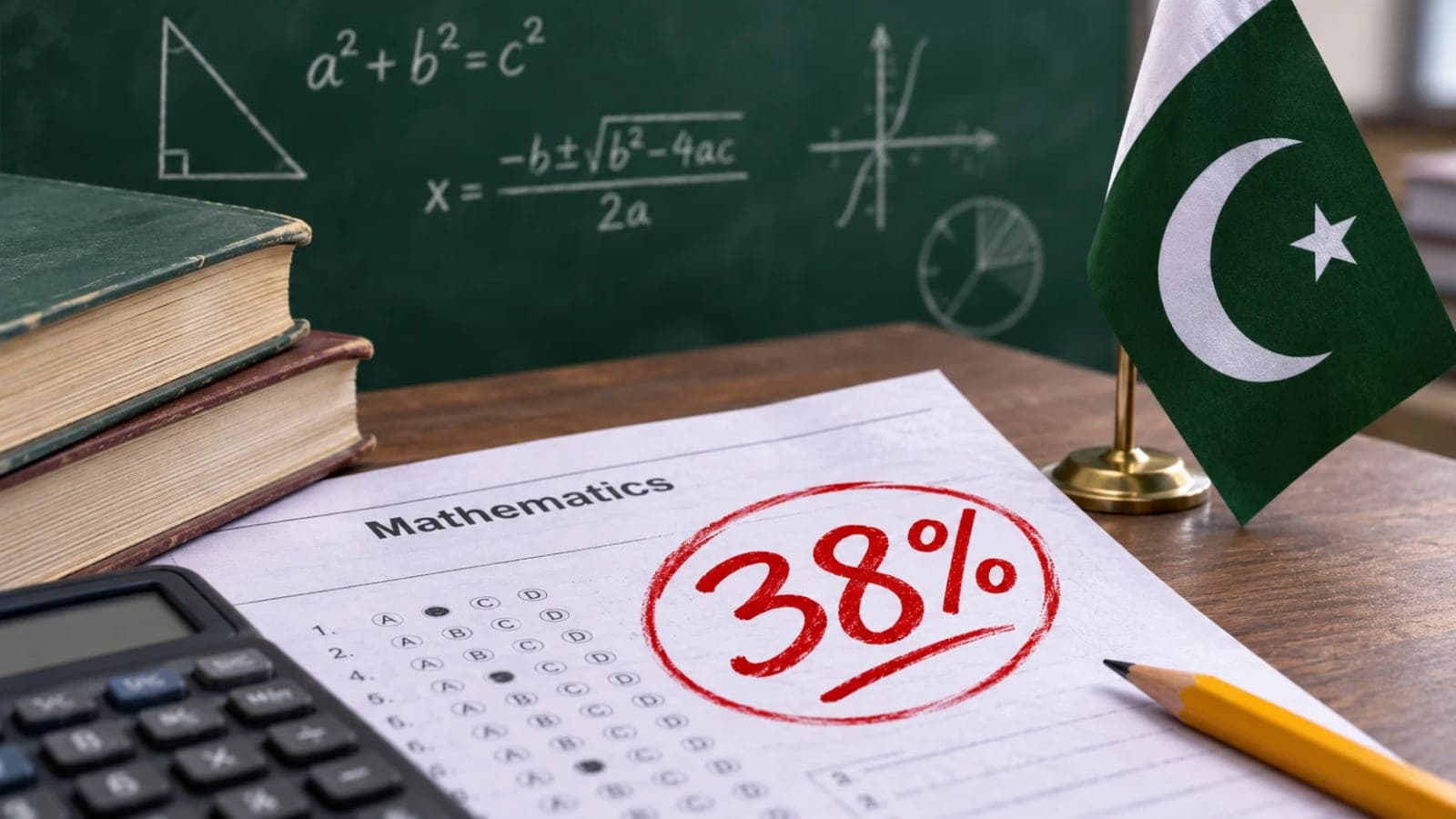
Pakistan maths scores have come in at just 38 per cent in a nationwide study, a figure that will worry any parent who has watched a child struggle with sums. Science did a little better at 47 per cent, but both numbers point to the same problem: too many children sit in classrooms without really learning the subjects that shape their future. Presented at the Aga Khan University in Karachi on Thursday, its message was blunt. The issue is not only which schools children attend, but what happens inside the classroom.
The study, Science and Mathematics Instruction and Learning Outcomes in Pakistan, was presented by the university's Institute for Educational Development at the closing of the Data and Research in Education Research Consortium, or DARE-RC, a three-and-a-half-year programme funded by UK International Development and led by Oxford Policy Management with Sightsavers International.
Researchers did not rely on exam results alone. They watched lessons as they happened, observing 436 maths and science teachers at 96 schools in six regions. A separate part used data from 3,836 pupils and 162 teachers in 36 schools to link classroom practice to test scores.
What the Pakistan maths scores tell us
The Pakistan maths scores come with a clear pattern. Private school pupils scored well ahead of their public school peers, and the researchers say part of that gap comes down to how teachers run their lessons. In the lessons observed, teachers mostly led from the front, and pupils rarely got to work through a problem or explain their thinking.
Class size made a visible difference. Classes with fewer than 40 pupils drew children into the lesson, while in crowded rooms the teacher talked and the children listened. Overcrowding, limited resources and weak guidance from school leaders made it harder for teachers to change how they taught.
Any parent of a child in a class of 50 or 60 will recognise this at once. A teacher with that many faces in front of her has little time for any one child, and a pupil who falls behind in week three can stay behind for the rest of the term.
When the Pakistan maths scores are read alongside the science result of 47 per cent, the picture stays the same. Children are not failing because the subjects are beyond them. They are falling short because the teaching rarely gives them room to practise, ask questions, or learn from mistakes.
The gap behind the Pakistan maths scores
The gap between private and public schools will draw the most debate. Researcher Sadia Muzaffar Bhutta, who led the study, and fellow researcher Sajid Ali wrote that private school students significantly outperform public school students, and that the gap is partly explained by different teaching practices in the classroom.
That wording matters. The researchers did not say private schools have better children. They said the teaching is different: private school teachers involved pupils, checked understanding as the lesson went on, and adjusted when children looked lost. Those habits can be taught in a government school just as well.
This debate sits on top of a bigger problem. The scores only cover children who are actually in school. About 25.1 million children aged 5 to 16, or 35 per cent of that age group, were out of school in 2023-24, per the Pakistan Institute of Education, from 27 per cent in Punjab to 69 per cent in Balochistan. A World Bank estimate found 80 per cent of children in Pakistan could not read and understand a simple text by age 10. The constitution promises free schooling for ages 5 to 16, yet getting children into school is only half the job. What they learn once they are there is the other half.
What the researchers say should change
One reason the Pakistan maths scores stay low is that teachers are often left to work things out alone. The study recommends lesson plans teachers can adapt to their own class, and asks school leaders to watch lessons and give honest feedback, so good practice spreads and weak practice gets fixed early.
Where schools cannot cut class sizes, the researchers suggest two teachers in a classroom, or moving staff to the schools that need them most. Both ideas cost money, but they are cheaper than a generation leaving school without the maths and science needed for college, jobs, or everyday life.
Parents can take something practical from this too. When you visit your child's school, ask how big the class is and how the teacher checks understanding. Ask to see your child's maths copy and look for worked sums, not just copied notes. If the teacher only marks right or wrong without explaining the mistake, the child needs help at home or extra support at school.
The Pakistan maths scores are a warning, but also a starting point. The study shows where teaching breaks down, and offers fixes that need no new building or curriculum: better lesson plans, smaller classes or a second teacher, and school leaders who watch lessons and help teachers improve. Those are choices the system can make now.
Frequently asked questions
What were the Pakistan maths scores in the AKU study?
The Pakistan maths scores averaged 38 per cent in the study presented at the Aga Khan University in Karachi on 26 November 2026, science at 47 per cent. It was carried out by AKU's Institute for Educational Development with its partners under the DARE-RC programme.
Why do private school pupils score higher?
Private school pupils significantly outperform public school pupils, and the gap is partly explained by different teaching practices. Private school lessons involved pupils actively, while public school lessons were mostly teacher-led, with little chance to practise or explain their reasoning.
What did the researchers recommend?
They recommended adaptable lesson plans, classroom observation and feedback from school leaders, and smaller classes. Where class sizes cannot be reduced, they suggested two teachers per classroom or moving staff where they are needed most.
What happens next for education
We will keep this page updated as the story develops rather than publishing a near-duplicate at a new address. Follow Education for related coverage.
Get the Verified Brief
One email each morning with the stories we checked overnight.
Spotted an error? Read our corrections policy and tell the newsroom.