

5G Speed in Pakistan 2026: Download, Upload and 4G Comparison
Pakistan's 5G speed in 2026 can reach hundreds of Mbps in covered areas. See download and upload speeds, 4G comparison, coverage and real-world results.

By News Desk · Verified Pakistan News Desk
Published · 7 min read
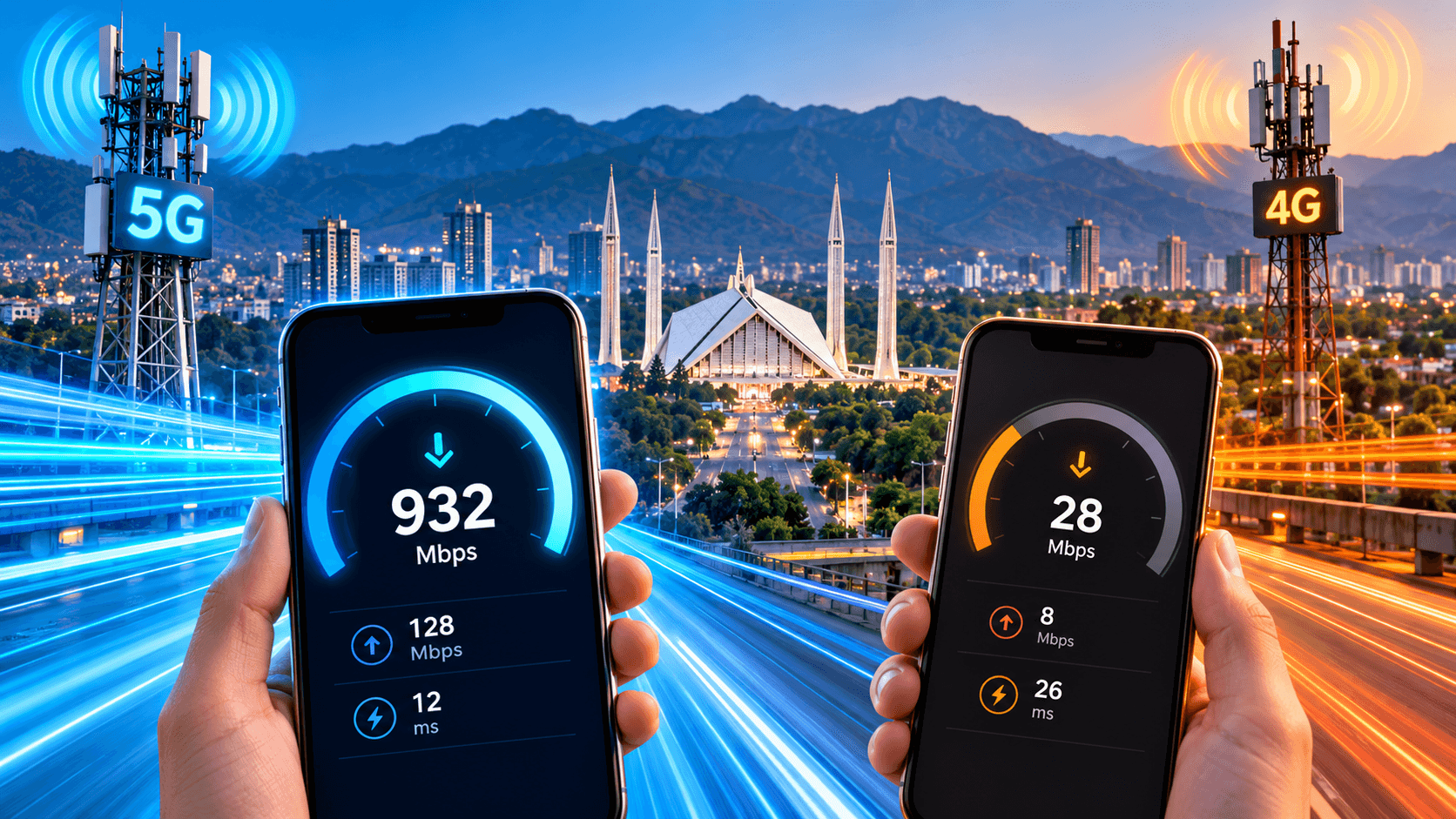
Pakistan entered the commercial 5G era in 2026, bringing faster mobile internet to users in major cities. Early 5G connections can deliver a noticeable improvement over 4G, particularly when downloading large files, streaming high-resolution video or using a phone as a mobile hotspot.
However, there isn't one fixed 5G speed for every user in Pakistan. Performance changes with the network, city, distance from the 5G site, phone model, available spectrum and the number of people using the network at the same time.
Pakistan's overall mobile internet performance has also improved during 2026. Speedtest Global Index data for August 2026 showed a nationwide median mobile download speed of 61.18 Mbps and upload speed of 13.36 Mbps. These figures cover the wider mobile network experience and should not be treated as 5G-only results.
What Is the 5G Download and Upload Speed in Pakistan in 2026?
Commercial 5G arrived in Pakistan in March 2026. Jazz announced its launch on March 19, initially making the service live at around 180 sites covering Islamabad, Rawalpindi, Lahore, Karachi, Peshawar, Quetta, Multan, Faisalabad and other important urban areas.
Zong also commercially launched 5G on March 19, saying its initial network covered more than 16 cities. The company announced plans to deploy or upgrade more than 1,000 5G sites during 2026.
So, how fast is it?
There is an important difference between maximum demonstrated speed and the speed customers normally receive. Zong says its 5G trials have crossed 1.4 Gbps, or 1,400 Mbps. That figure shows what the technology can achieve under trial conditions rather than guaranteeing that every customer will receive a 1.4 Gbps connection.
Independent community testing published during 2026 has reported median 5G downloads around 220 Mbps from submitted tests in Islamabad, Lahore and Karachi, compared with around 42 Mbps on 4G from the same operators. Reported 5G uploads were generally around 60 to 120 Mbps in that dataset. These figures are useful as an indication of early real-world performance, but they aren't an official nationwide benchmark and shouldn't be taken as guaranteed speeds.
In practical terms, a strong 5G connection can make a major difference when downloading apps, uploading videos, transferring large files or streaming 4K content. Someone getting 200 Mbps, for example, has considerably more bandwidth available than a user on a typical 10–30 Mbps 4G connection.
Upload performance matters too. Faster uploads are particularly useful for content creators, freelancers and businesses regularly sending large photos and videos or backing up files to cloud storage.
5G vs 4G Speed in Pakistan
The biggest advantage of 5G becomes clearer when it is compared with existing 4G performance.
A recent report citing PTA's Q2 2026 Mobile Network Experience Benchmarking data put Zong's average national 4G download speed at 18.55 Mbps and Jazz at 17.61 Mbps. Ufone was reported at 12.82 Mbps, while Telenor stood at 7.5 Mbps.
For uploads, the reported 4G averages were 7.81 Mbps for Zong, 6.26 Mbps for Jazz, 4.42 Mbps for Ufone and 2.82 Mbps for Telenor.
Against those 4G averages, a good 5G connection can be several times faster. The exact difference will depend heavily on where the test is conducted.
Another benefit is latency. Lower latency reduces the delay between sending a request and receiving a response. This can improve video calls, cloud applications and online gaming even when raw download speed isn't being fully used.
It is also worth remembering that 4G isn't disappearing. It remains an important part of Pakistan's mobile infrastructure and is likely to continue handling a large share of mobile traffic while operators gradually expand their 5G networks.
For users outside initial 5G coverage zones, a strong 4G signal may still provide a better experience than a weak or distant 5G connection.
Why Your 5G Speed May Be Different
Two people using the same mobile operator can get very different results, even within the same city.
Distance from the cell site is one reason. Buildings, walls and other physical obstacles can weaken the signal. Network congestion also matters. Speeds can fall during busy periods when many subscribers are connected to the same site.
Your smartphone is another factor. A device needs compatible 5G hardware and support for the frequency bands used by the operator. Simply owning a phone with "5G" in its specifications doesn't guarantee identical performance across every network.
Coverage is equally important. Pakistan's 5G rollout began with selected sites and cities rather than immediate nationwide coverage. Jazz's initial deployment covered around 180 sites, while Zong announced commercial availability in more than 16 cities at launch.
The nationwide figures also show why individual speed tests shouldn't be confused with countrywide 5G performance. Speedtest Global Index recorded Pakistan's median mobile speed at 61.18 Mbps download and 13.36 Mbps upload in August 2026. The data comes from real user tests across mobile connections, rather than representing a dedicated 5G-only measurement.
City-level results can differ as well. In August 2026, Karachi recorded a median mobile download speed of 44.09 Mbps and upload speed of 12.95 Mbps, while Lahore recorded 43.11 Mbps download and 10.29 Mbps upload. Again, these are overall mobile figures rather than 5G-only measurements.
Is 5G Worth Using in Pakistan?
For users who live or work inside a strong 5G coverage area and already own a compatible smartphone, 5G can provide a substantial speed improvement without requiring a fixed broadband connection.
The difference is most noticeable during large downloads and uploads. Downloading games, transferring video footage, backing up files and using high-resolution streaming services can all benefit from the additional bandwidth.
But 5G performance in Pakistan shouldn't be judged by a single headline speed. The network was still expanding during 2026, and availability varies significantly by location. A speed demonstrated during a controlled trial isn't the same as the everyday speed experienced by thousands of customers.
Pakistan's 5G rollout is therefore better viewed as an ongoing transition. Commercial networks are live, early users can access much faster connections in supported locations, and operators are continuing to add sites.
For consumers, the simplest way to judge the improvement is to run speed tests at the places where they actually use their phones. Comparing 4G and 5G on the same handset, network and location gives a far more useful answer than relying on advertised maximum speeds.
Frequently Asked Questions
1. What is the average 5G speed in Pakistan in 2026?
There isn't yet a single official nationwide 5G-only average covering every operator and city. Community testing has reported median downloads around 220 Mbps in selected major cities, while individual results can be much higher or lower. Pakistan's overall mobile median was 61.18 Mbps in August 2026, but that figure includes the broader mobile network and isn't a 5G-only measurement.
2. Can 5G reach 1 Gbps in Pakistan?
Yes, the technology can reach gigabit speeds under suitable conditions. Zong says its 5G trials have demonstrated speeds exceeding 1.4 Gbps. Trial results, however, shouldn't be interpreted as the speed every customer will receive in daily use.
3. Is 5G faster than 4G in Pakistan?
Yes, a strong 5G connection can provide considerably higher download and upload speeds than existing 4G networks. The size of the improvement depends on coverage, network congestion, spectrum, device capability and location.
4. Which Pakistani cities have 5G?
Commercial rollout began in major urban centres. Jazz's initial launch included Islamabad, Rawalpindi, Lahore, Karachi, Peshawar, Quetta, Multan and Faisalabad, while Zong said its launch covered more than 16 cities. Coverage within a listed city may still be limited to particular areas or sites.
5. Do I need a new SIM to use 5G in Pakistan?
A 5G-capable smartphone, compatible network service and 5G coverage are required. SIM requirements can depend on the operator and the SIM already being used, so customers should confirm compatibility with their network before replacing a SIM unnecessarily.
What happens next for tech
We will keep this page updated as the story develops rather than publishing a near-duplicate at a new address. Follow Tech for related coverage.
Get the Verified Brief
One email each morning with the stories we checked overnight.
Spotted an error? Read our corrections policy and tell the newsroom.