
Huawei's Big Push in Pakistan: Repair Centre, Support Hub, R&D Plans
The message was unmistakable: Huawei is not just selling equipment in Pakistan anymore it is investing in the country's people and its digital backbone.

By News Desk · Verified Pakistan News Desk
Published · 7 min read
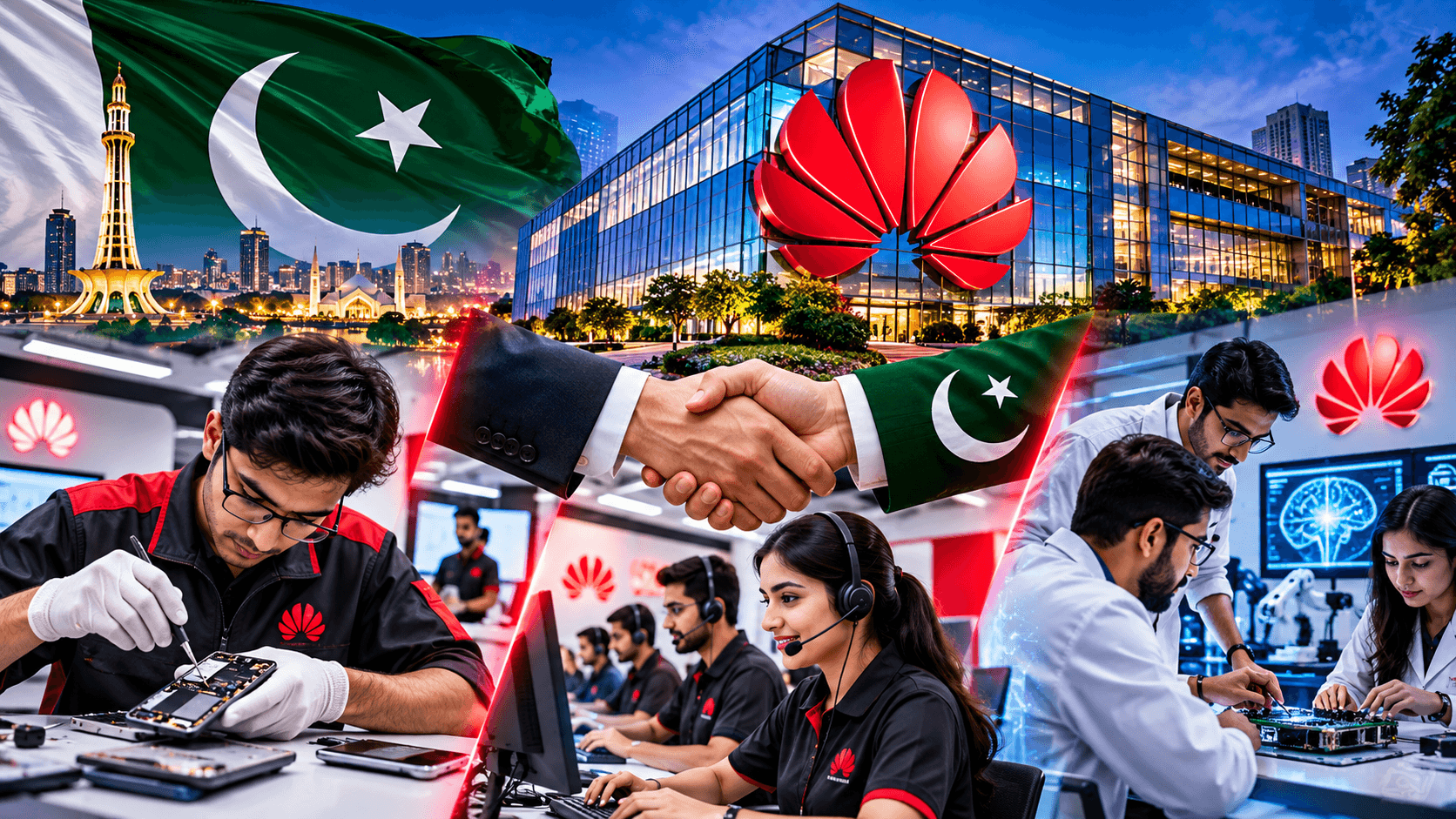
Pakistan's technology story just got a significant new chapter. IT Minister Shaza Fatima Khawaja recently inaugurated Huawei Pakistan's national-level Telecom Equipment Repair Centre in Islamabad a facility built to repair, test, troubleshoot and maintain the Huawei telecom equipment deployed across the country. The message was unmistakable: Huawei is not just selling equipment in Pakistan anymore it is investing in the country's people and its digital backbone.
The visit didn't stop at the repair centre. The minister also toured Huawei's Global Support Centre (GSC) in Islamabad, where she urged the company to go further: expand its investment and seriously explore establishing a research and development centre in Pakistan. Coming from a government that has repeatedly said it wants to turn Pakistan into a regional technology hub, the message landed with weight.
Huawei is no stranger to Pakistan. The company has been part of the country's telecom infrastructure for decades, powering the networks of major mobile operators. But this latest round of announcements suggests something bigger than business as usual. a deepening partnership between one of the world's largest technology companies and a country hungry for digital growth.
A Repair Centre That Changes the Game for Local Telecom
Until now, much of the repair and maintenance of sophisticated telecom equipment had to rely on overseas support or lengthy workarounds. The new national Telecom Equipment Repair Centre changes that equation. By providing local repair, testing, troubleshooting and maintenance under one roof, it cuts downtime for telecom operators and keeps critical network infrastructure running without depending on distant service points.
This matters more than it might sound. Every hour a piece of network equipment sits idle waiting for repair is an hour of degraded service for thousands of subscribers. Local repair capability means faster turnaround, lower logistics costs, and just as importantly. a transfer of technical knowledge into Pakistan. The engineers who staff this facility will build hands-on expertise with cutting-edge telecom hardware, skills that stay in the country long after any single repair job is done.
For Pakistan's telecom sector, which serves over 190 million mobile subscribers, reliability is everything. A domestic repair hub is the kind of quiet infrastructure investment that rarely makes headlines but genuinely moves the needle on network quality.
The Global Support Centre: Pakistan's Engineers Serving the World
The second stop on the minister's visit was Huawei's Global Support Centre in Islamabad. This facility is not just about Pakistan. it provides remote technical support, network operations, service assurance and other ICT services to international customers. And crucially, it is staffed by young Pakistani engineers.
Think about that for a moment. A global technology company is running part of its worldwide service operations out of Islamabad, powered by local talent. It is a vote of confidence in Pakistan's engineering workforce that money alone cannot buy. Every engineer at the GSC who handles an international client gains experience at a global standard experience that raises the bar for the entire local industry.
The minister's call for Huawei to expand this investment makes sense in that context. If Islamabad can host one successful global support operation, there is no reason it cannot host more. The GSC is proof of concept: Pakistani engineers can deliver world-class technical services, and global companies know it.
The Big Ask: An R&D Centre in Pakistan
The most ambitious part of the minister's message was her push for Huawei to establish a research and development centre in Pakistan. She framed it as a natural next step and she has a point. Huawei is one of the most research-intensive companies on the planet, having invested over CNY 1.8 trillion in R&D between 2007 and 2025, according to figures shared at a company roundtable in October 2026. An R&D presence in Pakistan would be a landmark development.
An R&D centre would do something no support or repair facility can: it would put Pakistan on the map as a place where new technology is created, not just consumed or maintained. It would attract top engineering talent, connect local universities to real-world research problems, and create the kind of high-value jobs that keep Pakistan's best minds at home instead of seeking opportunities abroad.
The minister paired this ask with a call for stronger government-industry-academia cooperation. The idea is straightforward: build a pipeline that takes students from Pakistani universities, gives them industry-relevant skills through partnerships with companies like Huawei, and connects them with global opportunities. It is the kind of ecosystem thinking that turns a single investment into a lasting national asset.
300,000 Young Pakistanis to Receive ICT Training
Perhaps the most concrete commitment on the table is Huawei's pledge to train 300,000 young Pakistanis in ICT skills. The partnership was agreed during Prime Minister Shehbaz Sharif's visit to China, and it represents one of the largest private-sector technology training commitments in the country's history.
Scale matters here. Pakistan has one of the youngest populations in the world, with millions entering the workforce every year. The gap between what universities teach and what the technology industry actually needs has been a persistent complaint from employers. A training programme of this size delivered by a company that lives and breathes telecom and ICT could genuinely narrow that gap.
Training at this scale also feeds back into everything else discussed during the minister's visit. The repair centre needs skilled technicians. The Global Support Centre needs capable engineers. A future R&D centre would need researchers. And Pakistan's broader digital economy from freelancers to startups needs a steady supply of technically fluent talent. Three hundred thousand trained young people is the raw material for all of it.
Of course, training pledges are only as good as their execution. The government will need to hold Huawei to this commitment and make sure the training reaches beyond a narrow group of urban students. But if delivered well, this could be the single most impactful element of the entire partnership.
Taken together, the repair centre, the Global Support Centre, the R&D ambitions and the massive training commitment paint a picture of a relationship that is evolving. Huawei Pakistan CEO Ethan Sun has positioned the company as a long-term partner in the country's digital journey, and the government's tone suggests it wants to lock in that partnership at a deeper level. For a country racing to digitise its economy, this is exactly the kind of momentum it needs.
FAQs
What is Huawei's new Telecom Equipment Repair Centre in Pakistan?
It is a national-level facility inaugurated by IT Minister Shaza Fatima Khawaja in Islamabad. The centre provides local repair, testing, troubleshooting and maintenance for Huawei telecom equipment deployed across Pakistan, reducing downtime for telecom operators and cutting the need for overseas repairs.
What does Huawei's Global Support Centre (GSC) in Islamabad do?
The GSC provides remote technical support, network operations, service assurance and other ICT services to Huawei's international customers. It is staffed by young Pakistani engineers, making Islamabad a hub for delivering world-class technical services to clients around the globe.
Is Huawei planning to set up an R&D centre in Pakistan?
The IT minister formally urged Huawei to explore establishing an R&D centre in Pakistan during her visit to the company's Islamabad facilities. No confirmed launch date has been announced, but the request signals the government's ambition to move from equipment repair and support toward genuine technology creation in Pakistan.
What is Huawei's commitment to train 300,000 Pakistanis?
Huawei committed to train 300,000 young Pakistanis in ICT skills under a partnership agreed during Prime Minister Shehbaz Sharif's visit to China. It is one of the largest private-sector technology training pledges in the country's history, aimed at closing the gap between academic education and industry requirements.
Who is leading Huawei Pakistan during this expansion?
Ethan Sun is the CEO of Huawei Pakistan. He has positioned the company as a long-term partner in Pakistan's digital journey, overseeing its growing footprint in telecom infrastructure, technical support services and talent development programmes.
What happens next for tech
We will keep this page updated as the story develops rather than publishing a near-duplicate at a new address. Follow Tech for related coverage.
Get the Verified Brief
One email each morning with the stories we checked overnight.
Spotted an error? Read our corrections policy and tell the newsroom.