
Petrol Price in Pakistan Today, October 10, 2026: Latest Rates, Changes and Fuel Cost Guide
Petrol price in Pakistan today is Rs. 398.30 per litre and diesel is Rs. 396.24. Check October 10–12 rates, latest changes and fuel cost calculations.

By News Desk · Verified Pakistan News Desk
Published · 17 min read
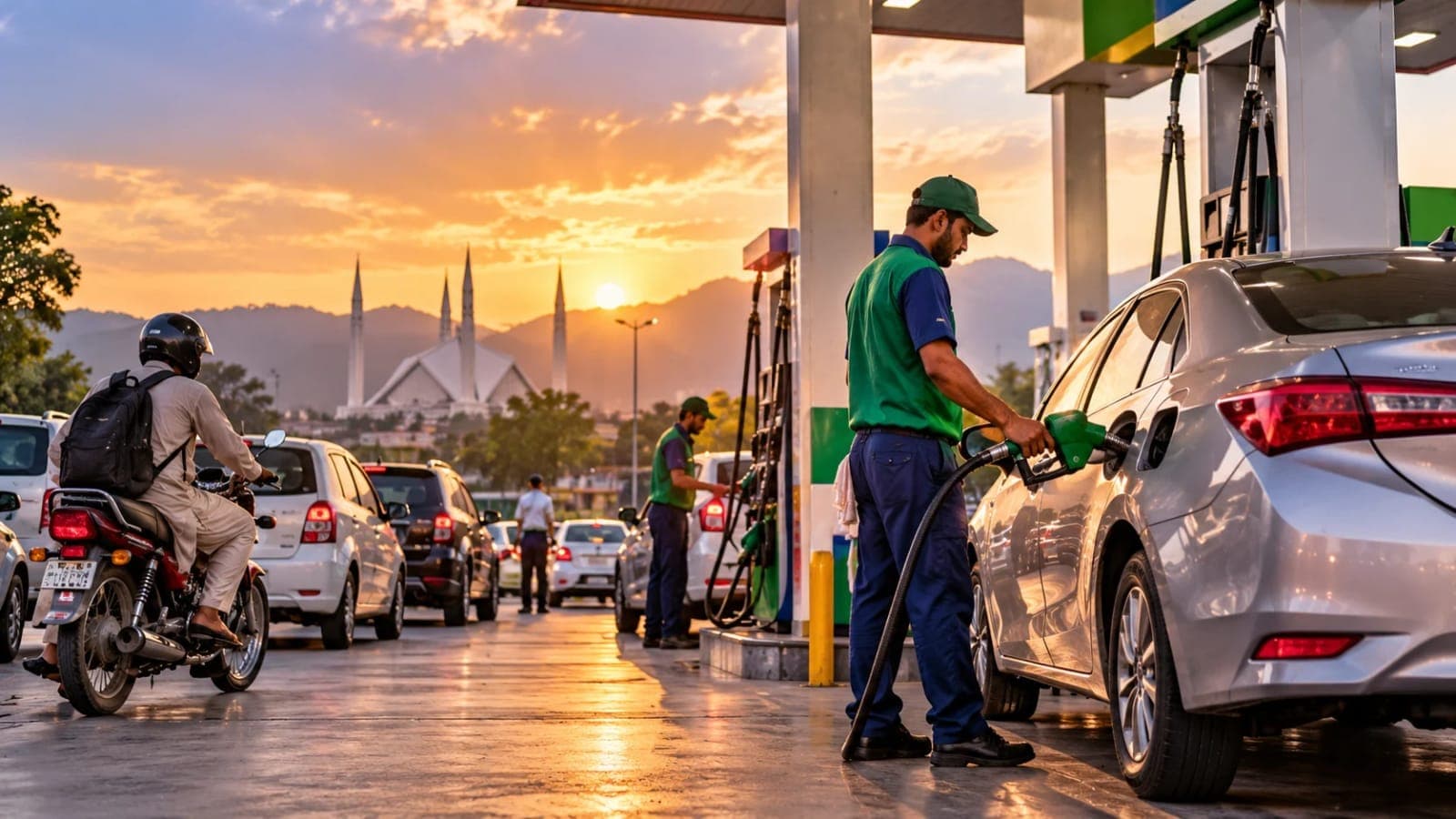
The federal government has reduced the price of petrol by Rs. 0.66 per litre while increasing the price of high-speed diesel by Rs. 0.52 per litre under the latest petroleum price revision.
According to the Ministry of Energy's announcement issued on October 9, the new petrol price is Rs. 398.30 per litre, effective from October 10 through October 12, 2026.
High-speed diesel now costs Rs. 396.24 per litre.
The changes are relatively small, but the overall price of fuel remains a major concern for households, transport operators, businesses and commuters across Pakistan.
For a motorcyclist, the difference of a few paisas per litre may have little immediate impact. However, continued price volatility makes it difficult for families to predict monthly transport expenses.
Diesel prices are particularly important for commercial transport and agriculture because the fuel is widely used in trucks, buses, machinery and other heavy vehicles.
The latest revision follows changes in international petroleum prices and comes amid continued uncertainty in global energy markets.
This guide explains the newly notified prices, their effective dates, the difference from previous rates and what the changes mean for ordinary consumers.
Petrol Price in Pakistan Today: October 10, 2026
The latest government notification establishes the following retail prices for petrol and high-speed diesel.
| Fuel type | Previous price | New price | Change |
|---|---|---|---|
| Petrol | Rs. 398.96 | Rs. 398.30 | Decrease of Rs. 0.66 |
| High-speed diesel | Rs. 395.72 | Rs. 396.24 | Increase of Rs. 0.52 |
All amounts are in Pakistani rupees per litre.
The prices apply from October 10 to October 12, 2026, under the announced three-day schedule.
Is Petrol Cheaper Today?
Yes.
Petrol has become slightly cheaper compared with the immediately preceding notified rate.
The reduction is 66 paisas per litre.
However, the price remains close to Rs. 400 per litre.
For most households, this small adjustment does not substantially change the overall cost of transportation.
Has Diesel Become More Expensive?
Yes.
High-speed diesel has increased by 52 paisas per litre.
The revised price is Rs. 396.24.
The increase is modest in percentage terms, but commercial users may pay attention because they purchase large quantities of diesel.
When Will the New Petrol Prices Apply?
The Petroleum Division's revised prices apply for three days.
The effective period begins on Saturday, October 10, and continues through Monday, October 12, 2026.
The government may announce another revision after this period.
Will Prices Remain the Same Throughout October?
Not necessarily.
The current notification covers a specific three-day period.
It does not guarantee that prices will remain unchanged for the rest of the month.
Consumers should check the latest government announcement before treating any quoted rate as current.
Why Are Fuel Prices Being Reviewed Frequently?
Pakistan has been using a more frequent petroleum pricing mechanism during a period of international market volatility.
More frequent reviews allow domestic prices to reflect changes in import costs sooner.
However, they can also create uncertainty for consumers and businesses that prefer predictable monthly expenses.
Why Did Petrol Become Cheaper While Diesel Increased?
Petrol and diesel are separate refined petroleum products.
Their international prices do not always move in the same direction.
Demand, supply conditions, refining costs and trading activity can affect each product differently.
The latest revision reflects a slight decrease in the assessed cost of petrol and an increase in the assessed cost of diesel.
What Happened in International Markets?
According to the October 10 reporting, the average refined petrol price over the preceding seven days declined slightly.
The corresponding diesel benchmark increased.
These changes contributed to the different directions of the domestic price adjustments.
Does a Lower Crude Oil Price Always Reduce Petrol Prices?
No.
The price of crude oil is only one factor in the cost of finished petroleum products.
Refining margins, freight charges, exchange rates and domestic taxes also matter.
A decline in crude oil prices may not produce an identical or immediate reduction in Pakistani retail prices.
How Much Petrol Can You Buy for Rs. 1,000?
At Rs. 398.30 per litre, Rs. 1,000 purchases approximately 2.51 litres of petrol.
The following table provides estimated quantities at the latest notified rate.
| Budget | Approximate petrol quantity |
|---|---|
| Rs. 500 | 1.26 litres |
| Rs. 1,000 | 2.51 litres |
| Rs. 2,000 | 5.02 litres |
| Rs. 3,000 | 7.53 litres |
| Rs. 5,000 | 12.55 litres |
| Rs. 10,000 | 25.11 litres |
These calculations assume the full amount is spent on petrol at the notified per-litre price.
Actual quantities may vary slightly because of rounding.
Why This Calculation Matters
Many drivers purchase fuel according to a fixed budget rather than asking for a particular number of litres.
Knowing the approximate quantity helps motorists estimate how far they can travel.
However, distance depends on the vehicle's actual fuel efficiency.
How Much Does a Full Petrol Tank Cost?
The cost of filling a tank depends on its capacity.
At the latest price of Rs. 398.30 per litre, the approximate cost is as follows.
| Tank capacity | Estimated cost |
|---|---|
| 5 litres | Rs. 1,991.50 |
| 10 litres | Rs. 3,983.00 |
| 20 litres | Rs. 7,966.00 |
| 30 litres | Rs. 11,949.00 |
| 40 litres | Rs. 15,932.00 |
| 50 litres | Rs. 19,915.00 |
These are mathematical examples, not prices for specific vehicle models.
A tank's usable capacity and the quantity required at the pump may differ.
How Much Does a Motorcycle Tank Cost?
A motorcycle requiring 10 litres of petrol would cost approximately Rs. 3,983 to fill at the latest rate.
A rider purchasing only five litres would spend approximately Rs. 1,991.50.
The actual expense depends on the amount purchased.
How Much Can Motorcyclists Save From the Petrol Reduction?
The latest petrol reduction is Rs. 0.66 per litre.
For a motorcyclist purchasing 20 litres over a period, the direct difference is Rs. 13.20.
For 30 litres, the difference is Rs. 19.80.
The immediate saving is therefore limited.
Why Monthly Fuel Efficiency Matters More
A motorcycle's fuel consumption can have a much greater impact on monthly expenses than a small daily price change.
Proper maintenance, suitable tyre pressure and smooth riding can help avoid unnecessary fuel consumption.
However, fuel efficiency depends on the motorcycle's condition, engine, traffic conditions and riding habits.
What Does the Diesel Price Increase Mean for Transporters?
High-speed diesel is used extensively in commercial transport.
Trucks, buses and other heavy vehicles may consume significant amounts of fuel.
A 52-paisa increase per litre adds Rs. 52 to the cost of purchasing 100 litres.
For 500 litres, the additional cost is Rs. 260.
Will Bus Fares Increase Immediately?
The latest diesel increase does not automatically establish a new bus fare.
Transport fares depend on several costs, including fuel, maintenance, labour and regulatory decisions.
A small diesel increase may be absorbed without an immediate fare revision.
Any official fare change should be confirmed through the relevant transport authority or operator.
What About Goods Transport?
Freight operators monitor diesel prices because fuel is a major operating expense.
However, transport charges also depend on distance, vehicle utilisation and market competition.
It would be inaccurate to claim that every delivery service must increase its rates because diesel rose by 52 paisas.
Why Are Petrol Prices So High in Pakistan?
Pakistan imports substantial quantities of petroleum products and related energy supplies.
International market conditions therefore influence domestic fuel costs.
The rupee's exchange rate also affects how much importers pay in local currency.
In addition, the final retail price includes government levies, distribution costs and other regulated components.
How Does the Dollar Exchange Rate Affect Fuel Prices?
Petroleum imports are commonly priced in foreign currencies.
If the Pakistani rupee weakens against the US dollar, the same international fuel price can become more expensive in rupees.
A stronger rupee may reduce some import-cost pressure.
However, the final domestic price also depends on other components.
Why Shipping Costs Matter
Imported petroleum products must be transported to Pakistan and distributed within the country.
Freight, insurance, port handling and inland transportation can affect the overall cost.
Disruptions to international shipping routes may create additional pressure.
What Taxes and Levies Are Included in Fuel Prices?
Pakistan's petroleum pricing structure includes several government charges and regulated margins.
According to the latest reporting, both petrol and high-speed diesel carry a petroleum levy of Rs. 80 per litre and a climate support levy of Rs. 5 per litre.
Other components include dealer margins, oil marketing company margins and inland freight adjustments.
Latest Reported Pricing Components
| Component | Petrol | High-speed diesel |
|---|---|---|
| Petroleum levy | Rs. 80.00 | Rs. 80.00 |
| Climate support levy | Rs. 5.00 | Rs. 5.00 |
| Dealer margin | Rs. 9.98 | Rs. 9.98 |
| Oil marketing company margin | Rs. 7.87 | Rs. 7.87 |
| Inland freight equalisation margin | Rs. 8.02 | Rs. 4.75 |
These figures represent selected reported pricing components.
They should not be interpreted as a complete itemised calculation of every element of the retail price.
Are Dealer Margins the Same as Government Taxes?
No.
Dealer and oil marketing company margins compensate participants in the fuel distribution chain.
Government levies are fiscal charges.
Although both contribute to the final price, they serve different purposes.
What Is the Petroleum Levy?
The petroleum levy is a government charge applied to specified petroleum products.
It forms part of the overall pricing framework.
Changes in the levy can influence the final retail price.
However, the latest October 10 adjustment was reported without a change in the stated petroleum levy rates.
Does Every Rupee Go to the Government?
No.
A litre of petrol includes the underlying product cost, transportation and distribution expenses, government charges and other pricing components.
It would be inaccurate to describe the entire retail price as tax revenue.
What Is the Climate Support Levy?
The climate support levy is another charge included in the reported petroleum pricing structure.
The latest figure is Rs. 5 per litre for petrol and high-speed diesel.
Its presence increases the final amount paid by consumers.
Is the Climate Levy the Same as the Petroleum Levy?
No.
They are separately identified charges.
The latest reported pricing structure lists both.
Consumers should distinguish between them when examining the composition of fuel prices.
How Does Pakistan's Fuel Pricing Mechanism Work?
Fuel prices are notified through the relevant government process.
The assessment considers international product prices and other domestic pricing components.
The Petroleum Division announces the applicable retail rates.
What Is OGRA's Role?
The Oil and Gas Regulatory Authority is involved in Pakistan's petroleum regulatory framework.
However, the official announcement of the latest retail prices is attributed to the Petroleum Division and Ministry of Energy.
Readers should avoid treating unofficial social media graphics as equivalent to a government notification.
Why Do Rates Change Even When Taxes Stay the Same?
The underlying cost of imported fuel can change.
Exchange rates and international refined-product benchmarks may also move.
Therefore, retail prices can rise or fall without a change in the listed government levy rates.
How Have Petrol Prices Changed Recently?
The immediately preceding notified petrol price was Rs. 398.96 per litre.
The new price is Rs. 398.30.
That represents a decrease of Rs. 0.66.
Diesel moved from Rs. 395.72 to Rs. 396.24.
Does This Mean Fuel Prices Are Falling Overall?
One small reduction does not establish a sustained downward trend.
Fuel prices have experienced considerable volatility.
The next direction will depend on international market conditions, exchange rates and government pricing decisions.
A longer period of data is required to identify a meaningful trend.
How Can Drivers Reduce Fuel Expenses?
Motorists cannot control the official petrol price, but they can manage some aspects of consumption.
Driving behaviour and vehicle condition can influence fuel efficiency.
Maintain Correct Tyre Pressure
Underinflated tyres can increase rolling resistance.
Drivers should follow the vehicle manufacturer's recommended tyre pressure.
Avoid Unnecessary Idling
Keeping an engine running while stationary consumes fuel.
Where practical and safe, reducing unnecessary idling can help limit consumption.
Maintain the Vehicle
Engine condition, filters and other mechanical components may affect efficiency.
Regular servicing can reduce avoidable performance problems.
Plan Trips Efficiently
Combining nearby errands may reduce total distance travelled.
However, route planning should also consider safety and traffic conditions.
How Can Families Budget for Petrol?
Fuel costs can represent a significant portion of monthly household spending.
A simple budget can help families understand their transport expenses.
Example Monthly Petrol Budget
Suppose a household uses 40 litres of petrol per month.
At Rs. 398.30 per litre, the cost is Rs. 15,932.
A household using 60 litres would spend Rs. 23,898.
At 80 litres, the cost would be Rs. 31,864.
These figures assume a constant price and do not include maintenance or other transport expenses.
Why Recordkeeping Helps
Tracking fuel purchases can reveal changes in consumption.
A sudden increase may reflect longer journeys, heavier traffic or a vehicle maintenance issue.
Budgeting becomes easier when households understand both price and quantity.
How Could Diesel Prices Affect Food Prices?
Diesel is used in transportation and some agricultural operations.
Higher diesel costs can contribute to the expense of moving goods from farms and warehouses to markets.
However, food prices depend on many factors.
These include crop yields, storage, demand, weather and distribution arrangements.
Will Vegetables Become More Expensive Tomorrow?
The latest 52-paisa diesel increase does not provide enough evidence to predict an immediate increase in vegetable prices.
Individual market prices must be assessed separately.
It is important to distinguish potential cost pressure from a confirmed retail price change.
What Is the Difference Between Petrol and High-Speed Diesel?
Petrol and diesel are refined fuels used in different types of engines.
Most conventional petrol motorcycles and many passenger cars use petrol.
Diesel engines are common in heavy transport and certain commercial vehicles.
The fuels are not interchangeable.
Can Diesel Be Used in a Petrol Vehicle?
No.
Using the wrong fuel can damage the vehicle's fuel system or engine.
Drivers should follow the manufacturer's fuel specification.
If the wrong fuel is added, they should seek professional assistance rather than starting the engine.
Are Petrol Prices the Same in Every Pakistani City?
Government-notified prices establish the applicable pricing framework.
However, the precise retail situation can depend on the relevant product and regulatory arrangements.
Consumers should rely on authorised fuel stations and current official information.
What If a Pump Charges More?
A consumer who suspects overcharging should retain the receipt and note the station's details.
They can contact the relevant company or competent authority for guidance.
Complaints should be based on the applicable official rate and actual transaction.
Why Fuel Quality Also Matters
Price is not the only consideration.
Consumers should purchase fuel from reputable stations.
Suspected quantity or quality problems should be reported through appropriate channels.
Is There a Petrol Subsidy in Pakistan in 2026?
The government has discussed and implemented targeted fuel-support measures during the recent period of high prices.
However, eligibility and benefits depend on the specific scheme and its current official rules.
The October 10 petrol price notification should not be confused with an announcement that every consumer automatically receives a subsidy.
Are All Motorcyclists Eligible for Support?
Not necessarily.
Targeted assistance generally depends on defined eligibility criteria.
Consumers should check official scheme information before assuming they qualify.
Beware of Fake Subsidy Messages
Fraudulent messages may promise cash or fuel discounts in exchange for personal information.
People should avoid sharing CNIC images, passwords or verification codes with unverified sources.
A genuine government benefit should be confirmed through recognised official channels.
Will Petrol Prices Increase Again After October 12?
The current notification applies through October 12.
The government may announce new rates for the following period.
Whether petrol increases or decreases will depend on the next assessment.
Can Anyone Predict the Exact Next Price?
Not reliably without the relevant official decision and pricing data.
International markets can move quickly.
Exchange rates and domestic policy choices may also change.
Consumers should treat forecasts as estimates rather than confirmed government rates.
What Should Consumers Check Before Sharing Petrol Price News?
Fuel price rumours can spread rapidly on social media.
Some posts use outdated screenshots or quote rates that were never officially notified.
Check the Effective Date
A rate may have been correct yesterday but no longer apply today.
Always confirm when the notification takes effect.
Check the Fuel Type
Petrol and high-speed diesel have different prices.
A report about one product should not be presented as a change in the other.
Check the Size of the Change
The latest petrol reduction is 66 paisas, not Rs. 66.
Confusing rupees and paisas can create a seriously misleading headline.
Confirm the Source
Official announcements and established news reporting are preferable to anonymous social media messages.
What Should Businesses Do During Frequent Price Changes?
Businesses that depend on fuel should maintain accurate records of consumption and expenses.
Frequent revisions can complicate transport budgeting and delivery pricing.
Monitor Actual Consumption
Tracking litres used is more informative than looking only at total spending.
A higher bill may reflect greater consumption, a higher unit price or both.
Review Transport Costs Carefully
Businesses should avoid changing customer prices solely because of a small fuel adjustment without considering their total operating costs.
Communicate Price Changes Clearly
Where a business must revise delivery charges, explaining the reason can help maintain customer trust.
Conclusion
The petrol price in Pakistan today, October 10, 2026, is Rs. 398.30 per litre following a reduction of 66 paisas.
High-speed diesel has increased by 52 paisas to Rs. 396.24 per litre.
The new rates apply from October 10 through October 12 under the latest government notification.
Although the adjustments are small, fuel remains expensive for Pakistani households and businesses.
The final retail price reflects international petroleum costs, exchange rates, government levies and distribution expenses.
Consumers should monitor official notifications, distinguish between petrol and diesel rates and avoid relying on unverified price rumours.
The next price revision may bring another change, so the current figures should always be read alongside their effective dates.
Frequently Asked Questions
1. What is the petrol price in Pakistan today, October 10, 2026?
The government-notified petrol price is Rs. 398.30 per litre.
2. What is the latest diesel price in Pakistan?
High-speed diesel costs Rs. 396.24 per litre under the October 10 notification.
3. Has petrol become cheaper in Pakistan?
Yes. Petrol has been reduced by Rs. 0.66 per litre from the previous price of Rs. 398.96.
4. How long will the new petrol prices remain effective?
The announced rates apply from October 10 to October 12, 2026, unless superseded by another official notification.
5. How much does 10 litres of petrol cost today?
At Rs. 398.30 per litre, 10 litres cost Rs. 3,983.
Editorial Disclaimer: The prices in this article are based on the government notification effective October 10–12, 2026. Petroleum rates can change following subsequent official revisions. Fuel-cost examples are calculations based on the stated retail rate.
What happens next for national
We will keep this page updated as the story develops rather than publishing a near-duplicate at a new address. Follow National for related coverage.
Get the Verified Brief
One email each morning with the stories we checked overnight.
Spotted an error? Read our corrections policy and tell the newsroom.