

Punjab Forest Department Plants 55 Million Trees in 2026
Punjab Forest Department reports 55 million plants, AI fire monitoring, digital forestry and stronger forest protection initiatives across Punjab.

By News Desk · Verified Pakistan News Desk
Published · Updated · 7 min read
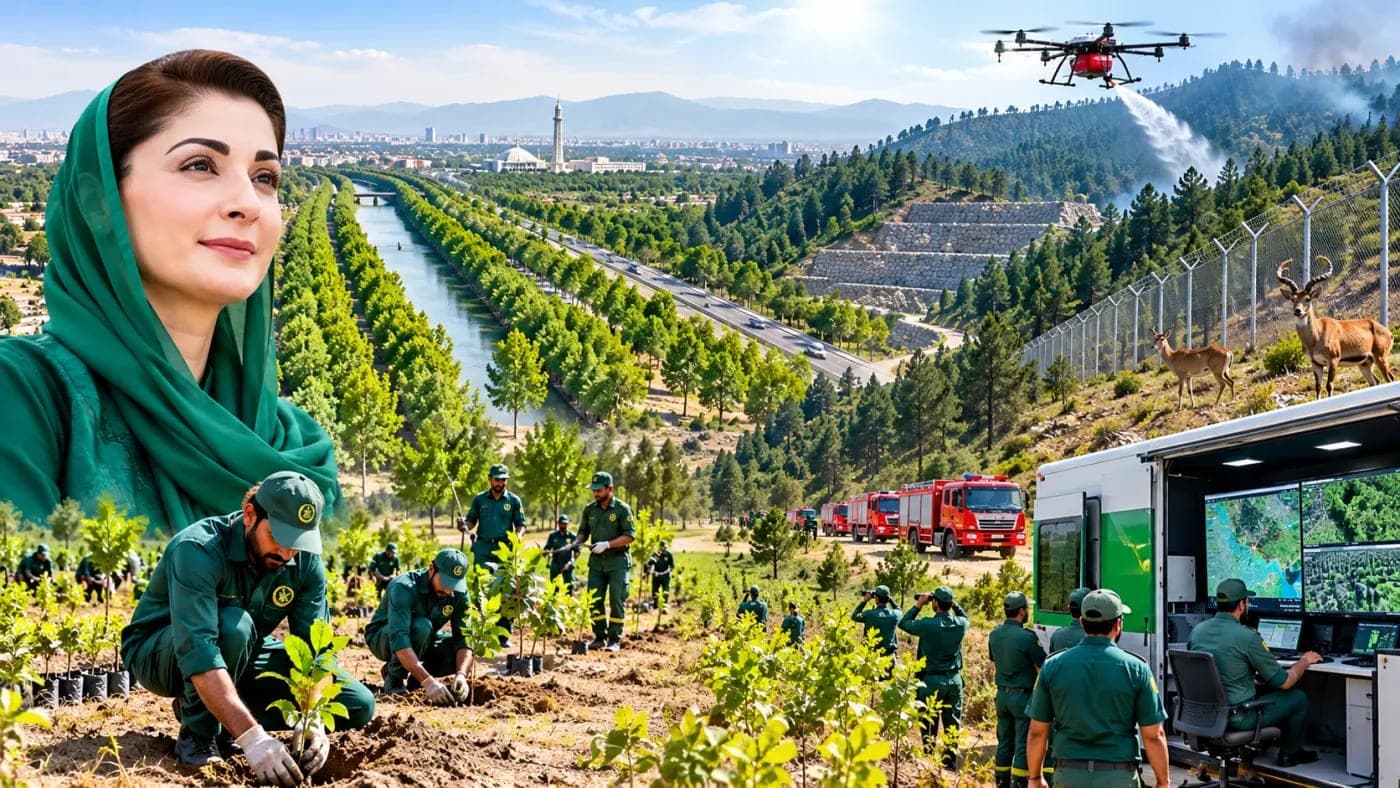
Punjab Forest Department Leads Green Transformation with 55 Million Plants, Smart Forestry and Stronger Forest Protection
Under the visionary leadership of Chief Minister Punjab Maryam Nawaz Sharif, the Punjab Forest Department is advancing a comprehensive green transformation focused on large-scale plantation, ecological restoration, biodiversity conservation, digital forestry, and stronger enforcement of forest protection laws.
Between 2024 and 2026, the department has planted 55 million plants across 55,000 acres of land throughout Punjab, marking a significant step towards expanding green cover, restoring degraded landscapes, and building a more climate-resilient province.
Barren Landscapes Transform into Green Corridors
The department’s plantation initiatives are transforming previously barren and degraded landscapes into greener, more productive ecosystems.
At Ghazi Ghat, located 34 kilometres from Muzaffargarh along National Highway 70, approximately 1.8 million plants have been planted across 1,500 acres. Further along the same highway, Bait Qaim Shah has witnessed plantation across 1,050 acres, with 700,000 plants contributing to the expansion of green cover.
In Rajanpur, the Chief Minister’s Agroforestry Initiative has brought 3,041 acres under plantation, with 2.2 million plants supporting landscape restoration and environmental sustainability.
These projects reflect the department’s continued efforts to restore degraded land, expand vegetation cover, and strengthen the ecological resilience of southern Punjab.
Innovative Nature-Based Solutions for Ecological Restoration
Beyond conventional plantation activities, the Punjab Forest Department is implementing innovative nature-based solutions to conserve soil, manage rainwater, and protect vulnerable ecosystems.
In the mountainous areas of Murree, bioengineering and soil conservation measures are being implemented to stabilize slopes, reduce erosion, and help mitigate landslide risks. Along the Murree Expressway, in Compartment No. 46 of the Lower Topa Sub-Division, approximately 45,000 cubic feet of soft gabion structures have been installed, alongside the sowing of more than 15,000 seeds.
These interventions are designed to stabilize vulnerable slopes, control rainwater runoff, and protect forest ecosystems and critical road infrastructure.
In the arid Pothohar region, dry afforestation techniques are being introduced across Attock, Jhelum, and Chakwal. Specially designed contour trenches, known as swales, capture seasonal rainfall and retain soil moisture, creating favourable conditions for the natural growth of native vegetation without relying on artificial irrigation.
The department is also promoting the seed-ball technique in the rugged hills of Chakwal, where conventional plantation methods can be difficult. The technique involves dispersing seeds encased in protective material across inaccessible slopes, allowing them to remain protected until suitable rainfall and environmental conditions support germination.
Together, these approaches are helping restore degraded landscapes through sustainable, locally adapted, and nature-based interventions.
Avenue Plantation and Urban Forestry Expand Green Cover
The department’s green transformation extends beyond designated forest areas. Along canals, roads, and railway corridors, 3,285 avenue miles have been brought under plantation, expanding vegetation cover along major public routes.
In Lahore, more than 20,000 fast-growing bamboo plants have been planted under urban forestry initiatives to help create greener urban spaces and support a more sustainable urban environment.
These initiatives complement large-scale forest plantations by integrating greenery into transport corridors, urban landscapes, and other public spaces.
Enhanced Protection for Lal Suhanra National Park
The Punjab Forest Department is also strengthening the protection of ecologically significant areas, including Lal Suhanra National Park, an important landscape for biodiversity and wildlife conservation.
A 99-kilometre protective fence is being established to strengthen the park’s protection and support natural habitat regeneration. Of the total planned length, 20 kilometres have been completed, while work on the remaining 79 kilometres is underway.
The initiative is intended to improve habitat protection, support wildlife conservation, and promote opportunities for responsible ecotourism.
AI-Powered Technology Strengthens Forest Fire Prevention
Recognizing the growing importance of forest fire prevention, the department has strengthened its fire detection and emergency response capabilities across the Murree and Kahuta hills through a technology-driven monitoring network.
The system combines drone surveillance, ground-based sensors, and 45 AI-powered thermal cameras deployed across high-risk areas. The cameras can detect potential fire threats from distances of up to 10 kilometres, enabling timely alerts and a coordinated response through the Central Command and Control System and wireless communication network.
Specialized firefighting drones further support operations in remote hillsides and dense forests. With a reported operational range of 11 kilometres and an extendable water hose reaching up to one kilometre, the drones provide additional capacity for rapid aerial firefighting.
On-ground response is supported by 12 fire vehicles, strengthening operational readiness and coordination during emergencies.
According to departmental figures, these measures have contributed to an 85% reduction in forest fire-damaged area and a 74% reduction in forest fire incidents.
Pakistan’s First GIS Mobile Lab Advances Digital Forestry
In a major step towards technology-driven forest management, the Punjab Forest Department has established Pakistan’s first GIS Mobile Lab, bringing advanced geospatial capabilities directly to field operations.
Equipped with AI-powered drones and live surveillance facilities, the mobile laboratory supports forest surveys, mapping, plantation monitoring, and real-time decision-making. It enables field teams to collect and analyse information more efficiently, helping improve the monitoring and management of forest resources.
The initiative represents an important advancement in integrating digital technology with conventional forestry operations.
Advanced Mapping and Satellite-Based Forest Monitoring
The department is expanding the use of advanced imagery and geospatial technology to monitor forest areas across Punjab.
High-resolution spatial mapping supports forest-change analysis, plantation assessment, resource monitoring, and the identification of changes across extensive forest landscapes. By combining satellite imagery, GIS technology, drone surveillance, and field-collected data, the department is developing a more comprehensive picture of Punjab’s forest resources.
These technologies are helping improve the accuracy of forest monitoring and support more informed decisions about conservation, plantation management, and resource protection.
Digital Tree Enumeration Improves Transparency and Accountability
To strengthen forest protection and improve accountability, the department has introduced digital tree enumeration, enabling field teams to record and monitor individual trees through a centralized digital system.
The process includes measuring tree girth, marking trees, recording relevant information on-site, and uploading the data directly to the system.
So far, more than 1.6 million trees have been digitally enumerated across Punjab, creating a digital inventory of forest assets to support monitoring and help prevent illegal tree cutting.
Plantation monitoring has also become increasingly data-driven. Approximately 1,180 plantation sites have been digitally recorded, covering 55 million plants.
More than nine in-house digital dashboards support departmental operations, including nursery management, complaint handling, and afforestation monitoring. These systems are strengthening operational oversight, transparency, and evidence-based decision-making.
Forest Act Amendment and Recruitment of 979 Forest Protection Personnel
Strengthening forest conservation requires effective legislation, dedicated personnel, and consistent enforcement.
After nearly a century, the Forest Act of 1927 has been amended to strengthen the legal framework for forest protection and enforcement.
To support implementation at the field level, 979 officers have been recruited and trained at the Forest Services Academy, Ghora Gali, and the Bahawalpur Forest School to serve in a dedicated Forest Protection Force.
The personnel are deployed to strengthen patrols, improve forest security, and help prevent illegal activities affecting Punjab’s natural resources.
More Than 1,850 Acres of Encroached Forest Land Recovered
Alongside plantation and conservation initiatives, the department is pursuing action against illegal occupation of forest land.
More than 1,850 acres of forest land have been recovered from encroachers, supporting efforts to restore protected landscapes and safeguard public natural assets.
The department has also intensified enforcement against illegal sawmills operating near forest areas. According to departmental figures, more than 300 sawmills operating within an eight-kilometre radius of forests have been sealed as part of efforts to curb illegal timber-related activities and strengthen forest protection.
A Sustainable and Climate-Resilient Future for Punjab
The Punjab Forest Department’s green transformation combines large-scale plantation with ecological restoration, biodiversity conservation, modern technology, and stronger enforcement.
From restoring barren landscapes and stabilizing vulnerable hillsides to deploying AI-powered fire detection, digital tree enumeration, and advanced geospatial monitoring, these initiatives represent a broader approach to sustainable forest management.
With continued investment in plantation, conservation, technology, and enforcement, Punjab is advancing towards a greener, healthier, and more climate-resilient future for its people and generations to come.
What happens next for punjab
We will keep this page updated as the story develops rather than publishing a near-duplicate at a new address. Follow Punjab for related coverage.
Get the Verified Brief
One email each morning with the stories we checked overnight.
Spotted an error? Read our corrections policy and tell the newsroom.