
Imported Tyre and Motorcycle Parts Prices in Pakistan: Why Costs May Rise
Imported tyre and motorcycle parts prices in Pakistan may rise after new customs duties. Explore the ECC decision, duty rates and impact on buyers.

By News Desk · Verified Pakistan News Desk
Published · 14 min read
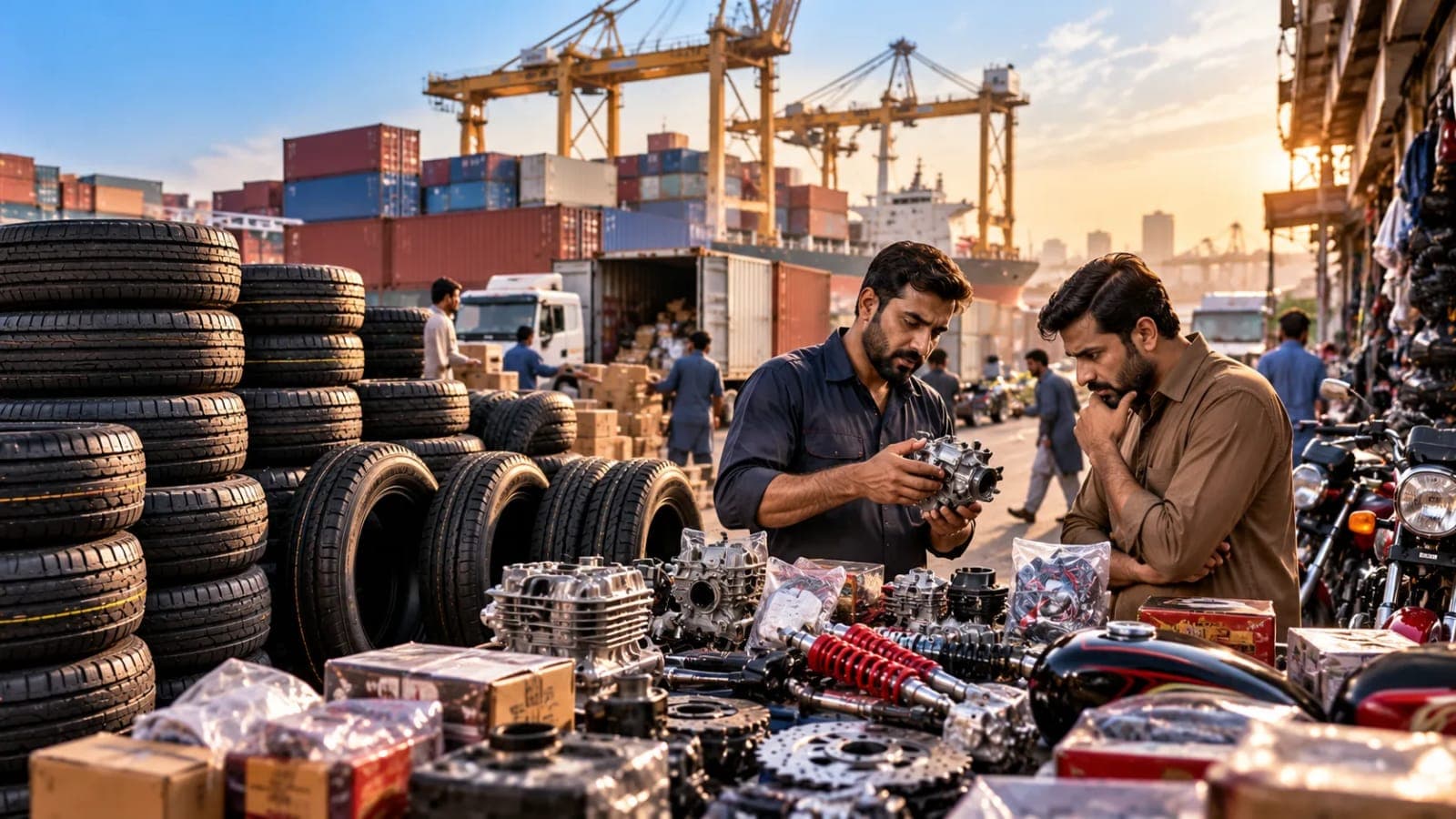
Imported tyres and motorcycle components could become more expensive in Pakistan after the federal government approved higher additional customs duties on selected products.
The Economic Coordination Committee of the Cabinet made the decision on October 8, 2026, during a meeting chaired by Finance Minister Muhammad Aurangzeb.
The policy is intended to support domestic manufacturing and encourage greater use of locally produced automotive components.
Under the decision, the additional customs duty on specified imported radial tyres has increased from 4% to 11%.
A separate category of motorcycle components imported by local manufacturers faces an increase from 11% to 31%.
These changes have created concerns about possible price increases for motorists, motorcycle owners, spare-parts dealers and businesses that depend on imported automotive products.
However, the approval of a higher customs duty does not mean every tyre or motorcycle spare part has already increased in retail price.
The actual impact will depend on the products covered, their import costs, existing inventory and the way businesses respond to the new tariff structure.
Why Imported Tyre and Motorcycle Parts Prices May Rise in Pakistan
Customs duties are taxes imposed on goods entering a country.
When additional customs duties increase, importing affected products generally becomes more expensive.
Importers may absorb some of the extra expense or pass it on to wholesalers and retailers.
Retailers may then adjust their selling prices.
This creates a potential chain of cost increases that can eventually reach vehicle owners.
However, the extent of any retail increase depends on market competition, stock levels, profit margins and the classification of the imported goods.
What Has Changed in October 2026?
The Economic Coordination Committee approved higher additional customs duties on selected automotive products.
The changes are intended to provide greater protection for goods that are already manufactured within Pakistan.
The policy is designed to make locally produced alternatives more competitive against imported products.
It also encourages businesses involved in motorcycle manufacturing to consider domestic components where suitable products are available.
Latest Customs Duty Rates for Imported Tyres and Motorcycle Parts
The October 8 ECC decision introduced two important tariff changes.
| Product category | Previous additional duty | Approved additional duty |
|---|---|---|
| Specified imported radial tyres and covered locally manufactured automotive items | 4% | 11% |
| Specified motorcycle components imported by local manufacturers | 11% | 31% |
These figures refer to additional customs duties, not necessarily the total taxes payable on an imported product.
Other duties, taxes and charges may apply according to the relevant tariff classification.
The precise product coverage must be determined from the applicable customs notification.
Why the Difference Matters
An 11% additional customs duty does not mean that the entire retail price of a tyre automatically increases by 11%.
Similarly, a change to a 31% additional duty does not establish that every motorcycle spare part will become 31% more expensive.
The new percentage applies to the relevant customs calculation.
Retail pricing involves additional factors.
Consumers should therefore avoid treating the announced rates as confirmed increases in showroom or shop prices.
What Is the Economic Coordination Committee?
The Economic Coordination Committee, commonly known as the ECC, is a federal cabinet committee that considers important economic and financial matters.
Its decisions can involve trade policy, government expenditure, subsidies, financing arrangements and other economic measures.
The October 8 meeting was chaired by Federal Minister for Finance and Revenue Muhammad Aurangzeb.
The committee considered proposals submitted by different government ministries and divisions.
Among the decisions was an amendment concerning additional customs duties on selected imported automotive goods.
What Is the Role of the Revenue Division?
The Revenue Division submitted the proposal relating to additional customs duties.
The government said the objective was to support domestic manufacturing.
Changes to customs duty arrangements are implemented through the applicable legal and administrative framework.
Businesses should review the final customs notification to determine exactly which tariff lines and products are covered.
Why Pakistan Wants to Protect Local Tyre Manufacturers
Domestic tyre manufacturers compete with imported products in several market segments.
Imported tyres may offer different brands, specifications, performance characteristics and prices.
When imported alternatives are cheaper, local producers can face competitive pressure.
Higher duties may increase the relative price of imported products.
This can create additional demand for locally manufactured tyres.
The government hopes such protection will encourage domestic production and investment.
Potential Benefits for Local Industry
A stronger domestic manufacturing sector can support industrial activity and employment.
Local production may also reduce dependence on some imported finished goods.
Manufacturers with stable demand may be better positioned to invest in equipment and production capacity.
However, these benefits depend on whether local companies can deliver competitive quality, sufficient supply and reasonable prices.
Tariff protection alone does not guarantee improved manufacturing performance.
Why Motorcycle Parts Face Higher Duties
Motorcycles are a major form of personal transportation in Pakistan.
They are widely used by students, office workers, delivery riders and families.
The motorcycle industry depends on a network of manufacturers, assemblers, component suppliers and spare-parts dealers.
Some components are manufactured locally, while others are imported.
The government's latest decision seeks to encourage greater localisation.
What Does Localisation Mean?
Localisation refers to producing components within the country rather than relying entirely on imports.
For motorcycle manufacturers, this can involve sourcing suitable parts from Pakistani suppliers.
Potential benefits include shorter supply chains, domestic industrial activity and reduced exposure to some international shipping disruptions.
However, local suppliers must meet the required technical specifications and quality standards.
A component should not be selected solely because it is locally produced if it fails to meet safety or performance requirements.
How the New Duty Could Affect Tyre Prices
Imported tyre prices may face upward pressure as new shipments arrive under the revised duty structure.
Importers will assess their total costs before setting wholesale prices.
Retailers may then adjust their prices based on replacement costs and market conditions.
However, some shops may continue selling existing stock at earlier prices.
Other businesses may raise prices in anticipation of higher replacement costs.
Will Every Tyre Become More Expensive?
Not necessarily.
The policy concerns specified imported products.
Locally manufactured tyres are not automatically subject to the same import duty.
Different imported tyre categories may also fall under different tariff classifications.
Vehicle owners should therefore compare actual prices for the tyre size and specification they need.
A broad headline about higher customs duties cannot establish the final price of every product.
How Motorcycle Owners Could Be Affected
Motorcycle maintenance is an unavoidable expense for many Pakistani households.
Common replacement items include tyres, chains, brake components, cables, filters and electrical parts.
If a component falls within the affected import categories, its cost may increase.
The impact will depend on whether the part is imported, manufactured locally or available from multiple suppliers.
Why Daily Commuters Should Pay Attention
Motorcycle owners often operate within limited monthly budgets.
Unexpected repair expenses can affect household spending.
For delivery riders, maintenance costs can also reduce earnings.
A higher price for an essential replacement part may be difficult to avoid.
However, delaying necessary repairs can create safety risks.
Consumers should prioritise roadworthiness rather than choosing the cheapest available component without checking its quality.
What About Motorcycle Assemblers and Manufacturers?
The higher duty on specified imported motorcycle components may encourage manufacturers to purchase more parts from domestic suppliers.
This could create opportunities for Pakistani component producers.
However, the transition may be difficult where locally produced alternatives are unavailable or cannot meet the required specifications.
Manufacturers must consider quality, production capacity and delivery reliability.
Could Motorcycle Prices Increase?
Motorcycle prices could face pressure if manufacturers incur higher component costs and cannot fully offset them.
However, the new ECC decision does not establish an immediate increase in the price of every motorcycle model.
Manufacturers may have existing inventories, supplier contracts or alternative sourcing arrangements.
Retail prices will depend on company decisions and market conditions.
Any specific motorcycle price increase should be confirmed through an official manufacturer announcement or current dealership information.
Why Local and Imported Parts Can Have Different Prices
The price of an automotive component depends on more than its country of origin.
Raw materials, production technology, labour costs, shipping expenses and distribution arrangements all influence pricing.
Imported products may also involve currency conversion, freight charges and customs clearance costs.
Locally manufactured products can avoid some international shipping expenses but still face domestic energy, material and financing costs.
Therefore, local products are not always cheaper in every category.
Quality Matters More Than Price Alone
Consumers should check whether a tyre or component is suitable for their vehicle.
For tyres, important considerations include size, load rating, speed rating and condition.
For motorcycle components, correct fitment and manufacturing quality are essential.
A low-cost part that wears out quickly may ultimately cost more than a durable alternative.
Safety-critical components deserve particular attention.
How Customs Duties Affect Importers and Dealers
Importers must account for customs duties when calculating the cost of bringing products into Pakistan.
An increase in additional customs duty can affect working capital requirements.
Businesses may need more funds to clear the same quantity of goods.
Dealers may also face uncertainty about replacement costs.
Existing Inventory Versus New Shipments
Products imported before the new duty arrangements become applicable may have different cost structures from later shipments.
This can lead to temporary price differences between retailers.
A shop with older inventory may offer a lower price than a competitor purchasing recently imported goods.
However, businesses may also price existing inventory according to expected replacement costs.
The market response is not always immediate or uniform.
How Exchange Rates Influence Imported Auto Parts
Many imported automotive products are purchased in foreign currencies.
The Pakistani rupee's exchange rate can therefore affect their local cost.
If the rupee weakens, the same foreign-currency invoice becomes more expensive in Pakistani rupees.
If the rupee strengthens, some import-cost pressure may ease.
These currency movements can amplify or offset part of the impact of customs duty changes.
Why Shipping Costs Matter
International freight charges also influence the final landed cost of imported products.
Shipping disruptions, port handling charges and insurance costs can affect importers.
Consequently, the retail price of an imported tyre may change even when the customs duty rate remains unchanged.
This is why a reliable price comparison should consider several factors rather than focus exclusively on taxation.
Could Higher Import Duties Benefit Pakistani Consumers?
The potential benefits are mainly indirect.
If domestic manufacturers expand production and improve efficiency, consumers may eventually gain access to more locally available products.
A stronger local supply chain can also reduce dependence on some imported components.
However, these outcomes are not guaranteed.
In the short term, reduced competition from imported products can create a risk of higher prices.
The overall consumer impact depends on how local manufacturers respond.
The Importance of Competition
Healthy competition encourages manufacturers to improve quality and control costs.
If tariff protection becomes a substitute for innovation, consumers may receive fewer choices without meaningful improvements.
A balanced industrial policy should support local manufacturing while maintaining product standards and reasonable market competition.
What Should Car Owners Do Before Buying Tyres?
Drivers should begin by identifying the correct tyre specification for their vehicle.
The required size and other technical details are usually provided in the vehicle documentation or on the manufacturer's recommended information label.
Buying an unsuitable tyre can affect handling, braking and safety.
Consumers should compare prices from reputable sellers and request proper invoices.
Check Manufacturing Information
Tyres carry identifying markings that provide important information.
Buyers should inspect the product's condition and relevant manufacturing details.
They should also check for visible damage, improper storage or other concerns.
A qualified tyre professional can help determine whether a product is appropriate.
Consumers should not replace a safe, serviceable tyre merely because they expect prices to increase.
How Motorcycle Riders Can Manage Maintenance Costs
Regular maintenance can help prevent expensive mechanical problems.
Riders should check tyre pressure, brakes, chain condition and other important components.
Using suitable parts and following recommended service intervals may reduce unnecessary wear.
However, cost-saving should not compromise safety.
Avoid Counterfeit Spare Parts
Higher prices can create incentives for sellers to market low-quality or counterfeit products.
Buyers should be cautious about suspiciously cheap items presented as genuine branded components.
Purchasing from reputable suppliers and keeping receipts can help reduce risk.
Where possible, verify packaging, markings and product compatibility.
What Else Did the ECC Approve on October 8?
The meeting covered several economic measures beyond automotive import duties.
The committee approved a financing framework intended to improve access to credit for small businesses and farmers.
The arrangement involves eligible financial institutions and risk-sharing mechanisms.
The committee also considered changes involving a credit guarantee facility connected with affordable housing finance.
These decisions indicate that the meeting addressed both industrial protection and access to financing.
Support for Small Enterprises
The approved framework provides first-loss coverage of up to 20% for qualifying small and medium enterprise loans.
For small farmers and medium-sized industries, the reported coverage is up to 10% in the relevant categories.
These figures describe the risk-sharing framework rather than a cash grant automatically available to every business.
Eligibility and implementation depend on the approved financing arrangements.
What Happens Next for Tyre and Bike Parts Prices?
The next important step is the implementation of the approved customs duty changes through the applicable legal notifications.
Importers and manufacturers will assess the impact on their supply chains.
Retailers may then adjust prices as new stock reaches the market.
However, no single nationwide increase can be predicted for every imported tyre or motorcycle component.
Consumers should monitor actual retail prices and manufacturer announcements.
Businesses should confirm the tariff classifications relevant to their products.
What Should Buyers Watch?
Buyers should pay attention to current quotations, product specifications and the availability of reliable local alternatives.
It is also important to distinguish between an announced tax change and a confirmed increase in a particular product's selling price.
Price comparisons are most useful when they involve identical specifications and comparable quality.
Conclusion
Imported tyre and motorcycle parts prices in Pakistan may face additional pressure following the Economic Coordination Committee's October 8, 2026 decision.
The government has approved higher additional customs duties on selected imported radial tyres and motorcycle components to encourage domestic manufacturing.
The policy could benefit local producers and support greater use of Pakistani-made components.
However, it may also increase costs for importers, dealers and consumers, particularly where suitable local alternatives are limited.
The final effect will depend on product coverage, customs implementation, exchange rates, inventory levels and market competition.
For motorists and motorcycle owners, the best approach is to compare actual prices, prioritise safety and avoid assuming that every automotive product will increase by the same percentage.
Frequently Asked Questions
1. Why are imported tyre prices expected to rise in Pakistan?
The government has approved higher additional customs duties on specified imported tyres that compete with locally manufactured products.
2. What is the new additional customs duty on imported radial tyres?
The ECC approved an increase from 4% to 11% for the relevant category.
3. Why has the duty on some motorcycle parts increased to 31%?
The government aims to encourage domestic production and reduce reliance on certain imported components.
4. Will every motorcycle spare part become 31% more expensive?
No. The 31% figure is an additional customs duty rate for specified imports, not a confirmed retail price increase for every spare part.
5. Will locally manufactured tyres also become more expensive?
The duty change does not directly establish a price increase for locally produced tyres. Their prices will depend on production costs, demand and market competition.
Editorial Disclaimer: This article explains the ECC decision reported on October 9, 2026. Exact product coverage and applicable duty treatment should be confirmed against the relevant customs notification. Retail prices may vary by seller, location and product specification.
What happens next for auto
We will keep this page updated as the story develops rather than publishing a near-duplicate at a new address. Follow Auto for related coverage.
Get the Verified Brief
One email each morning with the stories we checked overnight.
Spotted an error? Read our corrections policy and tell the newsroom.