

NASA AI Robot Doctor: Google Space Medical Robot for Moon and Mars
NASA AI robot doctor is being built by Google and NASA to help astronauts when Earth is up to 44 minutes away by radio, starting with fetching medical equipment.

By News Desk · Verified Pakistan News Desk
Published · Updated · 5 min read
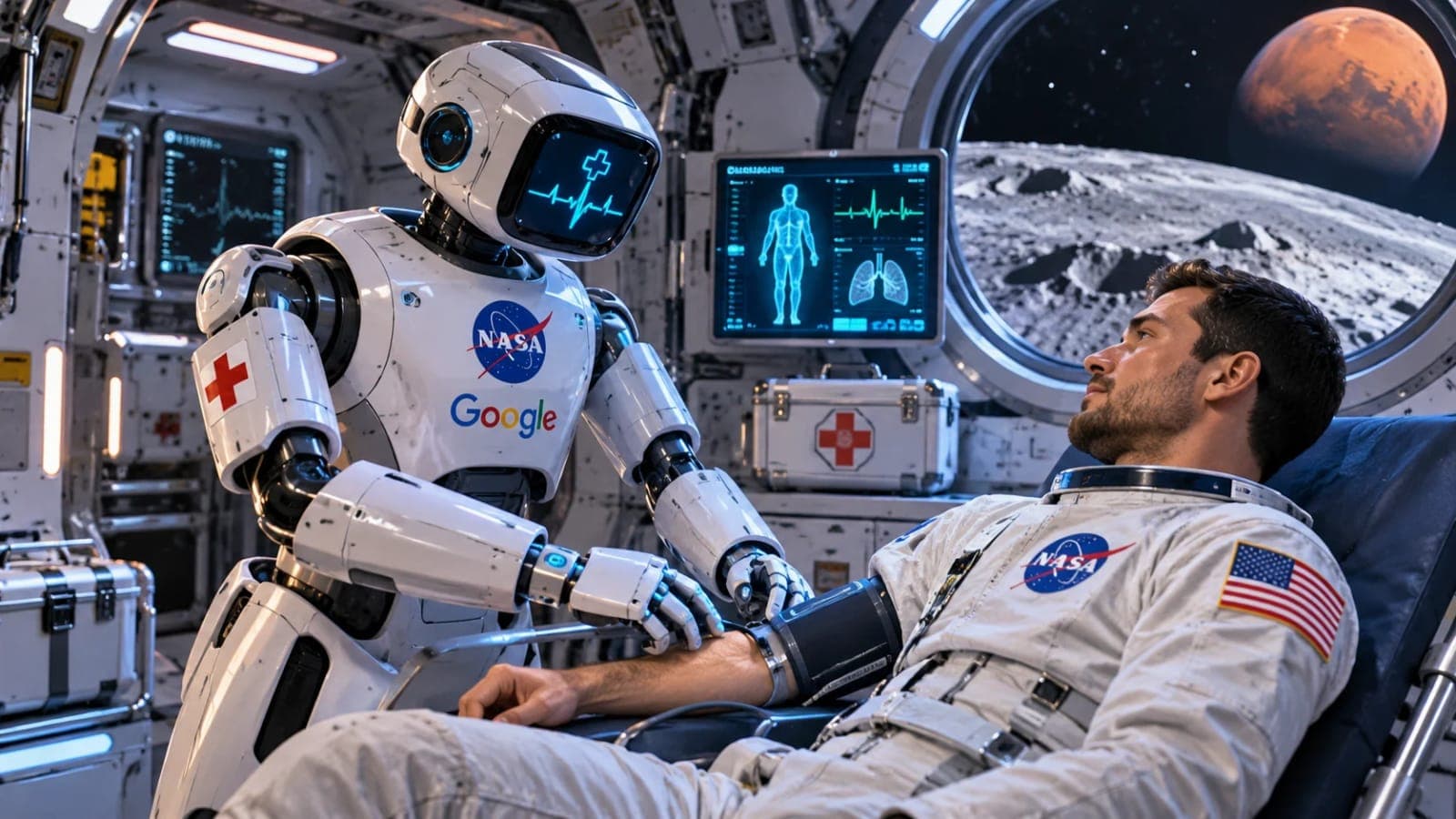
NASA AI robot doctor is not science fiction any more, but it is not yet a finished space machine either. It is a proof-of-concept system being built by Google and NASA.
The robot could one day help astronauts handle medical emergencies on missions to the Moon and Mars, where help from Earth cannot arrive in time.
The project is still in early laboratory testing, with no space-ready version announced.
NASA AI Robot Doctor: Why Astronauts Need One
Astronauts travelling to Mars could face serious problems if someone becomes sick or injured during a mission.
Because Mars is so far from Earth, communication between astronauts and doctors on the ground could experience significant delays.
According to Google, messages sent between Earth and Mars could take up to 44 minutes for a round trip.
That means astronauts may not be able to receive immediate medical advice during an emergency.
The NASA AI robot doctor is designed to support that officer, not to replace doctors on Earth or in space.
From a Digital Assistant to a Robot With Hands
The project builds on the Crew Medical Officer Digital Assistant, an AI medical support system that Google and NASA began testing in 2025.
The earlier system was designed to help astronauts understand health problems and make medical decisions when immediate assistance from Earth is unavailable.
It helps crew medical officers diagnose and treat issues when Earth contact is limited.
The new project aims to add physical assistance through a robot that can move around and handle equipment.
Partners include Google Cloud, NASA's Human Research Program, Johnson Space Center and the Jet Propulsion Laboratory.
Google Public Sector vice president Jim Kelly described the partnership in a blog post.
NASA AI Robot Doctor: How It Would Work
The robot is being designed to follow instructions from astronauts and help with different tasks inside a spacecraft.
Astronauts direct it through plain-English text prompts, using vision-language-action models linking language to movement.
The long-term goal is a robot that takes voice instructions under astronauts' direct supervision.
For example, if an astronaut experiences severe back pain that could indicate kidney stones, the robot could retrieve an ultrasound machine and prepare it for use.
The astronaut responsible for medical care would then examine the results and decide what treatment is necessary.
Google says the robot could eventually help with simple medical tasks, such as checking vital signs or assisting with ultrasound examinations.
However, it would not replace human medical personnel or make treatment decisions independently.
The robot fetches and prepares equipment, while the physician interprets results and decides treatment.
When medical assistance is not needed, the robot could perform other duties, including moving cargo, organizing tools, securing equipment, and helping with routine maintenance.
Early Tests: 85 Percent on a Medical Bag
Google and NASA have already started testing the technology in laboratory conditions.
During one experiment, the robot was asked to locate a medical bag and move it to another location.
The system completed the task successfully in approximately 85 percent of the initial tests.
Google has called that result an initial baseline ahead of further training and safety refinement, not a proof that the robot is ready for real emergencies.
Although the result shows progress, it does not mean the robot is ready to perform medical examinations or assist during serious emergencies.
The test measured a narrow task in a controlled environment: whether an arm can find and grip an object. It does not show that the robot can diagnose illness or provide safe treatment independently.
The Jet Propulsion Laboratory is adapting space object-tracking technology to help the robot navigate inside a spacecraft.
The team is also using Google DeepMind's MuJoCo simulation software to test the robot's movements in a virtual environment before trying them on physical hardware.
In the demonstration, the open-source Pi0 model used an eye-to-hand camera to find and move the medical bag.
Google says researchers have tested around 15 different computing devices to identify hardware that can run the AI system efficiently without consuming too much power.
That matters because spacecraft have limited power and computing resources.
What the Robot Cannot Do Yet
Google has not confirmed that a fully working, space-ready version has been completed, and has not announced when the robot could be sent into space.
Researchers still need to improve its reliability, movement, and ability to perform tasks safely around astronauts.
Medical certification is also unresolved: no flight date, mission, or certification path is public yet.
For now, the honest summary is narrow: a robot arm moved a medical bag in 85 percent of early lab trials.
That is still a meaningful step toward a space medical assistant, not the assistant itself.
Frequently Asked Questions
What is the NASA AI robot doctor?
The NASA AI robot doctor is a proof-of-concept robotic system being developed by Google Public Sector with NASA's Human Research Program, Johnson Space Center and the Jet Propulsion Laboratory, to help astronauts with medical tasks, cargo handling and routine maintenance on deep space missions.
Why do astronauts need a NASA AI robot doctor?
On Mars missions, a radio round trip can take up to 44 minutes, so astronauts cannot always get immediate advice. The robot supports the crew medical officer when Earth help is delayed.
What did the NASA AI robot doctor achieve in early tests?
In early lab demonstrations, the system moved a medical bag in about 85 percent of initial tests. Google calls that a baseline, not proof of medical readiness.
Will the NASA AI robot doctor replace doctors?
No. The robot would not replace human medical personnel or decide treatment independently. It fetches equipment, while the crew medical officer decides treatment.
When will the NASA AI robot doctor go to space?
Google has not announced a launch date or a specific mission. The project is in early testing at proof-of-concept stage, with no confirmed space-ready version yet.
What happens next for tech
We will keep this page updated as the story develops rather than publishing a near-duplicate at a new address. Follow Tech for related coverage.
Get the Verified Brief
One email each morning with the stories we checked overnight.
Spotted an error? Read our corrections policy and tell the newsroom.