Tesla Unveils Flying Roadster With SpaceX Technology, but There's a Catch
Tesla unveils its flying Roadster with SpaceX thrusters, 0–60 mph in 0.81 seconds and a 2028 production target. Explore its features and limitations.

By News Desk · Verified Pakistan News Desk
Published · Updated · 9 min read
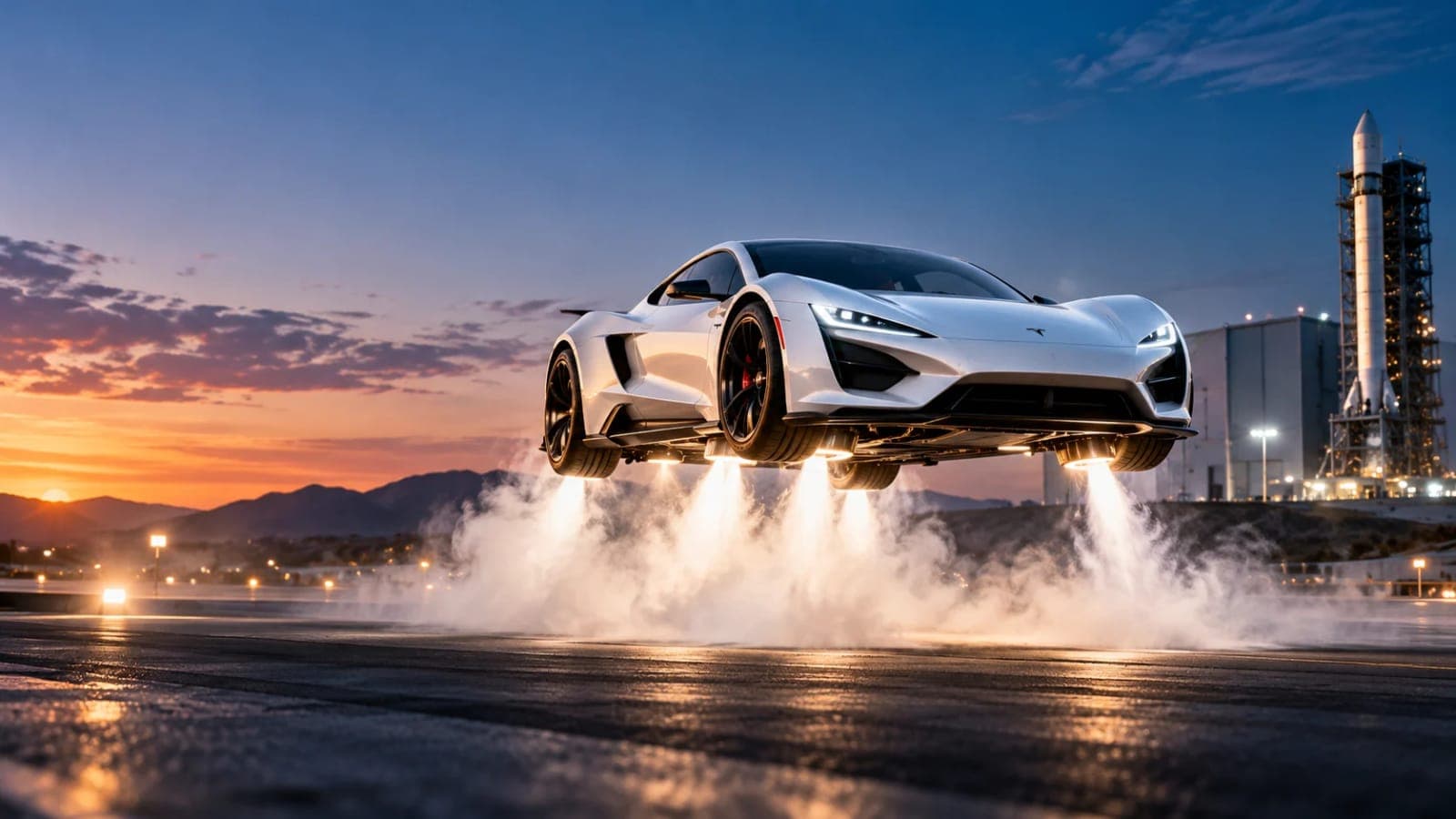
Tesla has finally revealed its long-awaited second-generation Roadster, introducing an electric supercar capable of briefly lifting off the ground using technology developed with SpaceX.
The dramatic unveiling took place on October 15, 2026, at a SpaceX facility in Texas, nearly nine years after Tesla first announced the next-generation sports car.
During the demonstration, the vehicle accelerated from 0 to 60 mph in just 0.81 seconds, drove along an inverted ramp and performed aerial maneuvers before landing safely.
However, the biggest surprise comes with an important limitation. The flying version is not approved for public roads, and customers may have to wait until 2028 before production begins.
Tesla CEO Elon Musk presented the vehicle as an example of what could become possible when electric vehicle engineering meets aerospace technology.
Although the demonstration attracted considerable attention, questions remain about safety, pricing, government regulations and whether the technology will become practical for everyday use.
Tesla Roadster Demonstrates Flying Technology for the First Time
Tesla's latest Roadster demonstration offered a glimpse of an unusual future for high-performance electric vehicles.
Unlike conventional sports cars, which rely on their engines and aerodynamic design for speed and stability, the new Roadster combines electric propulsion with additional systems designed to generate thrust and control movement.
During the event, a prototype climbed a specially designed curved ramp while maintaining contact with the surface, even as the vehicle moved into an upside-down position.
The car then used its thrusters to complete an aerial rotation and return to the ground.
In another demonstration, the Roadster briefly lifted itself over several Tesla vehicles, including the Cybertruck, Model 3, Model Y, Semi and Cybercab.
These demonstrations highlighted the vehicle's ability to perform movements that ordinary road cars cannot achieve.
However, the Roadster is not a flying car in the traditional sense.
It does not operate like an aircraft capable of carrying passengers across long distances through the air. Instead, its specialized propulsion system allows it to make short, controlled movements above the ground.
This distinction is important because the technology remains focused on extreme performance rather than conventional air transportation.
How Does the Tesla Roadster Fly Using SpaceX Technology?
The Tesla Roadster flying technology uses compressed air, high-pressure storage tanks and strategically positioned thrusters to generate additional force.
The system has been developed through engineering cooperation between Tesla and SpaceX, Elon Musk's aerospace company.
According to details presented during the unveiling, the most advanced Roadster configuration features 10 cold-gas thrusters.
These devices release compressed gas at high speed, producing force that can influence the vehicle's movement.
Unlike traditional rocket engines, cold-gas thrusters do not require combustion to produce thrust.
The Roadster reportedly uses approximately 600 litres of compressed-air storage to support its specialized propulsion system.
This technology allows the vehicle to perform brief aerial maneuvers, including lifting, rotation and controlled landing.
Another important feature is the fan-powered suction system installed beneath the car.
The system creates significant downward force, improving grip between the vehicle and the driving surface.
Tesla says this technology can produce enough suction to help the Roadster maintain contact with an inverted surface.
Together, the suction system and compressed-air thrusters give the Roadster capabilities that go beyond conventional electric supercars.
However, these systems introduce engineering challenges involving weight, energy consumption, pressure management and passenger safety.
Their performance during repeated use and in real-world conditions remains to be established.
Tesla Announces Three Roadster Versions With Different Features
Tesla has introduced three configurations of the next-generation Roadster, each designed for a different level of performance.
The lineup includes Performance, Thrust and Rocket versions.
Tesla Roadster Performance
The Performance version is designed primarily for conventional road use.
It features a two-seat configuration, active aerodynamic components and an advanced suction system.
This version is intended to deliver extreme acceleration and handling while remaining closer to the requirements of a traditional sports car.
Tesla Roadster Thrust
The Thrust version adds rear-mounted cold-gas thrusters to improve acceleration.
Tesla claims the additional propulsion system can help the vehicle accelerate from 0 to 60 mph in less than one second.
The Thrust configuration also features two seats and is aimed at customers interested in extreme track performance.
Tesla Roadster Rocket
The Rocket version represents the most advanced configuration in the lineup.
It features 10 cold-gas thrusters and a single-seat design, allowing the vehicle to perform brief aerial movements.
Tesla has described this configuration as suitable for specialized flight-style maneuvers rather than ordinary public-road driving.
The Rocket version is expected to be available only through invitation.
All three versions are associated with Tesla's claimed driving range of approximately 300 miles, while the company has also promoted top speeds exceeding 230 mph.
These specifications remain manufacturer claims and have not yet been independently verified for production vehicles.
Tesla Roadster Price, Reservations and 2028 Production Date
Despite revealing the redesigned Roadster, Tesla has not announced final retail prices for the new lineup.
The company has, however, introduced substantial reservation requirements for customers interested in securing a vehicle.
The Performance version reportedly requires a $50,000 reservation payment, while the Thrust version has a $250,000 reservation requirement.
The Rocket configuration is currently listed as invitation-only.
These amounts should not be confused with confirmed final purchase prices.
Tesla originally presented the second-generation Roadster in 2017 and initially planned to begin deliveries in 2020.
However, the project experienced several delays as the company concentrated on expanding its mainstream electric vehicle business and introducing other products.
The latest production target is now 2028.
If Tesla meets this schedule, the Roadster will arrive approximately eight years later than its original delivery target.
The extended development period has raised questions about production readiness and whether all demonstrated features will be included in vehicles delivered to customers.
Tesla has not provided a complete public timetable explaining when each Roadster configuration will become available.
As a result, prospective buyers still face uncertainty regarding final prices, delivery dates and regional availability.
Why Tesla's Flying Roadster May Not Be Legal on Public Roads
The most important limitation surrounding Tesla's flying Roadster is its legal status.
Although the prototype demonstrated the ability to briefly leave the ground, the Rocket version is not currently approved for public-road use.
Vehicles operating on public roads must comply with safety standards covering braking, structural protection, vehicle control and the safety of surrounding road users.
A car equipped with powerful thrusters introduces additional questions that conventional automotive regulations were not designed to address.
For example, regulators would need to consider how the vehicle behaves if a propulsion system fails, how its movements affect nearby traffic and whether its compressed-air equipment can operate safely under different conditions.
Aerial movement also raises questions about the boundary between automotive and aviation regulations.
These concerns could make approval significantly more complicated than for a conventional electric vehicle.
There are practical limitations as well.
A system capable of briefly lifting a vehicle into the air does not necessarily provide the efficiency, control or endurance required for sustained flight.
The Roadster's current capabilities are therefore better understood as short-duration aerial maneuvers rather than a replacement for aircraft or helicopters.
Even so, the technology could influence future developments in vehicle dynamics, advanced propulsion and high-performance automotive engineering.
For Tesla, the Roadster also serves as a demonstration of engineering ambition at a time when the company is increasingly focused on artificial intelligence, autonomous driving and robotics.
The challenge now is turning an impressive prototype into a reliable product that customers can actually purchase and operate.
What the Flying Tesla Roadster Means for the Future of Electric Cars
The unveiling of the next-generation Roadster marks an unusual development in the electric vehicle industry.
While most manufacturers are working to improve battery efficiency, charging infrastructure and affordability, Tesla is exploring technologies that push the boundaries of traditional vehicle performance.
The Roadster combines extreme acceleration with systems inspired by aerospace engineering.
Its demonstration suggests that electric vehicles could eventually incorporate propulsion and aerodynamic technologies previously associated mainly with aircraft and specialized racing machines.
However, the difference between a successful demonstration and a commercially viable product remains substantial.
Tesla must still address production costs, safety requirements, regulatory approvals and the practical limitations of compressed-air propulsion.
The company also needs to demonstrate that the Roadster can perform reliably outside controlled testing environments.
For customers, the immediate attraction may be its extraordinary performance rather than its ability to briefly fly.
The claimed 0–60 mph acceleration time of 0.81 seconds alone places the Roadster among the most ambitious high-performance vehicle projects announced by an automotive manufacturer.
Whether Tesla can deliver these specifications in a production model remains uncertain.
For now, the flying Roadster represents an engineering demonstration rather than a commercially available flying car.
Its next major milestone will be the planned production launch in 2028, when the company will face the challenge of turning its promises into vehicles that customers can actually drive.
Frequently Asked Questions
1. Can the new Tesla Roadster really fly?
Yes, Tesla demonstrated a prototype capable of briefly lifting off the ground using compressed-air thrusters. However, it cannot perform sustained aircraft-style flight.
2. When will the Tesla Roadster 2028 be released?
Tesla is currently targeting 2028 for production of its next-generation Roadster. A confirmed customer delivery schedule has not been announced.
3. How fast is the new Tesla Roadster?
Tesla demonstrated a claimed 0–60 mph acceleration time of 0.81 seconds and has promoted top speeds exceeding 230 mph. These figures have not yet been independently verified for production vehicles.
4. What is the price of the new Tesla Roadster?
Tesla has not confirmed final retail prices. Reported reservation amounts include $50,000 for the Performance version and $250,000 for the Thrust version.
5. Is the flying Tesla Roadster legal to drive?
The Rocket version, which can perform brief aerial maneuvers, is not currently approved for public-road use. Its future legal status will depend on applicable safety regulations and government approvals.
What happens next for auto
We will keep this page updated as the story develops rather than publishing a near-duplicate at a new address. Follow Auto for related coverage.
Get the Verified Brief
One email each morning with the stories we checked overnight.
Spotted an error? Read our corrections policy and tell the newsroom.