
PM Shehbaz Sharif Orders 557 Business Reforms to Save Rs460bn Yearly
PM Shehbaz Sharif has ordered a sweeping overhaul of Pakistan's business regulations. For once, the promise is not more rules it is fewer, simpler ones.

By News Desk · Verified Pakistan News Desk
Published · 7 min read
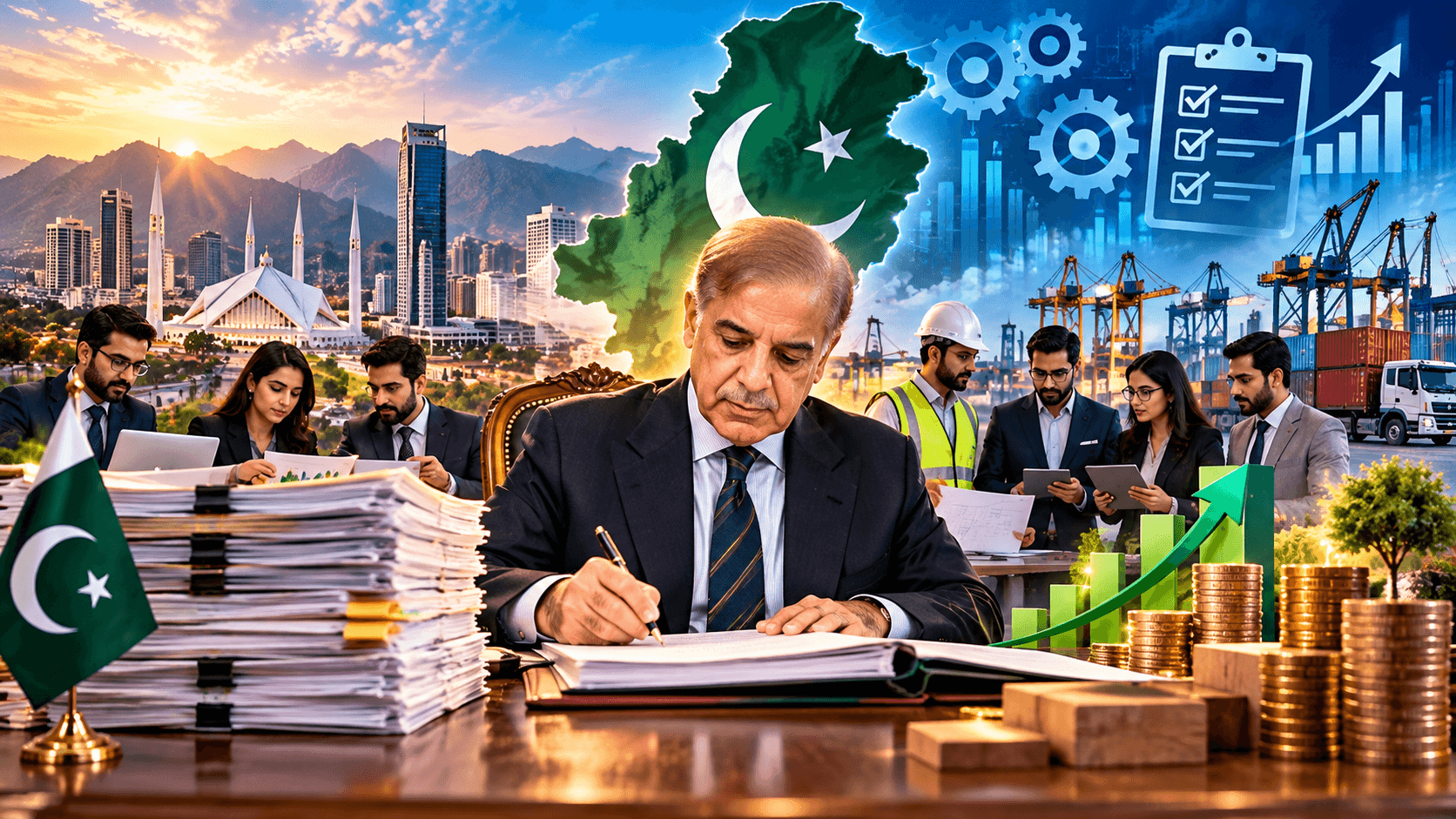
Ask any business owner in Pakistan what slows them down, and you will rarely hear about a lack of ambition. What you will hear about is paperwork the permits, the NOCs, the overlapping rules from half a dozen departments that turn a simple expansion plan into a months-long ordeal. On Friday, Prime Minister Shehbaz Sharif put that frustration at the top of the government's agenda. Chairing a high-level meeting on economic reforms in Islamabad, he ordered a sweeping modernisation of the country's regulatory authorities, with one clear goal: cut the bureaucratic hurdles and make Pakistan a place where domestic and foreign investors actually want to put their money.
For once, the promise is not more rules it is fewer, simpler ones. The prime minister directed officials to establish a comprehensive regulatory registry that would consolidate every existing requirement, rule and regulation under a single framework. In plain terms, a business owner would finally be able to see, in one place, everything the state asks of them instead of discovering new conditions every time they knock on another department's door.
The meeting was attended by the government's full economic team, including Deputy Prime Minister Ishaq Dar, Finance Minister Muhammad Aurangzeb, Law Minister Azam Nazeer Tarar and the prime minister's adviser on industries, Haroon Akhtar Khan. What emerged was less a routine review and more a to-do list with deadlines.
One Registry to Replace the Maze
The centrepiece of the announcement is the national regulatory registry. Right now, a business in Pakistan deals with federal regulators, provincial departments, municipal bodies and sector-specific authorities each with its own forms, timelines and interpretations. The registry is meant to pull all of that into one coherent system, so requirements are visible, predictable and, crucially, finite.
Shehbaz Sharif pointed to the Drug Regulatory Authority of Pakistan (DRAP) as proof that this kind of overhaul can work. DRAP has already been modernised through reforms, and the prime minister said similar changes should now be rolled out across other regulatory institutions. It is a sensible template: pick one regulator, fix it properly, then copy what worked.
The registry idea also answers a complaint businesspeople have made for years that rules change depending on who you ask. A single published framework makes it much harder for officials to invent requirements on the spot, and much easier for businesses to plan. Whether the registry gets real teeth will depend entirely on implementation.
557 Reforms and Rs460 Billion in Expected Savings
The numbers presented at the meeting were striking. Officials told the prime minister that the Cabinet Committee on Regulatory Reforms has approved 557 reforms across seven multi-sector areas, with expected annual savings of Rs460 billion for businesses. That is not a small figure it represents real money currently lost to compliance costs, delays and redundant processes.
There are already signs of movement on the ground. The meeting was informed that 8,717 applications have been initiated through Business Facilitation Centres, of which 71 percent have been completed, while the Islamabad Business Facilitation Centre alone has facilitated 4,612 new businesses. The Export Policy Order and Import Policy Order two documents every trading business lives with are being simplified. And the Business Facilitation Centre model is being modernised along the lines of Punjab's E-BIZ system, which businesses there have generally found easier to deal with.
Perhaps most tellingly, the prime minister ordered third-party validation of the reforms to independently assess their impact. That is an unusual and welcome step: instead of the government grading its own homework, an outside party will check whether the promised savings and simplifications actually materialise. It signals that this time, the focus is supposed to be on results rather than announcements.
Taking the Easy Business Act Nationwide
One of the biggest structural problems in Pakistan's business environment is that rules change at provincial borders. What is straightforward in Punjab can be a headache in Sindh or Balochistan, and businesses operating nationally end up navigating four different systems. The prime minister's answer is to implement the Easy Business Act across the entire country, harmonising regulatory systems so that businesses get uniform facilities in every province.
To make that happen, he directed a Special Investment Facilitation Council (SIFC) delegation, led by Haroon Akhtar Khan, to visit all provinces and take provincial governments into confidence on the reform process. SIFC is already coordinating with the provinces, including Azad Jammu and Kashmir and Gilgit-Baltistan, but getting every province to genuinely align rather than just nod along will be the real test. Provincial buy-in has sunk plenty of federal reform plans before.
There is also a concrete deadline on the table: the prime minister instructed the SIFC and the Punjab chief secretary to complete the integration of the eBiz Punjab system with the Islamabad business facilitation centre by March 2027. Deadlines in reform announcements are easy to set and easy to miss, but at least this one is specific enough to be tracked. The prime minister also ordered that SIFC's regulatory reforms be properly publicised, so businesses actually know what facilities exist a reform nobody has heard of helps nobody.
Will It Actually Change Anything?
Scepticism is natural. Pakistan has seen ease-of-doing-business drives before, and business owners have learned to judge by outcomes, not press releases. The prime minister himself seemed aware of this, stressing that reforms must deliver tangible benefits and not remain limited to policy announcements.
The broader context makes the push more urgent. Business leaders, including the FPCCI, have been demanding cuts in power tariffs Pakistani industry pays around 12 cents per unit of electricity compared to roughly 7 cents in competing regional economies and the finance minister has said plainly that the private sector must lead economic growth. There is some macroeconomic breathing room: the current account deficit narrowed to $543 million in July–August, suggesting the external position is stabilising. But stabilisation is not growth, and growth needs investment, which needs confidence.
That is what this reform package is really about confidence. A transparent registry, 557 concrete reforms, third-party validation and one consistent rulebook across provinces would, if delivered, meaningfully change the cost of doing business in Pakistan. The Rs460 billion in expected savings is the headline, but the deeper prize is a system where a young entrepreneur in Multan or a foreign investor in Karachi can start and scale a business without needing a guide to the bureaucracy. The meeting gave the orders. Now comes the harder part: making them real.
FAQs
What did PM Shehbaz Sharif order on 3 October 2026 regarding business regulations?
He chaired a high-level meeting on economic reforms and ordered the modernisation of Pakistan's regulatory authorities to cut bureaucratic hurdles and attract investment. Key directives included establishing a comprehensive regulatory registry, implementing the Easy Business Act nationwide, and completing the eBiz Punjab–Islamabad BFC integration by March 2027.
What is the regulatory registry the prime minister announced?
It is a planned single framework that will consolidate all existing regulatory requirements, rules and regulations in one place. The idea is that businesses can see everything the state requires of them in one system, instead of dealing separately with federal, provincial and municipal authorities, each with their own forms and timelines.
What are the 557 reforms and the Rs460 billion savings figure?
Officials briefed the meeting that the Cabinet Committee on Regulatory Reforms has approved 557 reforms across seven multi-sector areas. These reforms are expected to generate annual savings of Rs460 billion for businesses by cutting compliance costs, delays and redundant processes. The prime minister also ordered independent third-party validation to verify these results.
What is the Easy Business Act and why does it need nationwide implementation?
The Easy Business Act aims to harmonise business regulations so companies get uniform facilities across all provinces. Currently, rules differ from province to province, forcing national businesses to navigate multiple systems. An SIFC delegation led by Haroon Akhtar Khan will visit all provinces to bring provincial governments on board with the harmonisation effort.
What is the March 2027 deadline about?
The prime minister directed the SIFC and the Punjab chief secretary to complete the integration of Punjab's eBiz system with the Islamabad Business Facilitation Centre by March 2027. This merger is meant to create a unified digital platform for business facilitation, modelled on the E-BIZ system that businesses in Punjab have found relatively easier to use.
What happens next for business
We will keep this page updated as the story develops rather than publishing a near-duplicate at a new address. Follow Business for related coverage.
Get the Verified Brief
One email each morning with the stories we checked overnight.
Spotted an error? Read our corrections policy and tell the newsroom.