PM Orders Probe Into Hajj and Umrah Vaccine Contract After Court Challenge
PM Shehbaz orders a 48-hour inquiry into the Hajj and Umrah vaccine contract after seven companies challenge the procurement process.

By News Desk · Verified Pakistan News Desk
Published · 11 min read
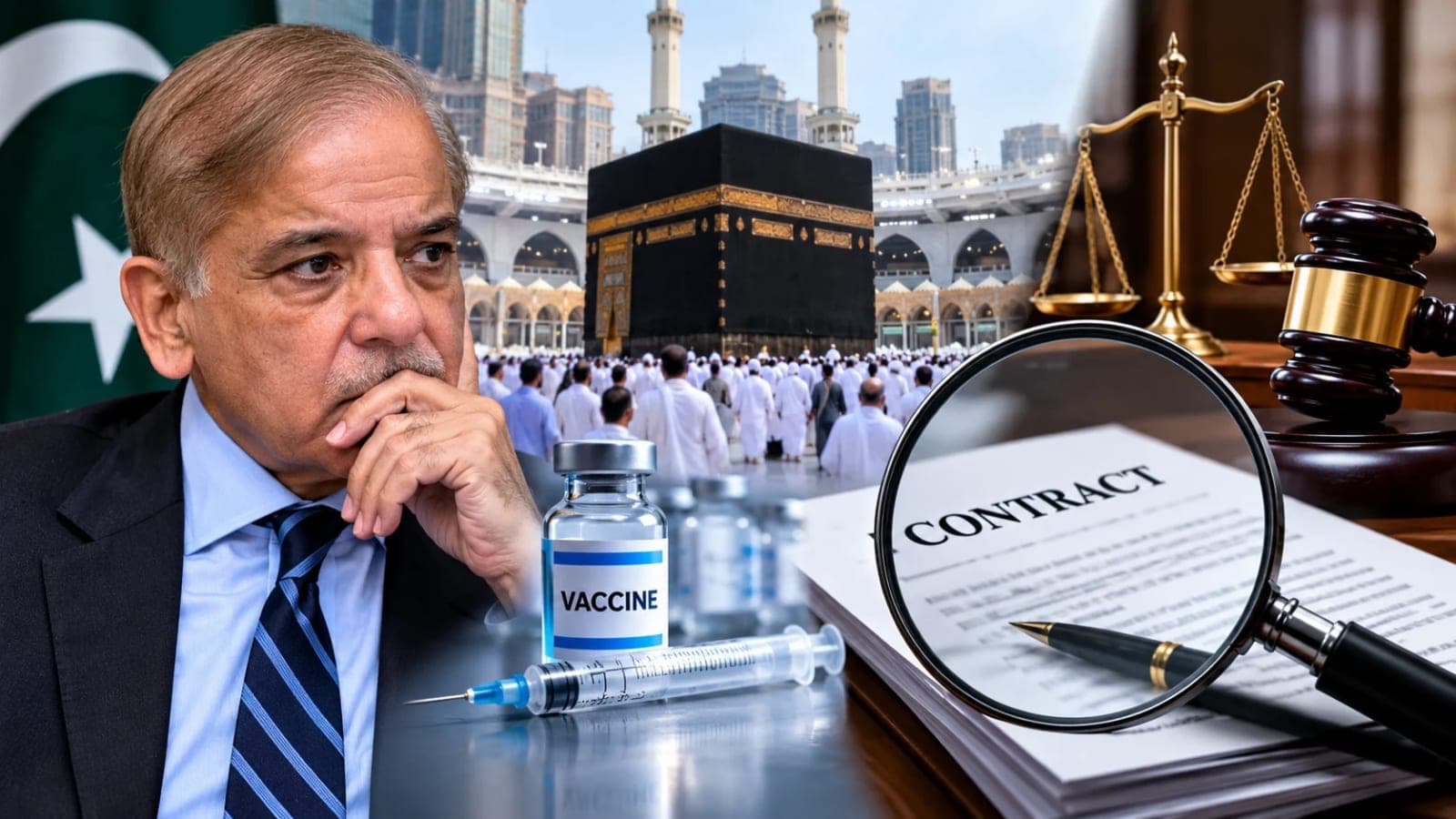
Prime Minister Shehbaz Sharif has ordered a high-level investigation into the procurement of vaccines for Hajj and Umrah pilgrims after seven pharmaceutical companies challenged the award of a vaccination services contract in the Islamabad High Court.
The inquiry focuses on arrangements made by Border Health Services (BHS) Pakistan for meningococcal meningitis and influenza vaccination services. A five-member committee has been directed to examine the procurement process, pricing arrangements and related financial matters.
According to reporting published on October 17, 2026, the Prime Minister's Office issued the inquiry notification on October 16 and instructed the committee to submit its findings within 48 hours.
The development has raised important questions about transparency in public procurement, the cost of vaccination services for pilgrims and the safeguards needed when government-related health services are delivered through private arrangements.
However, the allegations raised by the companies remain disputed. Neither the formation of an inquiry committee nor the filing of a court petition establishes that corruption or a legal violation has occurred.
Why the Prime Minister Ordered an Inquiry
The inquiry follows a dispute concerning the procurement and delivery of vaccination services for people travelling from Pakistan for Hajj and Umrah.
Seven pharmaceutical and vaccine companies have challenged the procurement process and the award of the contract to a private company.
Their objections concern the competitive bidding process, the opportunity available to other potential suppliers and the legal framework used for the arrangement.
The petitioners have also questioned whether the contract satisfied the requirements applicable to public-private partnerships.
These concerns have now attracted attention at the highest level of government.
The prime minister's decision places the procurement arrangements under a separate administrative review while the legal proceedings continue.
The inquiry is expected to examine documentary evidence rather than rely only on competing public statements.
Five-Member Committee Given 48 Hours
The government has established a five-member committee led by the Cabinet Secretary.
Its membership includes senior representatives of organisations involved in intelligence, medicines regulation, government legal affairs and public procurement oversight.
The committee comprises:
- Cabinet Secretary, serving as chairperson.
- Director General of the Intelligence Bureau.
- Chief Executive Officer of the Drug Regulatory Authority of Pakistan.
- A representative of the Attorney General's Office.
- Managing Director of the Public Procurement Regulatory Authority.
The PPRA managing director is also serving as committee secretary, while the Cabinet Division is providing secretariat support.
The committee was scheduled to begin examining the matter in Islamabad on Saturday, October 17.
Its short reporting deadline suggests that the government wants an initial assessment without a prolonged administrative delay.
Nevertheless, a 48-hour deadline does not guarantee that every disputed legal or financial question can be conclusively resolved in that period.
What the Committee Will Investigate
The inquiry has been directed to review the procurement process, vaccine prices and financial arrangements associated with the contract.
This could involve examining tender advertisements, eligibility requirements, submitted bids, evaluation records, contractual provisions and relevant approvals.
One important issue is whether potential suppliers were given a fair opportunity to participate.
Another is whether the financial terms offered value for money and complied with applicable rules.
The committee may also consider how the contract was structured and whether the relevant authorities followed the correct approval process.
Any findings will need to distinguish administrative weaknesses from conduct that actually violates a law or regulation.
That distinction is essential because procurement disputes can arise even where the parties disagree in good faith about the interpretation of applicable rules.
Seven Companies Challenge the Contract in Court
The legal dispute began when seven pharmaceutical and vaccine companies approached the Islamabad High Court.
They challenged the procurement conducted by Border Health Services and the resulting contract for vaccination services.
The companies alleged that the bidding process lacked sufficient transparency and did not provide fair competition.
Their petition also questioned the circumstances in which the contract was awarded after the tender attracted only one bid.
The Islamabad High Court issued notices to relevant respondents and sought procurement records.
The case therefore remains a matter for judicial consideration.
The court's involvement does not mean it has accepted the petitioners' allegations as proven.
The respondents have the opportunity to explain the process and defend their decisions.
Why the Single-Bid Tender Became Controversial
One of the central concerns raised in the case is that only one bid was received by the deadline.
The petitioners have argued that the circumstances of the tender deserve scrutiny.
However, receiving a single bid is not automatically a violation of Pakistan's public procurement rules.
Border Health Services has referred to Rule 38B of the Public Procurement Rules, 2004, which addresses a single responsive bid for goods, works and services.
Under the relevant framework, a single bid may be considered if it satisfies applicable evaluation criteria, technical requirements and other conditions.
Price reasonableness and value for money are also important considerations.
Consequently, the legal question is not simply how many bids were received.
It is whether the entire procurement process met the requirements governing competition, evaluation and approval.
Health Authorities Defend the Procurement Process
The controversy has produced competing accounts from the petitioners and government health authorities.
Health Minister Mustafa Kamal and Border Health Services have maintained that the applicable rules were followed.
BHS has argued that the receipt of one bid does not, by itself, invalidate the procurement process.
The authority has also indicated that it would present its position before the court.
This response is significant because a fair assessment requires the government's explanation to be considered alongside the objections raised by unsuccessful or excluded potential suppliers.
The prime minister's inquiry committee will therefore need to examine records that can establish what actually happened during the tender process.
Until the review and legal proceedings establish otherwise, allegations of wrongdoing should remain described as allegations.
Questions Raised Over the Cost of Vaccination
The cost of vaccination services has become another important part of the dispute.
Reporting on the court challenge indicates that petitioners questioned a charge of approximately Rs. 4,500 per person under the contested arrangement.
That figure should be understood as a reported charge raised in the dispute, rather than proof that every pilgrim has paid the same amount.
The inquiry has been directed to examine vaccine pricing and financial arrangements.
A meaningful price review would need to consider what services are included in the package.
The cost of a vaccine product is not necessarily identical to the total cost of a vaccination service.
Administration, storage, handling, documentation and other operational requirements may form part of a service arrangement.
The question for investigators is whether the charges are reasonable, properly authorised and consistent with the applicable procurement requirements.
Why Hajj and Umrah Vaccination Matters
Vaccination arrangements are an important part of travel health for people undertaking religious journeys.
Hajj brings large numbers of people together in a concentrated environment, making communicable disease prevention a public-health priority.
Umrah also involves international travel and large gatherings, although requirements can differ depending on the travel period and the official health instructions in force.
Meningococcal disease is a serious infection that can cause meningitis and bloodstream infections.
Vaccination can help reduce the risk of disease among travellers and others who may be exposed.
Influenza vaccination is also used to reduce the risk of seasonal flu, particularly among people who may be vulnerable to complications.
However, recommendations and mandatory requirements are not always the same.
Pilgrims should check the latest official Saudi health requirements and authorised Pakistani travel guidance before arranging vaccinations.
Mandatory Requirements Must Be Distinguished From Optional Services
A major concern in the wider debate is whether travellers are being asked to pay for services they are not legally required to obtain.
Some reporting has raised questions about influenza vaccination requirements for Umrah travellers.
Such claims should be assessed against the latest official Saudi health guidance, which can change over time.
A vaccine may be medically recommended without being a universal entry requirement for every traveller.
Similarly, a mandatory vaccine may apply only to particular categories of travellers or under specific circumstances.
Clear public information is therefore essential.
Pilgrims need to know which vaccines are compulsory, which are recommended and where they can obtain approved services.
Authorities should communicate those distinctions without creating confusion or unnecessary financial pressure.
What Is the Role of Border Health Services?
Border Health Services Pakistan is involved in health-related matters associated with international travel and border health protection.
Its responsibilities make it an important institution in the administration of travel health services.
Where private providers participate in such services, procurement and oversight arrangements become particularly important.
Public authorities must ensure that the selection of providers complies with applicable rules and that travellers receive accurate information.
The current controversy highlights the need for transparent contracts, clear pricing and effective complaint mechanisms.
It also demonstrates why procurement records and regulatory approvals matter when a public service is delivered through a commercial arrangement.
Why the Public-Private Partnership Question Matters
The petitioners have questioned whether the vaccination arrangement met the requirements applicable to a public-private partnership.
Public-private partnerships can be used to combine government oversight with private-sector resources or service delivery.
However, they involve specific legal, financial and governance considerations.
The applicable rules may depend on how the agreement is structured and which authority approved it.
The inquiry committee will need to examine the contract rather than assume that its label determines its legal status.
An arrangement described as a partnership must still satisfy the relevant requirements.
The final legal assessment will depend on the contractual documents and applicable law.
What the Islamabad High Court Could Examine
The Islamabad High Court proceedings provide a separate forum for assessing the petitioners' legal objections.
The court has sought relevant procurement records and issued notices to respondents.
The case may involve questions about the tender process, competition, regulatory approvals and compliance with procurement rules.
The government inquiry and the court case serve different purposes.
An administrative committee can review procedures and make recommendations to the executive.
A court can consider the legal claims brought before it and issue orders within its jurisdiction.
The existence of both processes does not mean that either has already reached a final conclusion.
What the Inquiry Means for Pilgrims
For prospective Hajj and Umrah travellers, the immediate priority is access to accurate vaccination information.
Travellers should not assume that the inquiry automatically cancels existing health requirements or makes vaccination unnecessary.
Likewise, they should not assume that a disputed service charge is automatically mandatory.
The correct approach is to consult current official travel health instructions and use authorised vaccination facilities.
Pilgrims should retain receipts, vaccination records and any official certificates issued to them.
If a fee or requirement appears unclear, travellers can seek clarification from the responsible health or religious affairs authorities.
What Happens After the 48-Hour Deadline?
The committee has been instructed to submit its findings within 48 hours.
Its report may provide recommendations concerning the procurement process, pricing or future administration of vaccination services.
The government could then decide whether further review or administrative action is required.
Any such action would need to be based on the evidence and the relevant legal framework.
Meanwhile, the Islamabad High Court case remains a separate legal matter.
The next important development will be the committee's findings and any official response to them.
Until those findings are released, claims about the outcome would be premature.
Frequently Asked Questions
1. Why did PM Shehbaz order a Hajj and Umrah vaccine inquiry?
The prime minister ordered a high-level review after seven companies challenged the procurement and award of a vaccination services contract, raising concerns about competition, pricing and approvals.
2. Who is investigating the vaccine contract?
A five-member committee headed by the Cabinet Secretary is examining the matter. Its members include representatives from the IB, DRAP, Attorney General's Office and PPRA.
3. How long does the committee have to submit its report?
The committee was directed to submit its findings within 48 hours of the government's October 16 notification.
4. Has the vaccine contract been declared illegal?
No final determination of illegality has been established by the reporting available on October 17. The allegations remain subject to inquiry and court proceedings.
5. Is influenza vaccination mandatory for every Umrah pilgrim?
Requirements can vary according to official Saudi health guidance and traveller circumstances. Pilgrims should check the latest authorised instructions rather than rely on claims circulating online.
Conclusion
Prime Minister Shehbaz Sharif's decision to investigate the Hajj and Umrah vaccine contract has placed public procurement, vaccine pricing and administrative accountability under renewed scrutiny.
The dispute involves serious questions raised by seven companies, but those questions must be assessed fairly against the government's response and the underlying procurement records.
The committee's findings and the Islamabad High Court proceedings will be important in determining whether the process complied with applicable rules.
For pilgrims, the most important outcome would be a transparent, reliable and affordable vaccination system supported by clear official guidance.
Last Updated: October 17, 2026.
What happens next for national
We will keep this page updated as the story develops rather than publishing a near-duplicate at a new address. Follow National for related coverage.
Get the Verified Brief
One email each morning with the stories we checked overnight.
Spotted an error? Read our corrections policy and tell the newsroom.