NCCIA Arrests Two in Lahore Call Centre Scam Targeting Americans
NCCIA arrests two men in Lahore over an alleged call centre scam targeting US citizens through fake insurance calls and stolen card details.

By News Desk · Verified Pakistan News Desk
Published · 11 min read
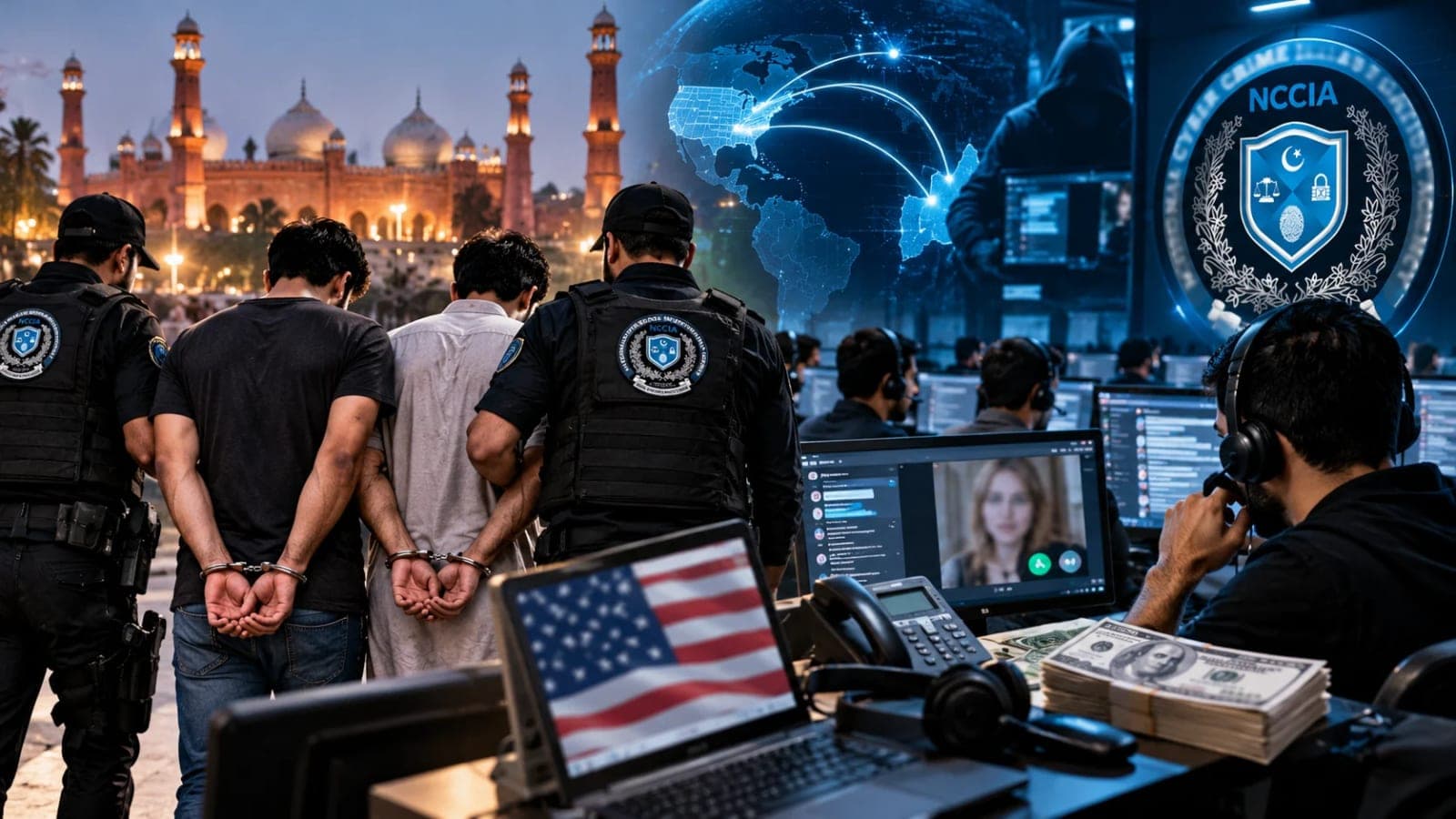
The National Cyber Crime Investigation Agency (NCCIA) has arrested two men in Lahore for allegedly operating an illegal call centre that targeted citizens of the United States through fraudulent insurance-related telephone calls.
According to officials, the suspects allegedly contacted Americans while pretending to represent insurance companies, obtained their credit and debit card information and used the details for unauthorised financial transactions.
The operation took place at a call centre on Main Boulevard in Gulberg, one of Lahore's major commercial areas.
The arrests were reported on October 17, 2026, following an operation carried out on Friday.
NCCIA officials said digital devices recovered from the premises contained online calling software and information allegedly connected to financial fraud.
The case highlights growing concerns about organised cybercrime networks that use apparently ordinary business operations to target people in other countries.
However, the accusations remain under investigation. The arrests do not establish the suspects' guilt, and the available reporting does not identify a final court verdict.
NCCIA Lahore Call Centre Scam: What Happened?
The NCCIA Lahore Zone carried out an operation against a suspected illegal call centre in Gulberg.
Investigators reportedly identified suspicious activities at the location through open-source intelligence.
After obtaining a search warrant from a court, officials searched the premises and arrested two men.
According to NCCIA Lahore Zone Additional Director Atif Ameer, preliminary inquiries indicated that the call centre was being used to contact US citizens under the cover of an insurance campaign.
The callers allegedly presented themselves as legitimate insurance representatives.
Their objective, according to investigators, was to persuade people to disclose financial information that could then be used without authorisation.
The allegations are based on the agency's initial investigation and remain subject to further examination.
Two Suspects Identified by Investigators
The two arrested men were identified by investigators as Irshad Ahmed Butt and Aurangzeb.
According to the NCCIA, Irshad Ahmed Butt was the owner of the call centre, while Aurangzeb was employed there.
The agency has alleged that the operation involved fraudulent calls directed at people living in the United States.
The precise individual roles of the suspects will need to be established through the investigation and any subsequent legal proceedings.
It is important to distinguish the agency's allegations from facts established by a court.
Both individuals remain entitled to the legal protections available under Pakistani law.
Why the Operation Took Place in Gulberg
The suspected call centre was located on Main Boulevard in Gulberg, a busy commercial district of Lahore.
Gulberg contains offices, shops and other business establishments, making it a common location for legitimate commercial activity.
The presence of a call centre in such an area does not itself indicate criminal conduct.
Call centres are widely used for customer support, sales, technical assistance and other lawful services.
The NCCIA operation was reportedly based on specific suspicious activity detected during its inquiry.
Investigators then sought judicial authorisation before searching the premises.
This distinction matters because law enforcement action should target suspected unlawful conduct rather than treat an entire business sector as suspicious.
Investigators Used Open-Source Intelligence
NCCIA officials said the agency detected suspicious activity through open-source intelligence.
Open-source intelligence generally refers to information obtained from publicly available sources.
Depending on the investigation, such information may include public websites, online advertisements, business listings, social media activity and other accessible digital material.
However, the agency has not publicly provided a complete breakdown of the specific information used in this case.
It would therefore be inaccurate to claim that investigators relied on any particular website, account or advertisement without supporting evidence.
The reported use of open-source intelligence illustrates how digital investigations may begin before officers enter a physical location.
Court-Issued Search Warrant Obtained
According to the NCCIA, investigators obtained a search warrant from a court before conducting the operation.
A search warrant provides judicial authorisation for investigators to search specified premises under applicable legal procedures.
The use of a warrant is significant because investigations involving offices, computers and personal devices can raise privacy and evidentiary concerns.
Law enforcement agencies must follow the relevant legal requirements when collecting and preserving evidence.
The fact that a warrant was obtained does not establish that the alleged offences occurred.
It establishes that investigators followed a reported legal step before carrying out the search.
The evidence collected must still be examined and assessed through the appropriate legal process.
How the Alleged Insurance Scam Worked
According to the NCCIA's preliminary account, the suspects allegedly contacted American citizens while posing as representatives of insurance companies.
The calls were presented as part of an insurance-related campaign.
During the conversations, callers allegedly attempted to obtain credit and debit card details from the people they contacted.
Investigators believe that financial information collected through these interactions was used for unauthorised transactions.
This type of allegation involves impersonation, in which a caller claims to represent a legitimate organisation to gain a person's trust.
The exact scripts used, the number of calls made and the identity of any affected insurance companies have not been publicly established in the available reporting.
The investigation will need to determine the full scope of the suspected activity.
Why Credit and Debit Card Details Are Valuable to Fraudsters
Payment card information is sensitive because it may be used to initiate financial transactions or support attempts at identity-related fraud.
Criminals may try to obtain card numbers, expiry dates, security codes or other authentication information through deceptive communication.
Not every piece of card information is sufficient to complete a transaction.
Banks and payment networks use additional security measures, including transaction monitoring and authentication requirements.
Nevertheless, sharing sensitive financial information with an unknown caller can expose a person to significant risk.
Legitimate businesses should not pressure customers to disclose confidential authentication details during unsolicited calls.
Consumers should independently verify an organisation's identity before discussing payment information.
Laptops and Mobile Phones Recovered
Investigators recovered digital devices from the suspected call centre.
Reporting by The News stated that the recovered material included two laptops and three mobile phones.
NCCIA officials said an initial examination revealed online calling software and data allegedly linked to financial fraud.
The devices were taken into custody for further investigation.
Digital evidence can help investigators understand how a suspected operation functioned.
It may contain records of communications, software installations, transaction information or other material relevant to an inquiry.
However, the presence of calling software on a computer is not inherently illegal.
Such software is widely used by legitimate businesses.
The legal significance of any recovered material depends on how it was allegedly used and what further examination establishes.
Number of Alleged Victims Not Yet Confirmed
One important limitation in the public information is that investigators have not announced a confirmed number of victims.
The NCCIA has also not specified the total amount allegedly obtained through the suspected scheme.
This means the financial scale of the case remains unclear.
It would be misleading to suggest that hundreds or thousands of Americans were affected without verified evidence.
Likewise, no particular dollar loss should be attributed to this operation unless authorities release supporting figures.
The number of attempted calls may also differ substantially from the number of people who suffered financial losses.
Further investigation may clarify these distinctions.
How Illegal Call Centres Can Damage Legitimate Businesses
Pakistan has a substantial services sector that includes legitimate customer support, information technology and business process outsourcing operations.
Many businesses provide lawful services to customers in international markets.
Cases involving alleged fraudulent call centres can create reputational challenges for the wider industry.
International clients may become more cautious when selecting outsourcing partners.
However, it is important not to confuse criminal allegations against specific operators with the activities of legitimate companies.
Professional call centres can help protect their reputation by maintaining clear contracts, appropriate data security and lawful customer communication practices.
Businesses should also train employees to recognise suspicious instructions involving customer financial information.
NCCIA Intensifies Crackdown on Suspected Cyber Fraud
The latest arrests come during a wider series of NCCIA operations against suspected illegal call centres in Lahore.
Earlier in October, the agency reported arrests connected to operations allegedly targeting foreign citizens through different forms of online deception.
On October 10, reporting indicated that NCCIA officials had announced the arrest of 281 suspects during a broader crackdown involving multiple call centres.
Other operations involved allegations of fake mobile phone offers, fraudulent medical billing arrangements and attempts to obtain financial information.
These earlier cases are separate investigations and should not be treated as evidence against the two men arrested in Gulberg.
Their relevance is that they demonstrate the agency's increased focus on suspected organised cyber fraud.
Why International Financial Fraud Is a Serious Concern
Financial fraud involving callers in one country and victims in another can create complicated investigations.
Potential evidence may be located across different jurisdictions, including banking systems, communication platforms and online services.
Investigators may need to establish the origin of calls, the identity of recipients and the movement of any allegedly stolen funds.
Cross-border cases can also require cooperation between relevant authorities.
However, no specific international law enforcement partnership has been publicly confirmed in relation to this particular operation.
The current reporting establishes an investigation by Pakistan's NCCIA, rather than a completed multinational prosecution.
How People Can Recognise Suspicious Insurance Calls
Insurance-related impersonation can be difficult to recognise when callers use professional language or claim to represent familiar organisations.
A suspicious call may involve unexpected requests for payment card information, urgent demands or pressure to act without independent verification.
A person receiving such a call should avoid sharing confidential financial details immediately.
Instead, they can end the conversation and contact the insurance provider through a verified official channel.
Consumers should not rely solely on the telephone number displayed on their screen, because caller identification information can sometimes be manipulated.
If financial details have already been disclosed, the affected person should contact their bank or card issuer promptly.
Early reporting can help institutions take appropriate protective action.
What Pakistani Call Centre Operators Should Know
The case also serves as a reminder that legitimate customer service operations must take compliance seriously.
Businesses handling international customers should establish clear procedures for collecting and protecting personal information.
Employees should know what information they are authorised to request and how customer data must be stored.
Management should monitor suspicious activity and ensure that marketing or sales campaigns are accurately represented.
Contracts with overseas clients should clearly define the services being provided.
Responsible practices can reduce legal exposure and support confidence in Pakistan's outsourcing sector.
What Happens Next in the Investigation?
The NCCIA has indicated that further investigation is underway.
Investigators may examine the recovered devices and other available evidence to determine the extent of the alleged activity.
They may also seek to establish whether additional individuals were involved.
Any further legal action will depend on the evidence and the applicable procedures.
The public should expect official updates rather than assume that the allegations have already been proven.
The next significant developments could include additional investigative findings, formal legal proceedings or clarification of the suspected financial losses.
Until then, the case remains an ongoing investigation.
Frequently Asked Questions
1. How many people were arrested in the Lahore call centre case?
The NCCIA arrested two men in connection with the suspected operation in Gulberg.
2. Who were the arrested suspects?
Investigators identified them as Irshad Ahmed Butt, described as the call centre owner, and Aurangzeb, described as an employee.
3. How were Americans allegedly targeted?
According to investigators, callers allegedly pretended to represent insurance companies and sought credit and debit card information.
4. What did NCCIA recover during the operation?
The agency recovered laptops and mobile phones. Reporting identified two laptops and three mobile phones among the seized devices.
5. How much money was allegedly stolen?
The NCCIA had not publicly specified the total suspected financial loss or the confirmed number of victims in the reporting available on October 17.
Conclusion
The arrest of two men in Lahore over an alleged call centre scam targeting American citizens highlights the challenges posed by cross-border financial fraud.
The NCCIA says its operation followed suspicious activity detected through open-source intelligence and was conducted after obtaining a court-issued search warrant.
Investigators are now examining recovered digital devices and allegations involving insurance impersonation and unauthorised financial transactions.
The outcome will depend on the evidence gathered and the legal process.
For consumers, the case reinforces the importance of protecting payment information. For legitimate businesses, it underlines the value of strong compliance practices and responsible handling of customer data.
Last Updated: October 17, 2026.
What happens next for national
We will keep this page updated as the story develops rather than publishing a near-duplicate at a new address. Follow National for related coverage.
Get the Verified Brief
One email each morning with the stories we checked overnight.
Spotted an error? Read our corrections policy and tell the newsroom.